

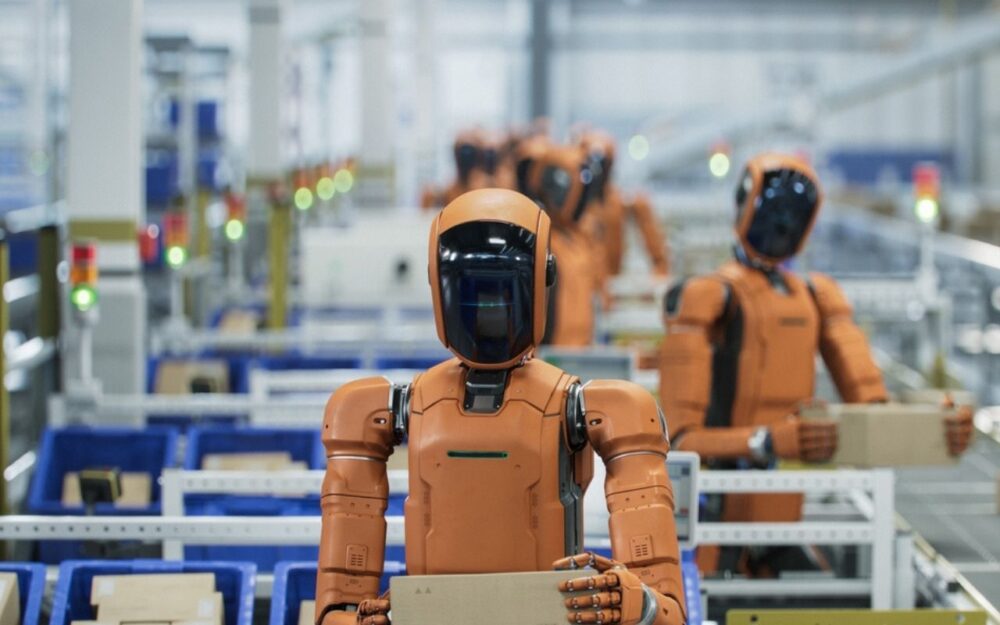

AI is acquiring eyes, arms and wheels. As intelligent machines move from controlled demonstrations onto factory floors, physical AI promises to transform industrial automation. But manufacturers still face major hurdles in turning impressive technology into reliable, scalable value.
For decades, industrial robots have excelled at doing exactly what they are told. Programmed to weld the same seam, move the same component or repeat the same assembly operation thousands of times, they have delivered huge productivity gains, provided their environment remains predictable.
Physical AI promises something different. By combining AI models with sensors, vision systems, actuators and industrial controls, it enables machines to perceive their surroundings, reason about what they encounter, and adapt their actions accordingly. IBM describes this as taking AI from the world of “bits” into the world of “atoms”, allowing machines to interact intelligently with physical environments.
For Anders Billesø Beck, Vice President, AI Robotics Products at Universal Robots,
“The distinction from conventional automation is the shift from programmed behaviour to responsive behaviour. It’s the move from robots that repeat to robots that respond.”
Interest is accelerating rapidly. A 2026 Capgemini Research Institute study found that 79% of organisations surveyed were already engaging with Physical AI, although only 27% were deploying or scaling solutions. Two-thirds viewed the technology as a high priority over the next three to five years.
The potential benefits are significant: more flexible production, higher productivity and quality, reduced downtime, safer workplaces and the ability to automate processes that have previously been too variable or complex.
Why Now?
Physical AI has been discussed for years. What has changed is the convergence of technologies required to make it practical.
Foundation models have dramatically improved the ability of machines to interpret complex information, while advances in computer vision and sensing are improving perception. Simulation and synthetic data allow robots to encounter millions of virtual scenarios before entering a factory. More powerful edge computing means AI can operate directly on or close to machines, reducing latency and dependence on cloud connectivity.
Digital twins are another important ingredient, allowing manufacturers to test and validate autonomous behaviour virtually, rather than experimenting on operational production lines.
According to Dr. Werner Kraus, Head of the Research Division Automation and Robotics at Fraunhofer IPA,
“The field of physical AI has gained traction now because several technologies have matured at the same time. Foundation models have greatly improved perception and generalisation, while simulation and synthetic data make it much easier to train systems for industrial edge cases.”
Market pressures are adding urgency. Manufacturers face persistent skills shortages, shorter product lifecycles, supply-chain pressures and growing demand for customised products — precisely the conditions in which rigid automation can struggle.
Where Is Industry Moving Fastest?
Automotive, electronics and semiconductor manufacturing, logistics and advanced manufacturing are currently among the leading adopters of physical AI. These sectors combine relatively mature digital infrastructure with large volumes of operational data, significant automation experience and clear opportunities to measure returns.
Automotive is particularly well positioned because robots, machine vision and automated logistics are already deeply embedded in production lines. Electronics manufacturers, meanwhile, need to manage complex processes and demanding quality requirements, while warehouses provide an increasingly important proving ground for autonomous mobile robots (AMRs).
The common denominator is variability. Parts may arrive in different positions, product mixes can change frequently, and people and vehicles move unpredictably through production environments.
In the past, manufacturers would often redesign these environments to accommodate the limitations of automation. Physical AI potentially reverses this dynamic, enabling automation to accommodate more of the factory’s variable parameters.
From Impressive Demo to Dependable Machine
Moving from the laboratory to continuous industrial operation is nevertheless a formidable challenge, says Kraus:
“The hardest technical obstacle is validation. Because learned AI policies are statistical, proving that they will behave correctly across every possible operating condition remains difficult.”
His pragmatic solution is to retain
“a certified deterministic safety layer that constrains the AI so it never has final authority over hazardous motion”.
Reliability presents a related problem. A robot that succeeds 99% of the time may look impressive in a demonstration, but still fail far too frequently on a production line operating thousands of cycles per shift. According to Kraus, shifting reliability from 99% to 99.9% can require a disproportionately large engineering effort.
Manufacturers must also contend with fragmented data, cybersecurity, regulatory compliance, integration costs and uncertain ROI. Jan Van Den Bossche, Regional Vice President, Software & Control EMEA at Rockwell Automation, points out that manufacturers in the company’s EMEA research effectively use only 42% of the data they collect.
Despite fears surrounding AI and jobs, workforce acceptance may not be the biggest obstacle. Universal Robots’ 2025 Automation Survey found that 84% of companies reported a positive employee response to robot implementation, particularly when machines remove repetitive or physically demanding work.
Where Physical AI Is Already Paying Off
Some physical AI applications have already moved beyond experimentation.
AI-enhanced vision is improving quality inspection, while robots equipped with AI-enabled vision and force control are increasingly handling machine tending, assembly, pick-and-place, welding, packaging and palletising. AMRs are navigating dynamic factories and warehouses without requiring the rigid infrastructure associated with older automated guided vehicles.
According to Anders Billesø Beck, AMRs used for internal transport can typically deliver ROI over a relatively short timeframe through labour savings and fewer production-line stoppages. Fraunhofer IPA, for example, has developed a pick-and-pack cell capable of identifying goods and selecting them according to customer-specific packing rules at up to 1,300 cycles per hour, without requiring a model of the objects beforehand.
There is evidence of wider industrial gains too. Taiwanese electronics manufacturer Foxconn, for example, is using AI and digital twins to automate complex operations such as cable insertion and screw tightening. Digital-twin simulation cut deployment times by 40%, while AI-powered robots improved cycle times by 20–30% and reduced error rates by 25%.
What remains largely experimental is much closer to the popular image of autonomous AI: general-purpose humanoids capable of switching seamlessly between many jobs, unrestricted AI control of complex production environments and factories requiring little or no human oversight.
For Beck,
“For most manufacturing mobility applications today, wheels remain more effective than legs. Combining AMRs with robotic arms can already address a wide range of industrial tasks using technology manufacturers can deploy now.”
A few months ago, at the Logimat trade show in Stuttgart, KUKA’s head of marketing, Jonas Micheler, shared with our team the same insights. The company manufactures mobile platforms with robotic arms (called KMR – KUKA Mobile Robotics – system), that delivers the same capabilities as a humanoid but does not have the form of a humanoid:
“It doesn’t matter what a robot looks like. What matters is the task it needs to perform. Our customers need robots that can handle a variety of tasks in diverse environments. With KMR, we combine a mobile platform with robotic arms. The robot can move, perceive its surroundings, and manipulate objects—essentially performing the same tasks as a humanoid, just in a different form.”
The Factory Five Years From Now
The most realistic future, therefore, is not a sudden leap to completely autonomous factories. It is the progressive spread of bounded autonomy. AI will be making more decisions within carefully defined operational and safety limits. This is what predicts Jan Van Den Bossche:
“Physical AI is likely to become a standard capability embedded throughout industrial operations rather than a standalone technology. This doesn’t mean creating ‘human-free factories’. Instead, increasingly capable machines will work alongside people, with employees focusing more on exception management, optimisation and higher-value decision-making.”
This will see factories become more adaptive: robots better able to cope with product variation, AMRs increasingly commonplace, digital twins supporting commissioning and optimisation, and intelligent vision and monitoring systems continuously interpreting production conditions.
This evolution may be less spectacular than the humanoid demonstrations attracting headlines, but ultimately more important. Instead of automation requiring a perfectly choreographed factory, factories will increasingly contain machines capable of coping with the messy, variable world around them.
For manufacturers considering their first step, the message from all four interviewees is remarkably consistent: start with the problem, not the technology. Choose a bounded application where the pain (downtime, quality, labour availability or material flow) is measurable, establish clear success criteria, and scale only once value has been demonstrated. Physical AI may be moving out of the lab, but industrial autonomy will arrive one practical use case at a time.