


The competition between the United States and China over advanced semiconductors has become one of the defining economic and geopolitical issues of the decade. Chips—particularly high-end AI processors—now sit at the intersection of national security, technological leadership, and global supply chains.
In a hurry ? Here are the key notes to know:
- Semiconductors as geopolitical leverage: The brief U.S. approval—and China’s rapid rejection—of Nvidia’s H200 chip exports illustrates how both Washington and Beijing use chip policy as a strategic bargaining tool amid rising tensions.
- The H200 as a technological threshold: Nvidia’s H200 represents the upper limit of AI capability the U.S. is willing to export to China. While it would significantly boost Chinese firms’ AI development, more advanced chips remain banned, reflecting U.S. efforts to preserve a strategic AI advantage.
- China’s constrained but adaptive response: Rather than a full ban, China appears to pursue calibrated restrictions on foreign AI chip imports while accelerating domestic alternatives. Despite rapid progress, Chinese firms—led by Huawei—still lag behind Nvidia and face manufacturing scale and performance limits.
- Structural chokepoints shape the long-term balance: Control over key nodes—ASML’s EUV lithography and Taiwan’s TSMC—severely constrains China’s access to leading-edge chips. As a result, both the U.S. and China are investing heavily in domestic semiconductor capacity, favoring managed competition and partial decoupling over a complete break in tech trade.
On January 13th, 2026, the Trump administration formally approved Nvidia’s H200 chips for export to China, reversing months of restrictions on the company’s second-most-powerful AI processor. The approval came with conditions: a 25% fee on sales, security requirements, and a prohibition on military use. According to Reuters, 24 hours later, Chinese customs authorities had instructed agents the chips would not be permitted entry. At the same time, government officials summoned domestic tech companies and urged them not to purchase the processors.
This recent exchange is a perfect enactment of the broader geopolitical chess game Washington and Beijing are playing. Both countries are using chip policy as a bargaining instrument, possibly ahead of President Trump’s planned April visit to meet with Xi Jinping.
Nvidia’s H200 Gambit
NVIDIA’s H200 delivers approximately six times the processing power of the H20, the previous best chip approved by the US administration for sale to China. With computational requirements for frontier AI model training doubling roughly every six months since 2018, access to high-performance chips is key to how quickly firms can develop and deploy new AI systems.
The H200 also represents the threshold of what the US is willing to let China access when it comes to AI tech. Nvidia’s more advanced Blackwell processor, in fact, remains blocked. For Chinese firms like Alibaba, Tencent, Baidu, or ByteDance, acquiring H200s at scale would substantially accelerate their AI capabilities, especially while companies like Huawei still struggle matching NVIDIA’s chip performance. According to industry analysts, Chinese technology companies have already placed orders for more than two million H200 chips, far exceeding Nvidia’s available inventory of approximately 700,000 units.
Read also
How the US Controls the Chips
The American approach to advanced semiconductor exports is a layered web of restrictions and conditional access and represents the forefront battlefield of the ongoing chip wars between USA and China. Since October 2022, the US has banned exports of AI chips to China exceeding certain performance thresholds. The goal is to maintain an advantage in AI development while limiting technology transfer that could benefit China’s industrial and military complex.
The H200 approval therefore represents a notable exception. Nvidia CEO Jensen Huang has lobbied consistently for expanded access to the Chinese market, arguing that global sales are essential for American competitiveness and that overly restrictive controls would push China to develop domestic alternatives faster than expected. In Washington this position has many critics, who argue instead that exporting advanced chips undermines the strategic advantage the US has cultivated through years of export controls.
According to Austin Lyons, a semiconductor analyst who writes Creative Strategies’ Chipstrat newsletter:
“It is rational that Huang and his shareholders want to sell into China even with 25% tariffs. That said, is Huang’s stated reason believable? There’s definitely truth to the claim that constraints force innovation; even if Chinese-made chips can’t access leading-edge process nodes it’s still possible to make AI datacenters that can train and serve large LLMs. There are different approaches China can take, as demonstrated by the Nvidia acquisition of Groq, a company that was able to train and serve large LLMs using 14nm chips built by GlobalFoundries. Less efficient chips and maybe older slower memory can still be paired with interesting architectures and used to advance AI. Or, they can just buy Nvidia H200s, and there’s less incentive for Chinese companies to invent these alternative workarounds.”
China’s Calibrated Resistance
On many occasions, Beijing has characterized US export controls as discriminatory and an abuse of trade policy. The reported customs block and guidance to domestic firms not to purchase H200s initially suggested an outright rejection. But the picture is more nuanced. According to Nikkei Asia, citing sources familiar with the matter, China’s central government is drafting rules that would regulate the total volume of advanced AI chips local companies can purchase from foreign suppliers but not ban them outright. This way China could balance support for domestic chip development with its tech giants’ need for advanced AI hardware.
China’s internal semiconductor ambitions are nonetheless substantial and the country has evolved its chip-making sector at breakneck pace in the last few years. Yet, the industry still faces heavy constraints. Huawei has emerged as the leading domestic contender in AI components, with its Ascend series positioned as an alternative to Nvidia’s offerings but performance comparisons still suggest a persistent gap. Moreover, Huawei’s ability to manufacture chips at scale is limited by its reliance on domestic fabs that still don’t match the quality and output levels of established companies that are currently under the US sphere of influence (namely: TSMC).
On the other hand, China’s rapid expansion into mature “legacy” chip production for consumer electronics and automotive represents a different kind of strategic play, as it tries to establish global dependencies in segments where cutting-edge performance matters less than cost and volume, like EVs and home appliances.
Related article
The Lithography Bottleneck
China’s chipmaking ambitions have to deal with a fundamental technical constraint: the machinery required to manufacture the actual chips.
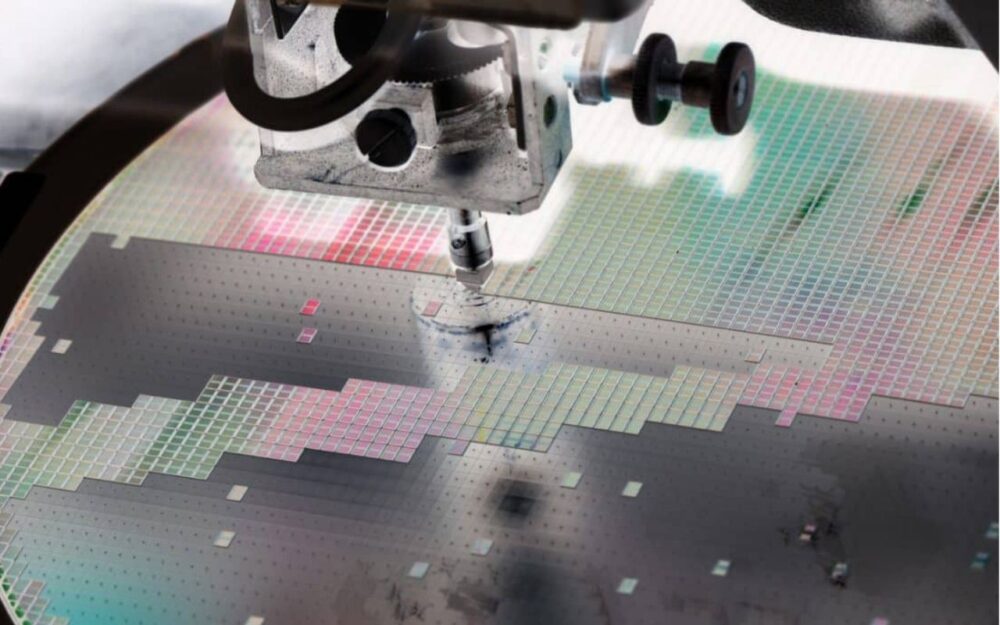
The Dutch company ASML currently holds a global monopoly on extreme ultraviolet lithography (EUV) systems, the extremely expensive tools necessary to produce leading-edge semiconductors. Without EUV machines, which might soon cost more than 600 million Euro per unit, fabricating chips at the most advanced process nodes is near impossible.
As former French finance minister Bruno Le Maire, now a special adviser to ASML, proudly noted in an event we attented last November:
“ASML builds the world’s most advanced lithography machines, using deep ultraviolet to etch silicon wafers down to 2 nanometers—that’s 100,000 times thinner than a human hair. It’s unique in the world, and probably Europe’s greatest technological asset today. These extraordinary machines are built in Eindhoven and shipped to China, Taiwan, and the U.S.”
ASML’s position rests on decades of accumulated expertise and a supply chain that includes sole-source dependencies, notably on Germany’s Zeiss for precision optics and ultra-smooth mirrors used in the EUV process.
For China, this represents a chokepoint that cannot be easily engineered around. ASML, under pressure from the US and Dutch governments, does not sell its most advanced systems to Chinese customers. Building a China-first alternative would require replicating ASML’s capabilities, together with a complex supplier ecosystem.
According to Austin Lyons, there could be alternatives. But they are highly impractical and not guaranteed to succeed at the levels needed by China:
“Without EUV, China can attempt to fabricate even smaller transistors using a process called multiple patterning DUV. It’ll be very low yield, so expensive per die, but they can continue to work toward slightly smaller transistors. Still, ultimately they would want EUV. A conservative 2030 timeframe for China to be able to come up with an alternative to ASML is still not very likely, especially.If they follow ASML’s playbook.”
Besides, he adds, that would require the setup of an entire supply chain:
“Getting the Laser Produced Plasma for the EUV light source is hard, getting the optics right is hard (and Zeiss wouldn’t sell anything to them), getting the mechatronics so you can move wafers around quickly and reach high throughput is hard. Yet, there is still a slim chance that they could be working on alternatives to EUV. That is unlikely, but US startups like Substrate and xLight are exploring this space. If American entrepreneurs are thinking outside the box, there is definitely a chance that China might as well”.
The Taiwan Variable
ASML is not the only chokepoint of the global chip supply chain: Taiwan’s TSMC also plays a fundamental role. The company, whose name stands for Taiwan Semiconductors Manufacturing Company, fabricates the vast majority of the world’s most advanced chips. Together with other Taiwanese firms the company accounts for over 37% of global chip production. Nvidia’s H200 and Blackwell processors are manufactured there. So are Apple’s mobile chips and components for most other leading tech companies.
This concentration creates a vulnerability that both Washington and Beijing have been aware of for a long time. Taiwan sits approximately 100 miles from mainland China, and the country’s position on it is explicit. Beijing considers the island a province that must eventually be reunified with the mainland.
The US has responded to this threat by encouraging domestic manufacturing, with TSMC building a fab facility in Arizona. Samsung in the meantime is expanding near Austin, Texas. Replicating Taiwan’s manufacturing ecosystem is a multi-year, multi-billion-dollar undertaking, though. And even optimistic projections leave the US reliant on Taiwanese production in the mid to long term.
Despite its reunification stance, China has not yet moved to take Taiwan by force. The reasons are certainly military and diplomatic, but the semiconductor angle also plays a role. Advanced chip fabs are extraordinarily fragile and their operation depends on a global supply chain of equipment, materials, and expertise that could collapse in a conflict scenario. The global economic fallout would be severe. And China would bear the weight of sanctions and damaged international relations without gaining any real advantage, as the chipmaking capacity that makes Taiwan valuable could no longer work as expected.
The Implications for the Industrial Sector
For companies reliant on the chip supply chain, the practical takeaway is to build flexibility into procurement and planning. Specific policy decisions will remain contingent on diplomatic dynamics that shift quickly.
Some structural trends, however, appear durable regardless of the geopolitical shifts. As we’ve mentioned, both the US and China are investing heavily in domestic fabrication to reduce mutual dependencies, and that trajectory is likely to continue regardless of what happens in April during the high-stakes Trump-Xi summit. Even in the case of a much needed step toward normalization and appeasement.
The 25% fee on H200 seems like a “moderate” template that both the US administration and US companies could live with and follow again for other exports. Despite the bold and aggressive claims, the US may prefer to tax its technology trade relationships with China instead of severing them entirely. A middle path between the hawkish calls for full decoupling and the commercial interests of the US’ global tech giants.
Related article