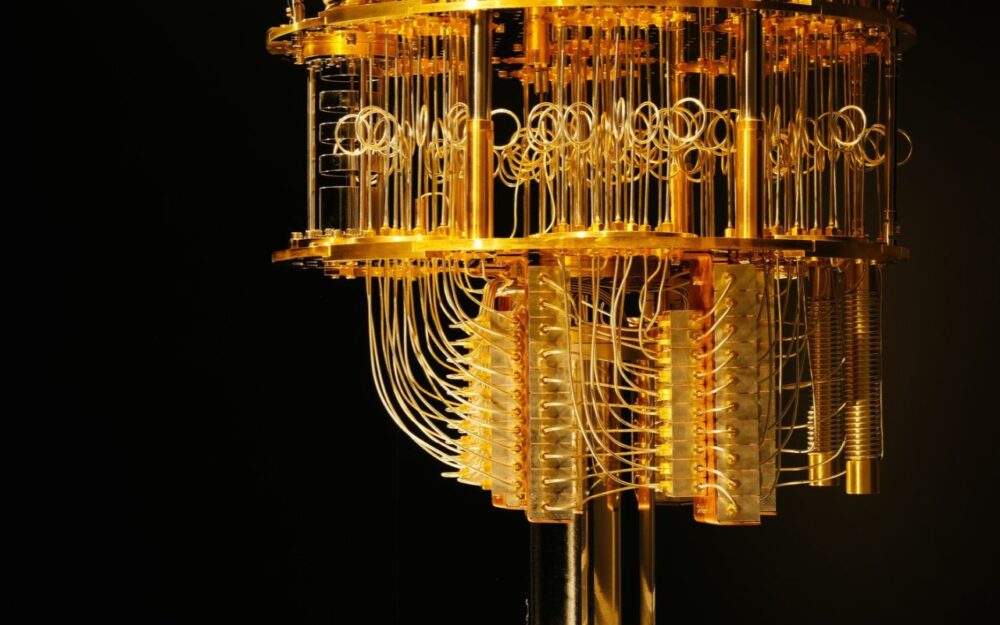

Fault-tolerant quantum computers are due from 2028. Here’s what IBM’s latest update means for industry, what work the first machines will do and how to get time on them.
IBM says 2026 is the year quantum computers started beating ordinary ones, a milestone it calls “quantum advantage”. It made the claim at its November developer conference in Chicago. The next race, it said, is to make the machines useful. Today, they can do little that an ordinary supercomputer can’t.
The jobs industry wants most from quantum computers, from longer-lasting batteries to cleaner fertiliser and tougher aircraft alloys, need something today’s machines don’t have yet. What we are waiting for are fault-tolerant quantum computers and most major roadmaps point to them arriving from 2028.
What Can a Quantum Computer Do That Others Can’t?
A quantum computer isn’t a more powerful version of an ordinary computer. It’s closer to a GPU, a specialist, very good at certain jobs and no use for most others.
Its speciality is chemistry and follows the same rules of physics as atoms and molecules. So it can mimic them in a way no ordinary chip can, and predict how a new material, coating or catalyst will behave before anyone makes it in a lab. Ordinary computers can only approximate how electrons behave, and those approximations are weakest in many of the materials industry cares about most, such as the catalysts used to make hydrogen and the magnetic materials in motors.
Ask a quantum computer to do almost anything else and an ordinary computer will beat it. So the test for any quantum project is simple: is the problem about how atoms and electrons behave?
Even if you have the right problem, today’s machines aren’t ready. The best machines get roughly one step in every 1,000 wrong, and a useful calculation needs millions of steps. For Yuval Boger, chief commercial officer at QuEra, which builds quantum computers,
“What’s going to happen with 10,000 steps? What’s going to happen with 100,000 steps? It’s going to be garbage.”
What Is Fault-Tolerant Quantum Computing?
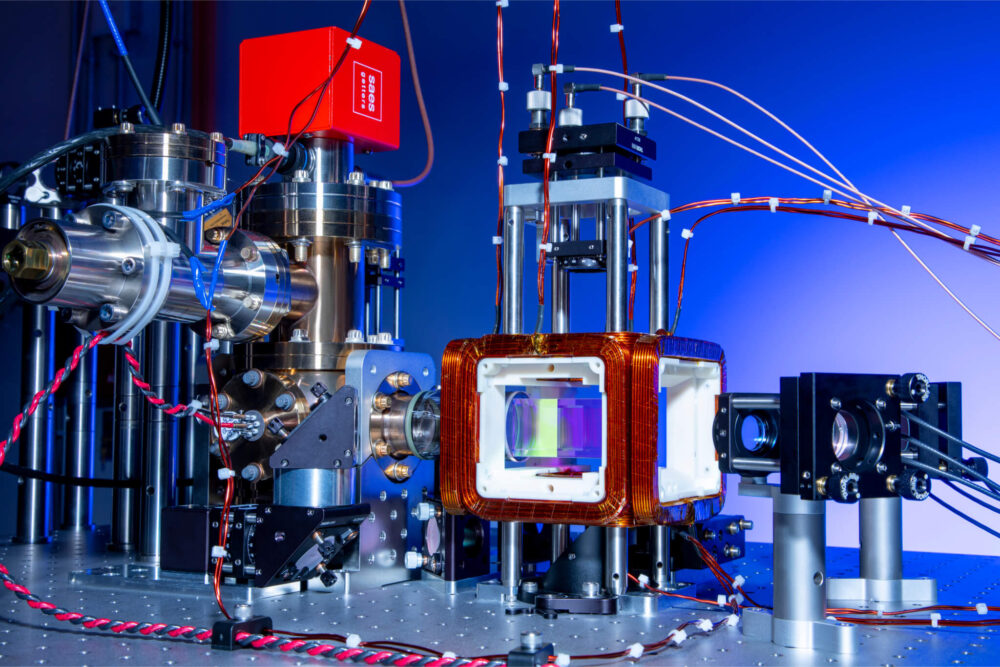
Fault-tolerant quantum computing is the ability of a quantum computer to detect and correct its own errors while it runs, so it can finish calculations long enough to be useful. The machine still makes mistakes, but it fixes them before they can ruin the answer. It’s the step that turns quantum computers from experiments into tools industry can use.
The error rate sets the size of the job a machine can handle, because a calculation can only run about as long as the machine can go without a mistake. QuEra’s first fault-tolerant machine, due in 2028, aims for about one in a million, and the generation after that for one in a billion.
Quantum’s Next Shift Starts in 2028
QuEra plans to put that machine, called Libra, on Amazon’s cloud in 2028, Boger says:
“Day one of quantum computing is in 2028.”
Like most roadmaps, QuEra’s is counted in qubits. A qubit is a quantum computer’s basic working unit, the counterpart of a bit in an ordinary chip. The number that matters now is reliable, or “logical qubits” the ones a machine keeps free of errors as it works.
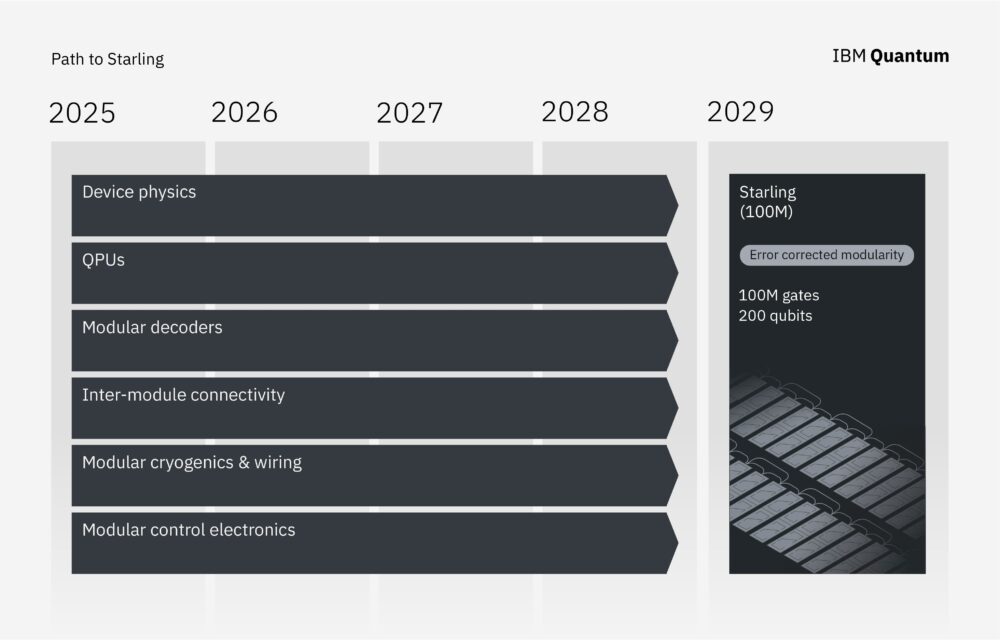
Libra aims for 256 reliable qubits. IBM, the biggest name in the field, follows in 2029 with Starling, with 200 reliable qubits running 100 million operations.
The Path to Starling
IBM appears to be on track. A fault-tolerant machine depends on three things: correcting errors as fast as they appear, joining many chips into one machine, and making those chips reliably. At their developer conference IBM reported progress on all three.
IBM says its error-correcting software, called Relay-BP, is now fast enough for Starling. To keep pace with the machine, though, the software needs a custom chip of its own. IBM is designing one on 2-nanometer technology, the most advanced chipmaking in use today, but hasn’t said when it will be ready.
Starling is also too big to fit on one chip, so IBM will build it from smaller modules linked together, much as a data center links many servers. Those links have to pass information between modules without errors creeping in. So far, IBM has linked two processors, and about one transfer in 100 goes wrong. Starling will need more than 100 links on every module, each ten times more reliable than that.
Making the chips is the other hurdle. Each processor contains thousands of tiny, delicate components, and a single faulty one means the processor doesn’t fully work. IBM has cut the number needed from about 5,000 to 2,000. And has raised its production yield from one fully working processor in 12 to one in three.
Of the three areas where IBM reported progress, only the links come with both a figure for today and a target for Starling. That makes them the number to watch. If IBM’s next updates show link errors falling towards that target, the 2029 date looks safer.
Other Competitors
IBM’s rivals are working on the same calendar. Quantinuum, another quantum computer maker, says its fault-tolerant machine, Apollo, is still on schedule for 2029, and Microsoft aims for a scalable machine the same year.
The US government is planning on the same dates. The Department of Energy’s Quantum Genesis initiative, launched in June, aims to demonstrate machines with “logical qubits numbering in the low hundreds in 2028”. Its scientific advisers are more cautious, and disagreed in a September report on whether useful fault tolerance will arrive by then.
Even so, 2028 to 2029 has become a date to plan around.
What Work Will the First Machines Do?
The first fault-tolerant machines will be small, so the first useful jobs will be in chemistry and materials, the work quantum computers do best. Most manufacturers have a materials problem somewhere, whether it’s a scarce metal, a coating that wears out or a battery that loses its charge too soon.
The hydrogen industry has an iridium problem. Many of the machines that split water into hydrogen use it as a catalyst, and it’s one of the rarest metals on Earth. Finding a catalyst that needs less of it means working out how electrons behave on its surface during the reaction. That is the kind of calculation ordinary computers can only approximate.
Johnson Matthey, which makes the catalyst-coated parts at the heart of these machines, is working with the start-up Phasecraft, QuEra and Harvard to simulate the reaction on a quantum computer. The project is funded by ARPA-E, the US energy department’s research agency. Its program backs about ten teams to have chemistry and materials methods ready for machines that have around 100 reliable qubits, roughly the size of the first fault-tolerant systems.
Other work will have to wait for bigger machines. Rolls-Royce wants to simulate how gases flow inside its turbines. In July, it joined Quantinuum, the error-correction specialist Riverlane and the University of Edinburgh’s supercomputing centre in a multi-year project to do that on a quantum computer.
The machines the project is aiming at would run a trillion operations, 10,000 times as many as Starling. Rolls-Royce is starting anyway. For Leigh Lapworth, the company’s fellow in computational science,
“If we want to be in a position to benefit from such devices, we have to start now, co-developing the algorithms, hardware and software.”
That’s the lesson for any manufacturer. The hardware arrives on the vendors’ timetable, but the methods, the people who understand them and the problems worth solving arrive on yours, and they take years.
How Fast Will the Work Ramp Up?
If the first fault-tolerant machines arrive on schedule, the next problem will be getting time on them. There will only be a handful, and a big job could take a few weeks. Boger expects that
“you’re not going to be able to solve more than 100 problems per year on a given machine [and] the process of preparing each problem might take a year”.
For a 2028 machine, that means starting in 2027 at the latest, or having to
“watch your competitors take up the available slots”.
That preparation runs on today’s machines. IBM’s newest, Nighthawk r2, runs more than 7,500 operations accurately on 120 qubits. Its successor, due in 2027, is built for 10,000 operations across 520 qubits, and IBM plans to link two into a single system. Neither is fault-tolerant. They’re where companies can test their methods now, ahead of machines that can run them in full.
IBM called 2026 the year of quantum advantage. For the industry, the year that matters is 2028, when a quantum computer can first run a calculation long enough to be useful. The wait is nearly over for the companies already preparing. And for everyone else, the next two years are the time left to decide whether to join them.