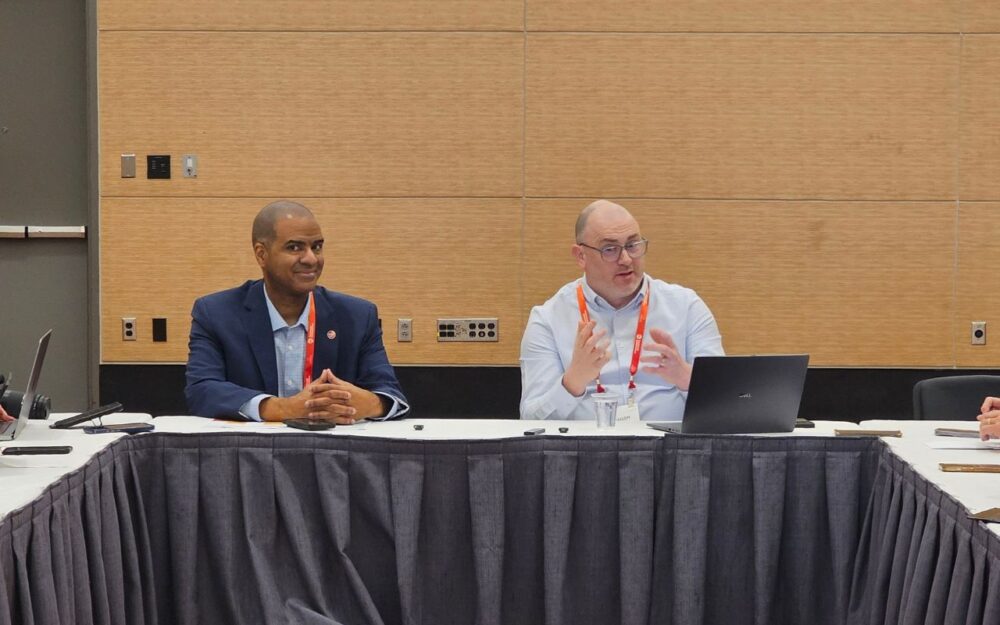

DirectIndustry is at Automation Fair in Boston this week, Rockwell Automation’s flagship annual event, to explore the latest trends shaping industrial automation. In this report, we look at a project involving Rockwell Automation, its system integrator partner inControl Systems, and UK steel producer 7-Steel. During a media briefing, Graham Jennings, Digital Solutions Director at inControl Systems Ltd, explained how connecting fragmented energy and production data is helping 7-Steel turn energy monitoring into a tool for improving efficiency and operational decision-making.
For energy-intensive industries, improving energy efficiency is not just about reducing consumption. It also means understanding what drives it, identifying inefficiencies and knowing when and where to intervene.
Yet many industrial facilities still struggle to make full use of the data they generate. Energy, production and equipment information is often scattered across different systems, making it difficult to link energy use to operational performance (read our article on industrial data silos).
At Automation Fair, Rockwell Automation presented a project with inControl Systems and 7-Steel UK, showing how connecting these different data sources can support more responsive energy management.
From Fragmented Data to a Unified Energy Picture
7-Steel is an established UK steel producer and one of the country’s leading low-carbon steel manufacturers. The company has invested in new furnaces and relies heavily on recycled steel. Its next challenge was to improve energy efficiency while maintaining production performance. But understanding exactly where energy is being used is not straightforward. Information is often spread across different systems and equipment, including legacy installations. All that makes data collection and consolidation a time-consuming process.
For example, Graham Jennings explained 7-Steel previously relied on spreadsheets to collect energy data, requiring considerable manual work before it could be analyzed:
“A lot of data [was] collected on spreadsheets […] many hours everyday being expended just getting data on a spreadsheet.”
This made it, obviously, difficult to get a sufficiently detailed and timely picture of energy consumption, limiting the company’s ability to identify inefficiencies and react to changing conditions.
Connecting Energy Consumption With Production Data
To address this challenge, Rockwell Automation and inControl Systems deployed FactoryTalk Energy Manager, using FactoryTalk DataMosaix as its industrial data foundation. FactoryTalk DataMosaix contextualizes operational technology (OT) and information technology (IT) data. FactoryTalk Energy Manager provides energy monitoring, analysis and reporting capabilities.
One of the main challenges was integrating existing equipment and data sources into a unified system, despite the age and diversity of the installations. Rather than adding another isolated monitoring tool, the aim was to bring information together and make it accessible in real time.
Knowing how much electricity a facility consumes is only part of the picture. Manufacturers also need to understand why consumption changes, which processes are responsible and how these variations relate to production. By connecting energy data with operational context, the system gives 7-Steel a clearer picture of its consumption patterns, including energy-intensive processes and periods of peak demand.
From Monitoring to Real-Time Operational Decisions
One of the main benefits for 7-Steel is also the ability to access energy information in real time. The system provides visibility into changing energy prices and signals from the local electricity network. This helps the company adapt its response to changing operating conditions, as Jennings explained:
“Now that they have that in real time […] they were able to react and make those changes.”
This is particularly relevant for energy-intensive manufacturers, where electricity costs can have a substantial impact on operating expenses. The project also illustrates how contextualized industrial data can reveal problems beyond energy consumption itself.
Jennings also highlighted how the data helped identify production losses caused not by equipment failure, but by a lack of available staff to carry out essential maintenance and operational tasks.
The example shows how connecting different types of information can help manufacturers identify the real causes of performance issues, whether they relate to equipment, production or staffing.
Supporting Energy Performance and Regulatory Objectives
Beyond day-to-day operations, the project also supports 7-Steel’s broader energy management objectives. Automating data collection reduces the time spent compiling spreadsheets and makes information more readily available for analysis and reporting. More reliable data can also help manufacturers document improvements and support compliance requirements.
For 7-Steel, the initiative has contributed to progress towards ISO 50001 readiness, the international standard for energy management systems. Documenting improvements can also help companies demonstrate that they meet the criteria for public funding and other energy-efficiency support schemes.
Connecting energy consumption with production data also makes it possible to develop energy-intensity indicators, relating the energy used to the amount of output produced. This provides a more meaningful measure of performance than looking at total consumption alone, particularly when production volumes fluctuate.
Building an Energy Management System That Can Evolve
For inControl Systems, the objective is not to provide disconnected, single-purpose applications, but to build flexible environments that can integrate different data sources and evolve with customer needs. As Jennings put it:
“What they need today, what they need tomorrow in their data is not going to be the same as what they need in ten years.”
This flexibility is particularly relevant for established industrial sites, where replacing entire infrastructures is neither practical nor necessarily desirable. Integrating existing systems while allowing new data sources and applications to be added over time offers a more gradual route towards digital transformation.
Although the 7-Steel project focuses on steel production, the same approach can be applied to other energy-intensive sectors, including mining and chemical processing.