


AMR and AGV are both mobile robots. One, AMR, is autonomous, as its name suggests: Autonomous Mobile Robots. The other, AGV, is guided, as its name, Automated Guided Vehicles, indicates. At LogiMAT, one of Europe’s leading intralogistics trade shows, which we attended a couple of weeks ago, we spoke with two German manufacturers, Jungheinrich and Stäubli. Each was presenting a new release in one of these categories. Far from a technological clash, they explained how their solutions highlight not just different machines, but fundamentally different visions of warehouse automation.
AGVs and AMRs are both mobile robotics solutions, but they are designed for different objectives. At LogiMAT a few weeks ago, both types of technologies were gaining strong momentum. And for good reason: they make operations more flexible, optimized, and faster. However, the two technologies are not equivalent. They present major differences and are not deployed for the same purposes.
We visited the booths of two German manufacturers presenting new products in one of these categories to better understand the needs each solution addresses.
Jungheinrich: AMR and the Rise of Flexibility
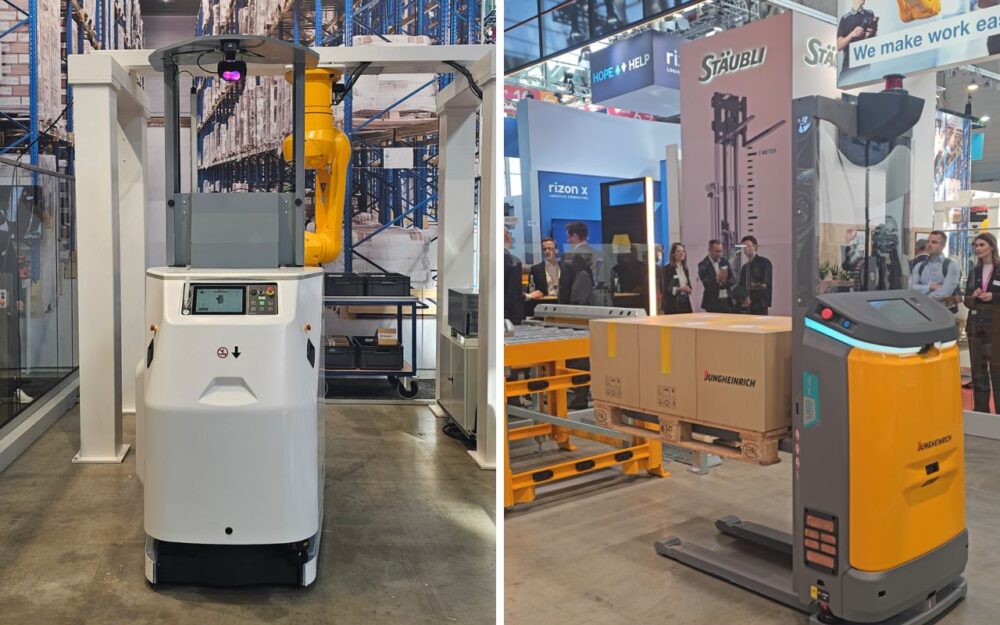
At Jungheinrich’s booth, the spotlight this year was on an AMR. The star of the show was the EAE 212a autonomous forklift robot. This new-generation system is designed for maximum flexibility and minimal infrastructure. Unlike traditional AGVs, it does not rely on reflectors or predefined routes. Instead, it uses a combination of cameras, laser scanners, and onboard intelligence to navigate freely.
The system features autonomous navigation without reflectors or fixed infrastructure, a compact design capable of operating in tight spaces such as door clearances of 2.2 meters, and pallet handling capabilities up to 1.2 tonnes and 1.2 meters in height. It also allows direct handover to conveyor stations without adaptation and includes an advanced safety system compliant with the latest standards, including EN ISO 3691-4 and performance level requirements.
Safety is a central differentiator. Jungheinrich emphasizes precise station detection and anti-crushing protection, using extended sensor arrays to detect both pallets and their environment.
AMRs also stand out for their faster deployment and lower cost. According to a Jungheinrich representative we met at the booth, the biggest advantage lies in ease of deployment: no infrastructure setup is required, no reflector installation is needed, and layout modifications are minimal. According to this representative, installation at one of their client sites was completed in just two days.
Cost is also a key argument. With pricing around €88,000 to €95,000, including software and integration, AMRs such as the EAE 212a are becoming accessible even for smaller fleets.
But the real shift is operational. As the representative put it,
“You tell it where to go, the robot does the rest.”
AMRs adapt dynamically to obstacles, making them ideal for changing environments where strict “warehouse hygiene” cannot always be maintained.
It is worth noting that Jungheinrich also manufactures AGVs, as AGVs address very specific needs, which we will explore next.
Stäubli: AGV and the Power of Precision
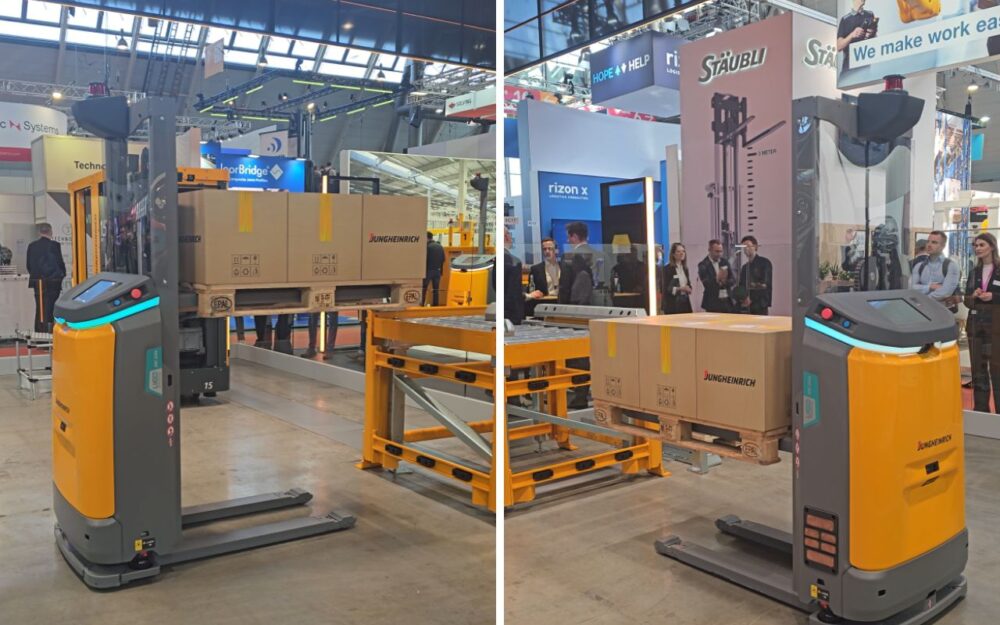
Just opposite Jungheinrich’s booth, Stäubli was presenting its latest counterbalanced AGV forklift, FL1500, released in November.
This machine is designed for heavy-duty, high-precision industrial environments, particularly in automotive manufacturing. Its counterbalanced design, with no forks on the ground, enables greater versatility. It can handle payloads of up to 1.5 tonnes and manage various pallet types and cages from multiple directions. It also offers more than 24 hours of autonomy thanks to a large 48V battery (230 Ah) and is built from standard industrial components for easier maintenance.
Unlike AMRs, this AGV follows predefined routes. If an obstacle appears, it stops and waits rather than rerouting. For Stäubli, this is not a limitation but a deliberate choice. Their philosophy is clear: predictability over adaptability and stability over autonomy. As one representative explained,
“You don’t want full autonomy with high payloads.”
AGVs are therefore seen as the safer and more reliable option when handling heavy loads in controlled environments.
Stäubli also introduces an advanced navigation approach, with sensors placed at 2.6 meters height to “see above” pallets and detect stable building structures rather than temporary obstacles. The system includes continuous payload monitoring that stops operations if anomalies occur.
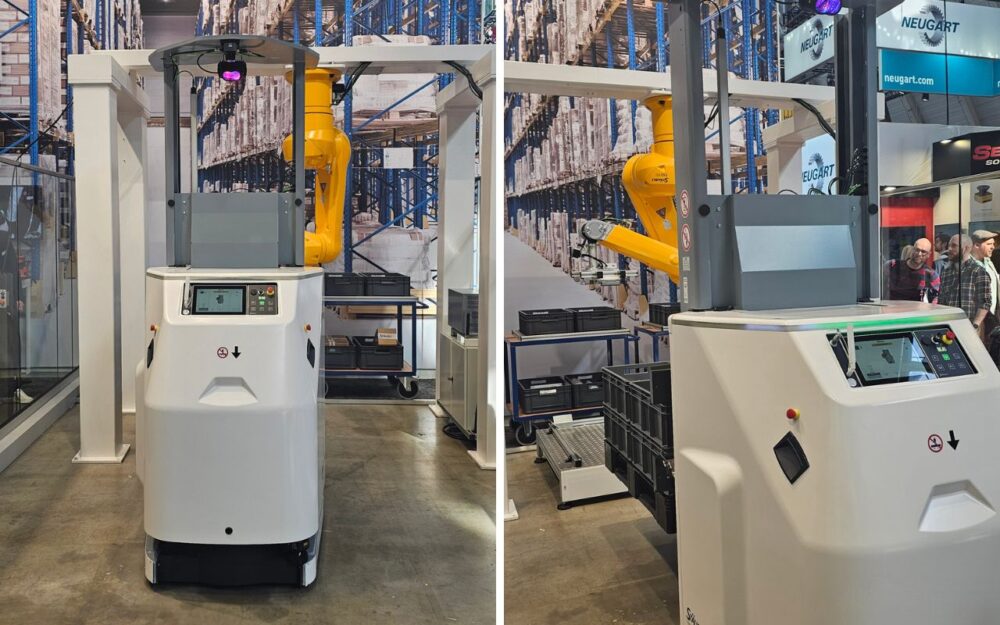
It can also be integrated with robotic arms for fully automated workflows, such as picking boxes from pallets and placing them on mobile trolleys using vision systems.
The Real Question: Use Case Over Technology
At LogiMAT, it became clear that this is not about one technology replacing the other. Instead, the market is segmenting based on use cases. AMRs are gaining ground in e-commerce, third-party logistics (3PL), and fast-changing warehouse environments. AGVs remain dominant in the automotive and heavy industry.
Even Jungheinrich’s representative acknowledges that high-performance tasks, such as loading a truck in under ten minutes, remain a major challenge for autonomous systems.
Another manufacturer we met, STILL, was also showcasing its AMR loading and unloading solution at LogiMAT (read our article). It currently completes these operations in around 35 minutes.
Rather than a winner-takes-all battle, AMR vs AGV is evolving into a strategic divergence. While AMRs bring agility, speed, and lower barriers to entry, AGVs deliver precision, reliability, and heavy-duty performance.
Choosing the Right AMR or AGV: Our Guides
Choosing between AMR and AGV is not simply a matter of technology preference; it requires a clear understanding of your operational constraints, performance requirements, and level of environmental control. Each solution comes with its own advantages, limitations, and ideal use cases.
To help you navigate this decision, our editorial team has developed comprehensive buying guides that break down the key differences, selection criteria, and real-world applications of both technologies. These guides will answer your questions and support you in identifying the solution best suited to your needs.
Read our guides