

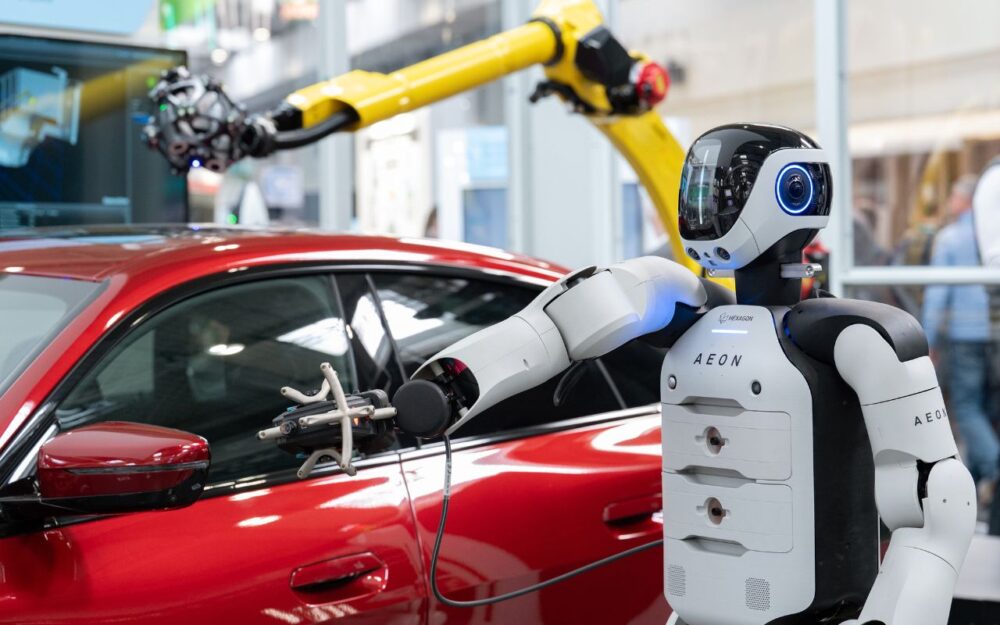

VDMA, the German network organization that represents the machinery and equipment manufacturing industry in Europe and Germany, released four scenarios regarding the future of humanoid robots in the industry and in society. We contacted Anne Wendel, Director Robotics, Automation and Machine Vision at VDMA, to know more about these scenarios, what are the most probable one(s), how Europe positions in this trend and if the continent can lead (or lag) in the humanoid revolution.
Humanoid robots have become a strategic imperative for the global machinery industry. Projected to generate billions in revenue by 2040 with annual sales in the millions, these robots promise to redefine automation, logistics, and even domestic life.
Why Humanoid Robots Matter Now
As the VDMA’s Future Business Study “Humanoid Robotics 2040” reveals, their potential lies in their human-like adaptability: designed to operate in environments built for people, they could bridge gaps where traditional robots fall short—handling unstructured tasks, collaborating with humans, and navigating dynamic spaces.
Yet, as Anne Wendel notes in an interview with us:
“We hear a lot about pilot projects and impressive videos from US or Chinese manufacturers. But let’s be honest: I haven’t seen any humanoid robot truly interacting with people in industry yet. Carrying empty baskets is one thing; deploying them in real, unfixed industrial environments is another.”
Anne agrees that labor shortage, a challenge currently faced by both Europe and the United States, is a key driver for humanoids.
And in this segment, Europe stands at a pivotal juncture. With its full value chain coverage (from components to integration) and a legacy of industrial excellence, it has the tools to lead. But without accelerated investment, collaboration, and smart regulation, it risks ceding ground to China and the U.S., where massive capital and political will are already shaping the market.
Besides, adds Anne,
“Labor shortage is a driver for humanoids, which we are all facing in Europe and even in the United States currently.”
But without accelerated investment, collaboration, and smart regulation, it risks ceding ground to China and the U.S., where massive capital and political will are already shaping the market.

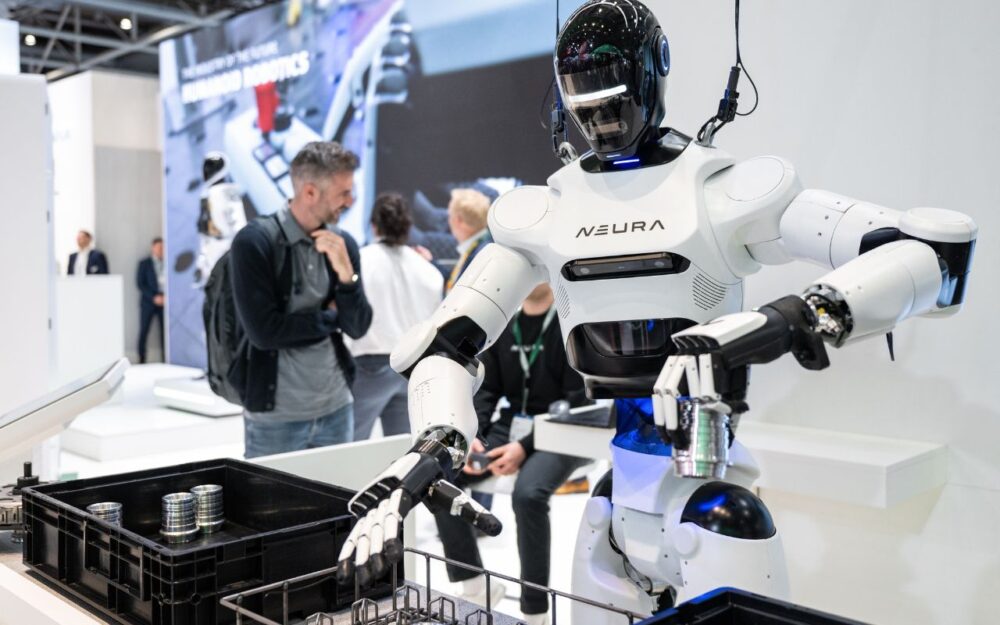
The VDMA’s Four Scenarios for 2040: A Spectrum of Possibilities
Developed with Z_Punkt GmbH and industry experts, the VDMA study outlines four plausible futures for humanoid robotics, each with distinct implications for Europe’s mechanical engineering sector.
According to Anne Wendel, this exercise is part of VDMA’s annual tradition of exploring the future of the machinery industry:
“This is an exercise VDMA does once a year. We have a department called VDMA Future Business, and they bring together different VDMA associations to discuss. For this edition of the study, VDMA Robotics + Automation, VDMA Software and Digitalisation, VDMA Electrical transmission and Drives, VDMA HealthTech,, as well as research institutes, academia, potential end users, and manufacturers identified influential factors (e.g. labor market trends, societal issues, regulations, AI development) and combine their potential developments to create possible futures. It’s not a prediction or a market study; it’s a structured dialogue about how the future of humanoid robotics in Europe might look.”
And these discussions led to the following four scenarios.
Scenario #1: Trustworthy Helpers: Robots in Everyday Life
According to this first scenario, by 2040, humanoid robots will be ubiquitous—affordable, certified, and integrated into homes and workplaces. They will operate under strict data protection and safety standards, creating a mass market with high cost pressure and rapid development cycles.
Opportunities for Europe:
- Leadership in safety, certification, and maintenance services.
- Scalable production of quiet, user-friendly systems.
Risks:
- Platform dependency: Europe could become a mere sales market if R&D and operations are dominated by foreign players.
- Commoditization: Low margins if differentiation fails.
Scenario #2: Premium Niche: Robots for the Affluent
In this second scenario, humanoid robots become exclusive status symbols, akin to luxury cars or haute couture. High performance, discretion, and personalization drive costs up, limiting volumes.
Opportunities for Europe:
- High-margin subsystems: Precision drives, “dexterous hands,” advanced perception, and safety features.
- Lifetime service contracts and certified upgrades.
Risks:
- AI dependency: Without heavy investment in AI, Europe could be reduced to a hardware supplier for foreign AI-driven platforms.
According to Anne Wendel:
“China and the U.S. are investing massively. China already scales production at lower costs, and the U.S. has venture capital and AI giants like Nvidia driving expectations. Europe has the technology, the research, and the component manufacturers, but we lack venture capital.“
Scenario #3: B2B Bot: Certified Employees for Services
In this third vision, humanoid robots are certified “employees” in logistics, healthcare, and industry, addressing labor shortages. Deployment is selective, focusing on niches where human-robot collaboration is critical.
Opportunities for Europe:
- Turnkey solutions: Integration, training, recertification, and availability guarantees.
- Regulatory leadership: Setting global standards for functional safety and liability.
Risks:
- Platform dominance: Reliance on a few global players’ ecosystems.
- High liability costs in human-proximity environments.
According to Anne Wendel:
“The world is made for humans, and nothing adapts to it as easily as a humanoid. Hence the dream of a humanoid that can do its job here in the real world, and we don’t have to create spaces designed for robots. The world is really made for humans, and that is driving the development of humanoids. With humanoids, we also see imitation learning. They can directly learn from humans, so you can transfer your knowledge and capabilities to the humanoid. This is of interest, for example, in logistics or industry for handling tasks, or in hazardous environments where mobile robots are already controlling heavy industries in energy plants.”
Scenario #4: Stuck in a Niche: Humanoid Winter
In this last scenario, humanoid robots remain confined to industrial niches, with limited public acceptance due to safety incidents, trust deficits, and fragmented standards. Growth is slow, and scaling is regional.
Opportunities for Europe:
- Robust, safety-focused systems for harsh environments.
- Long-term service contracts and remote control solutions.
Risks:
- Missed learning curves: Falling behind in Physical AI and large-scale deployment.
- Irrelevance: While other regions advance, Europe’s cautious approach stifles innovation.
When asked which of these futures seems most probable, Anne Wendel shares the consensus among participants:
“I would say most of the participants think it will be either the ‘Trustworthy Helper’, robots in everyday life, or the ‘B2B Bot’certified employees for services. We don’t think that humanoid robotics will be stuck in a niche. But bear in mind that today, we already have cobots and mobile platforms that do many jobs perfectly. For some tasks, you don’t need a humanoid.”
Key Takeaways: What Europe Must Do to Lead
The VDMA study and Anne Wendel’s insights underscore five critical actions for Europe to secure its position in the humanoid robotics revolution.
1. Invest in Physical AI and Ecosystems
According to the VDMA, humanoid robotics is a Trojan horse for Physical AI, which will transform all of mechanical engineering. Collaboration between OEMs, startups, and research is non-negotiable. Europe’s strength lies in its integrated value chain, but only if it acts as a unified front.
2. Accelerate Pilot Projects and Real-World Testing
Europe must create regulatory sandboxes for liability, incident reporting, and data logging. Public-private funding can lower barriers for SMEs, enabling faster iteration and deployment. As Wendel notes:
“It’s a huge investment at the beginning, but it will pay off. That’s our strong belief. Governments can really drive innovation and encourage companies to try out and make more use of robots and automation.”
3. Double Down on Safety and Trust
With ISO working groups already expanding safety standards to humanoids, Europe has a chance to lead. But the margin for error is slim:
“If a 100 kg humanoid crashes into someone, it could halt progress for a decade. Safety isn’t just a technical challenge—it’s an existential one for the industry.”
4. Mobilize Private Capital
Tax incentives for robotics investments and simplified access to funding are essential. Wendel stresses the need for bold action:
“We need targeted programs to assist pioneering companies in co-developing solutions. Reducing bureaucratic burdens for SMEs to access investment programs is critical—Europe can’t afford to move at its usual pace.”
5. Leverage Europe’s Strengths
Europe’s component excellence (drives, sensors, manipulation, machine vision) and its 3,400 “hidden champions” in the VDMA network are unmatched. Its standardization frameworks, safety, data protection, could become global benchmarks. But as Wendel warns:
“China is already the world’s biggest robot market, and the U.S. has venture capital and AI giants driving expectations. Europe has the tools to compete, but it needs to act now—before the window closes.”
The Bottom Line: Automation as a Job Preserver, Not a Job Killer
The conversation around robotics has evolved. As Anne Wendel makes clear:
“It’s not about killing jobs, we’re beyond that discussion. It’s about keeping jobs in Europe. We have to create incentives for robotics and automation. Without investment in these fields, we will keep losing competitiveness.”
The potential for humanoid robots and automation extends far beyond manufacturing. Agriculture, logistics and healthcare are ripe for transformation. But realizing this potential requires capital, political will, and a shift in mindset. Wendel underscores the urgency:
“There are so many opportunities where automation can bring real benefits. To seize them, we strongly need capital to work. Politicians must make robotics and automation a top policy priority. To maintain manufacturing in Europe, you need to automate.”
Europe stands at a crossroads. The choice is simple: lead the humanoid revolution or risk irrelevance. The tools, the talent, and the vision are already here. What’s missing is the speed and scale of action. The time to invest, collaborate, and innovate is now—before the future is written by someone else.