
Traditional web traffic is collapsing. Everyone’s saying it: up to 25-60% less referral traffic depending on domain authority since ChatGPT arrived in late 2022. But here’s what almost nobody is talking about: conversion rates are going up, most noticeably in B2B.

Since AI entered the mainstream in 2023, web visibility has begun shifting from volume to quality. This shift could be particularly significant for B2B, where AI can synthesise complex technical information in seconds, enabling faster, more informed and better-qualified lead generation.We believe that, despite the disruption, B2B could emerge as one of the major beneficiaries of the AI revolution. Which is why we’re inviting you to join us as we embark on this transformation.
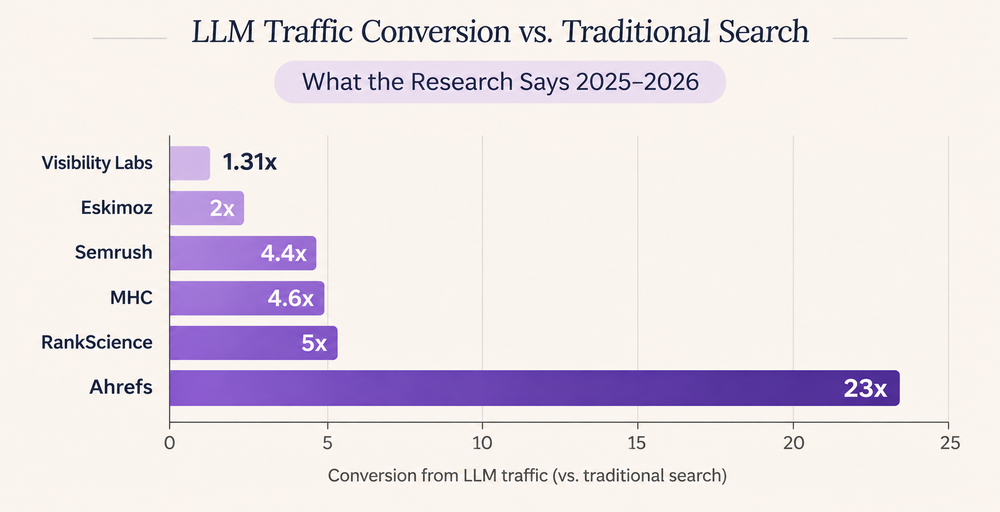
Depending on the source, the figures vary widely, but they all point the same way: traffic from LLMs converts better than traffic from conventional search engines. Excluding the Ahrefs outlier, these studies average out to roughly a 3.5 x higher conversion rate for LLM traffic.
BUT DOES THAT COMPENSATE FOR THE LOSS IN OVERALL TRAFFIC?
=> NO, NOT EVEN CLOSE.
LLMs don’t generate need. Most people take the information and leave, because they don’t yet need to act on it. But when the need is there, LLMs give enough insight and clarity to make it actionable. The value of LLMs from a sales perspective is therefore not lead generation per se, but lead qualification: rapidly turning generic, time-intensive inquiries into actionable negotiations.
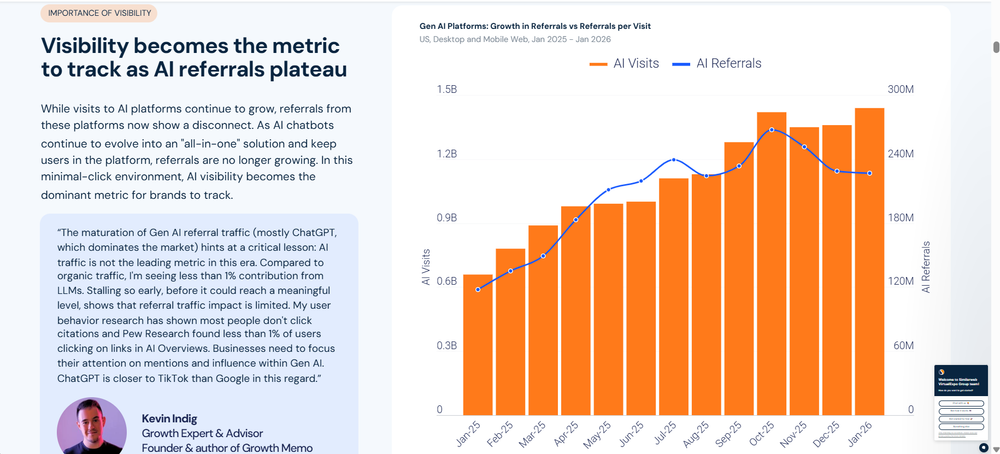
So, if LLM referrals, despite their relatively low volume, convert three times better than traditional search traffic, the same principle applies to our own approach: AI’s greatest value lies not in creating intent, but in sharpening existing intent until it becomes actionable. The key is insight, not volume.
As a lead-generation platform that helps buyers compare products and connect with suppliers, we don’t use AI to generate traffic or create intent. Our strong long-tail SEO already does that, attracting buyers with a clear purpose before they even click through to our platform.
Instead, we use AI to sharpen that intent, turning buyer interest into high-potential sales enquiries that bypass much of the traditional discovery phase and move straight towards negotiation.
So we think the doom and gloom about falling traffic misses the real opportunity AI offers B2B. It’s complexity, not traffic volume, that has always held B2B back online compared to B2C. And complexity is exactly where AI excels: sharpening intent by simplifying it in seconds.
First, buyers complain that nobody replies, or if they do reply, it’s back to the 20th century, with long forms to fill out before you can even get a basic notion of cost. Sellers, on the other hand, complain that leads are vague. Some get judged by appearances and never even get an answer, while others result in a list of questions when the buyer was expecting an answer.
Long forms with mandatory fields? Today’s buyers, raised on TikTok and ChatGPT, simply don’t want to fill them in.
So we put this to the test: we replaced the request form with our own LLM.
On July 15, we launched a beta of a conversational assistant on the French version of DirectIndustry. The visitor describes their project, the assistant helps refine the need, gives guidance on costs and applications, recommends products, and then sends the quote request to manufacturers, all without leaving the conversation.
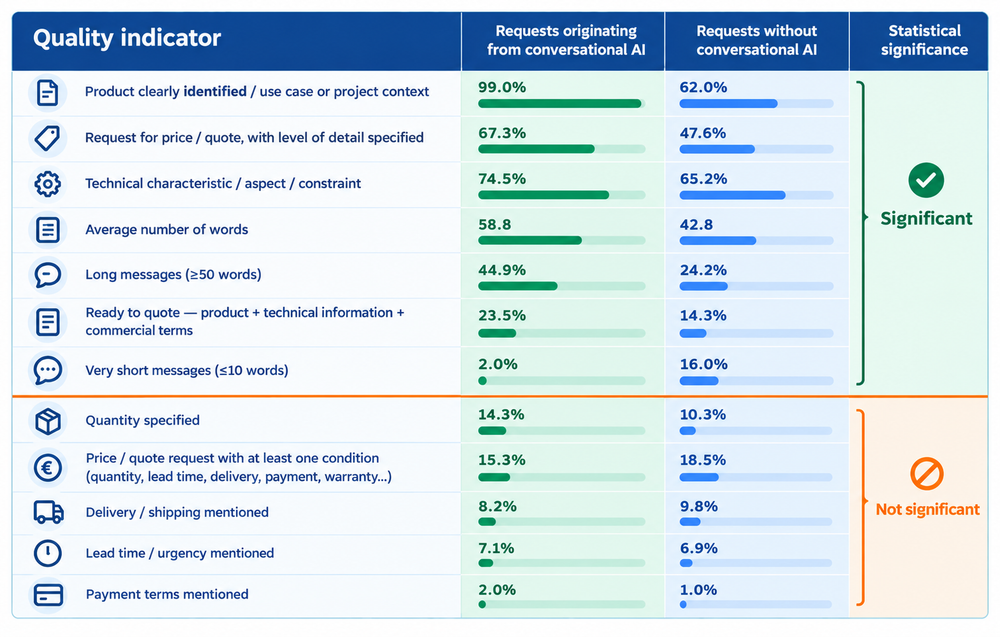
The result? Lead quality up 30%.
Those requests beat the standard ones on every statistically significant quality criterion. For example: “Does the request contain technical characteristics detailing the specific requirement?”
Now here’s the beautiful bit we didn’t expect – volume!
Earlier I said that LLMs like ChatGPT are better at sharpening existing intent than generating intent in the first place, hence the low click-through rates. That’s true. But what if the intent is already there? Well, that’s the case on DirectIndustry.com. We are, after all, an industrial sourcing tool, not a generic LLM. People only come to find industrial products, not to get the latest weather forecast or the best recipe for tiramisu.
So after integrating instant conversational AI into the lead generation functionality, as well as boosting quality, the volume of requests went up by a staggering 130%.
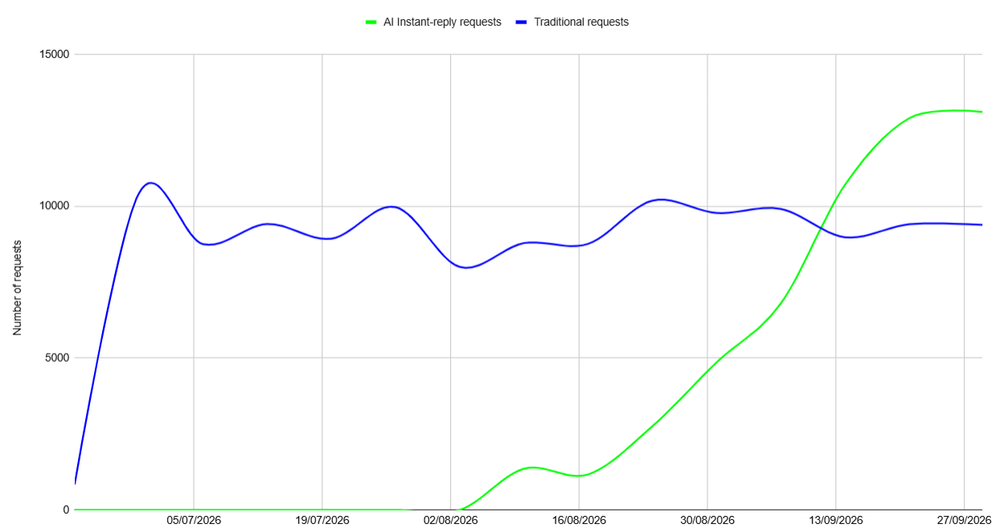
This won’t happen on a general-purpose LLM like ChatGPT. But our long-tail SEO strategy targets high-intent users. The intent was there before they clicked. It just needed unlocking with instantaneity. This is why we believe AI is one of the biggest opportunities B2B has had online.
DON’T PUT YOUR AI BUDGET IN THE LLM. PUT IT IN YOUR LEAD GEN.
AI’s value for buying trainers is limited: you don’t need it to tell you your shoe size or shortcut the pleasure of choosing styles and brands. But you do need an LLM to synthesize vast reams of performance specs and made-to-measure case studies to get actionable, sharpened insight on which suppliers to contact for a new machine cutting tool.
For us, the way forward is not to invest in AI to drive more traffic to our platforms, but to use AI to convert more of the traffic we already have into qualified leads. This finally resolves the age-old B2B impasse: buyers want immediate answers, while sellers need detailed information. AI makes it possible to deliver both.
That’s what VirtualExpo calls the Intelligent Sourcing Platform. Sellers spend less time chasing leads and more time closing deals.
So, is falling traffic a problem? Maybe it’s the wrong question, and chasing the answer is dangerous. The GEO market (spending on LLM visibility) is forecast to grow 40.6% a year through 2034, and 54% of US marketers plan to implement it within months. Anyone expecting that spend to win back lost traffic could be very disappointed.
The real question is: are you investing in AI where it makes the greatest difference : helping existing prospects to qualify their needs and contact you? And are your sales teams ready to jump on those opportunities with fast, straight-to-the-point verification, rather than rigid procedures, forms and “homework”?
This finally resolves the age-old B2B impasse: buyers want immediate answers, while sellers need detailed information. AI makes it possible to deliver both.
Of course, AI can give wrong or overly approximate answers. But technical sellers should embrace that inexactitude rather than lament it, because it secures their new role in the AI age: professional buyers want you to verify the insights they’ve gained quickly from AI, not to “educate” them from scratch. The LLM does that now. Gone are the days when the seller at a trade show was the only source of technical expertise.
The sellers who win will be the ones who can answer fast and helpfully. That’s what the Intelligent Sourcing Platform is built for.
- Semrush — AI Visibility Index
- Similarweb — Generative AI – Brand Visibility Index 2026
- Averi — AI Search Visitors Convert 23x Higher. Everyone’s Ignoring It.
- Ahrefs — Does AI Search Traffic Convert Better Than Traditional Search? For Ahrefs, Yes
- RankScience — Why Google Still Matters: The Real Data Behind AI Search Hype
- Viuz / Eskimoz — Jérémy Lacoste (Eskimoz) : L’enjeu du search, devenu global