

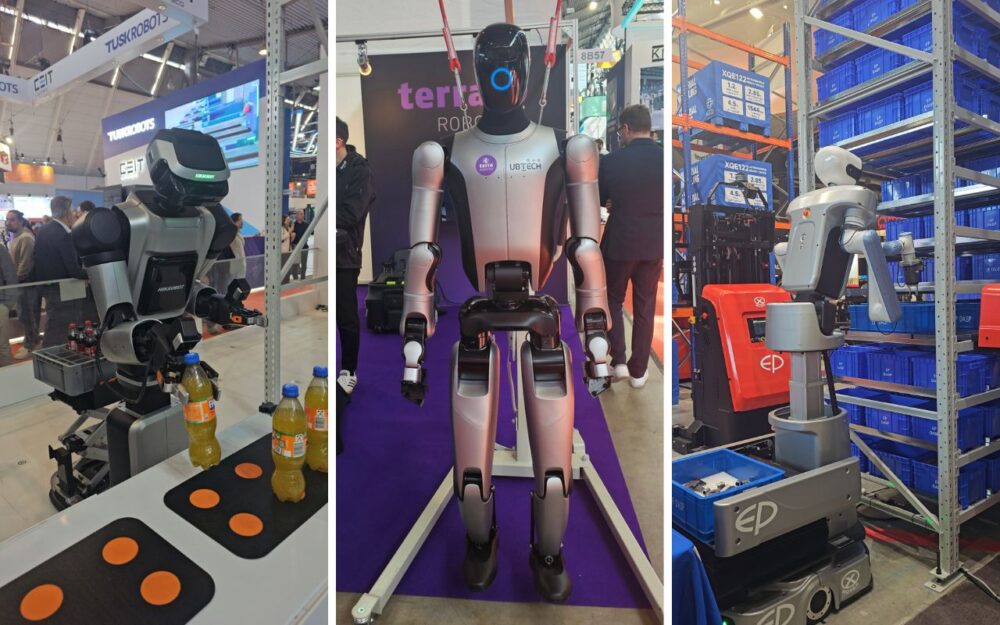

At LogiMAT 2026, the world’s largest intralogistics exhibition we attended last week in Stuttgart, Germany, humanoid robots shared the spotlight with more mature automation technologies such as Autonomous Mobile Robots (AMRs). While AMRs clearly dominated the show floor, humanoid robots, still rare, captured attention and sparked debate. Are they just the latest industry hype, or a credible response to Europe’s growing labor shortages and aging workforce?
A Signal Worth Noticing
Humanoid robots were present at LogiMAT, but only in limited numbers. Compared to the widespread deployment of AMRs and AGVs, they remain a niche technology. Yet their ability to attract attention was undeniable. More importantly, something is shifting.
Integrators and resellers are beginning to include humanoid robots in their portfolios, testing early use cases and gauging market demand. Conversations with industry leaders revealed a growing interest, particularly for tasks requiring dexterity, adaptability, and human-like interaction, areas where traditional automation still struggles.
So we met with manufacturers of humanoid robots, resellers, and industrial robot manufacturers to get a sense of this trend.
Chinese Humanoids Targeting Logistics
One striking observation is that the vast majority of humanoid robots on display came from Chinese manufacturers. This reflects China’s current dominance in the sector, with deployments already underway in domestic industries (read our recent story on Chinese humanoid robots).
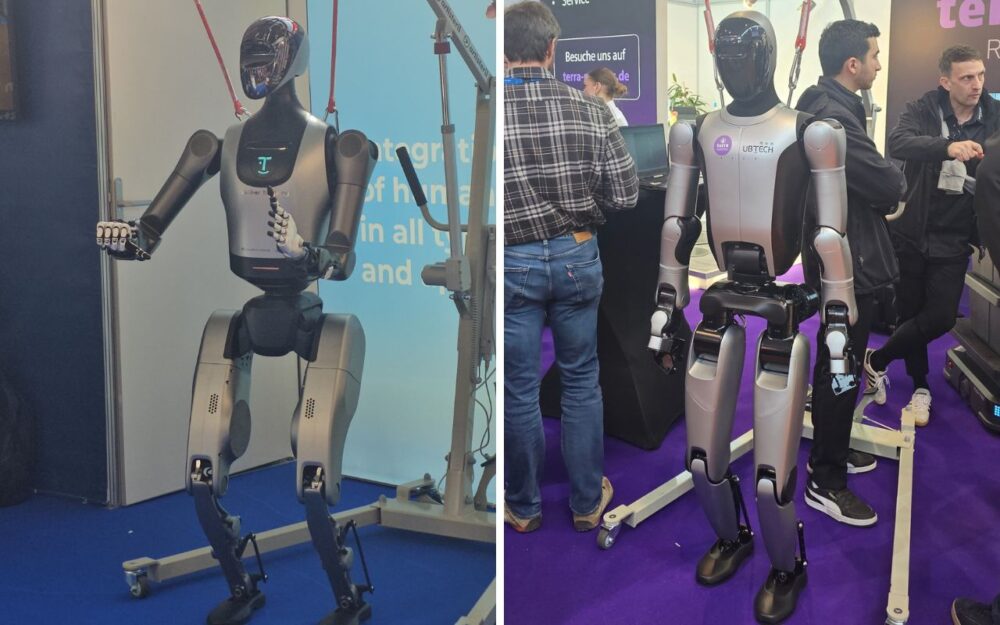
And these robots are genuinely designed for logistics, as explained by Murat Arpaci, CEO of Terra Robotics, a German distributor of Chinese humanoid robots from UBTech on the European market:
“The strongest potential today is in industry, for relatively simple tasks like pick & place or inventory. These are the use cases we’re currently developing with major companies.”
Humanoids are not positioned as replacements for existing systems, but as complements. Handling irregular objects, working in human-designed environments, or performing multi-step tasks are areas where traditional automation still struggles.
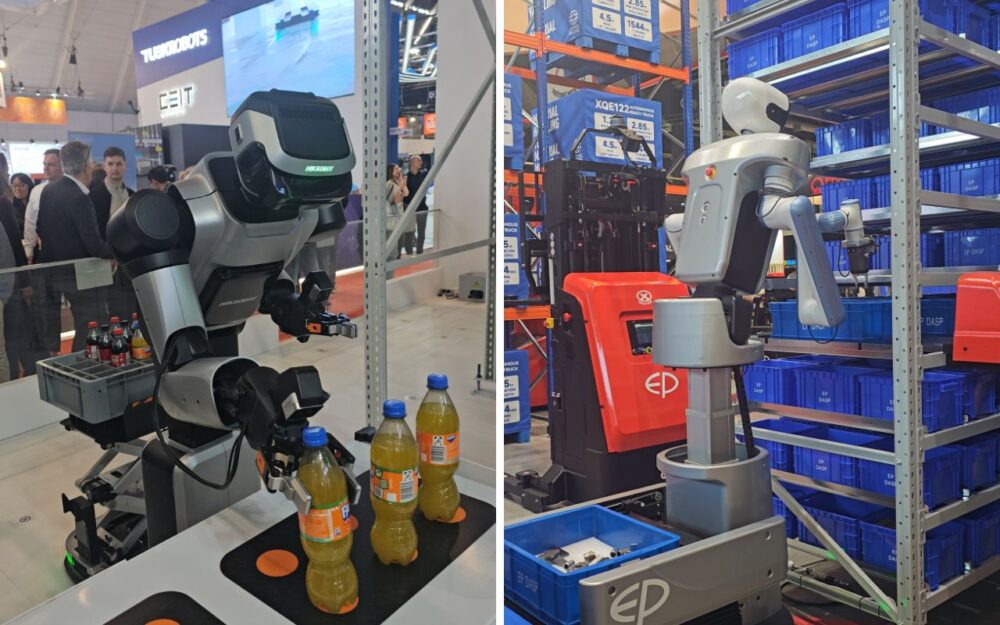
Hikrobot
At the booth of the Chinese manufacturer Hikrobot, a humanoid robot picks up and places bottles to demonstrate in real conditions how such a system can operate on a production line.
Hikrobot is already testing its humanoid robot in real industrial environments. While the LogiMAT demonstration featured bottle picking, the company is also working on applications involving the handling of industrial cameras for production lines, highlighting the robot’s versatility beyond simple tasks.
According to a representative at the booth:
“Over the next few months, we have a project using this type of humanoid robot in a factory that manufactures industrial cameras, where it will pick up the cameras and deliver them to the production line.”
EP Equipment
At the EP Equipment booth, a humanoid robot was fully integrated into a logistics solution designed for warehouse operations.
The robot is capable of picking small metal items and placing them into boxes, automating both inbound and outbound warehouse processes. According to Keven Ge, EP Equipment representative at the booth,
“it takes 25 to 35 seconds to move a box into position, with the full cycle, from picking to box placement, completed in 1 to 2 minutes.”
This dual-arm humanoid robot is equipped with magnetic grippers, making it particularly effective for handling metal parts. It can also adapt to other materials, such as cardboard boxes, by switching gripping tools.
Its humanoid form enables more natural movement and greater adaptability in unstructured environments. It can replicate human actions such as lifting, turning, and bending. But to improve efficiency, the robot’s torso can rotate 360° and can therefore quickly reposition itself without needing to turn its entire body.
According to the company, the robot is trained using AI and years of material-recognition data. Its key advantages lie in applications across manufacturing, spare parts logistics, pharmaceuticals, electronics, and any sector requiring the handling of small components or boxed goods.
A Marketplace for Humanoid Skills
One particularly surprising element came from a Spanish company. Aristeril, a Barcelona-based manufacturer of AGVs and AMRs, is taking a unique approach: creating a marketplace for humanoid skills. The company is leveraging its expertise in mobile robotics to integrate humanoid technology into its portfolio, working with Chinese manufacturers like Unitree and UBTech.
Aristeril’s strategy revolves around training humanoids to perform specific tasks, then offering these pre-trained skills in a marketplace. According to Sergio Gomz Esteban, sales manager,
“Our technology is to try to do a training center to teach these skills and then to make some kind of marketplace with these skills installed in different robots of different companies. To be like some kind of a common language and to move these from different robots of different companies.“
This allows companies to “download” skills, such as picking a box or performing pick & place, onto their own robots, regardless of the manufacturer.
To train the robots, Aristeril uses virtual reality (VR) and AI, recreating real-world environments where humanoids can learn by observation and repetition.
Labor Shortages and Aging Populations in Europe
So why were all these Chinese humanoid robots on the European market? While such robots are already deployed in numerous factories across China, take BYD, for example, which uses them extensively in its automotive plants, Europe has yet to see widespread adoption. Still, according to industry insiders, the potential on the continent is significant.
Europe faces two pressing challenges: a shrinking workforce and an aging population. Traditional automation solutions like AMRs address some of these issues, but humanoid robots promise to fill gaps where human-like dexterity is essential, for instance, picking small or irregularly shaped items, handling delicate materials, or working alongside human operators.
Murat Arpaci, CEO of Terra Robotics, explains the urgency:
“In Europe, labor costs are at least €40 per hour, and younger generations are less willing to take on the repetitive work that older employees used to do. We need automation to achieve the same, or even better, results than in the past.”
For sectors such as automotive, pharmaceuticals, and logistics, humanoid robots offer a flexible, scalable complement to existing automation systems. Arpaci also notes that the decision to distribute Chinese humanoids in Europe was driven by their proven success in China and the potential to replicate that story on the continent.
“One European customer is considering humanoid robots for simple pick-and-place tasks. If these prove effective, they plan to roll out 1,000 to 2,000 units across their twelve subsidiaries in Europe. Overall, this could translate into sales of 2,000, 3,000 robots for that single company.”
Hikrobot is also actively engaging European clients, especially in logistics, where labor-intensive operations are common:
“Our humanoid robots aim to reduce labor costs in factories and production lines. They are designed to move efficiently, perform repetitive tasks, and increase productivity. We’re seeing strong interest from European logistics companies that need additional workforce support. Our humanoids can help meet that demand.”
Spanish robotics company Aristeril echoes this perspective:
“We see new opportunities in logistics. Certain labor shortages can be addressed by robots, and our solutions offer clear operational benefits.”
You could also be interested in this story
KUKA’s Perspective: Task Over Form
What do traditional industrial robotics manufacturers think about humanoid robots? We spoke with KUKA, a global leader in the field, which offered a pragmatic counterpoint to the humanoid hype.
According to Jonas Micheler, head of marketing, the priority is function over appearance:
“It doesn’t matter what a robot looks like. What matters is the task it needs to perform. Our customers need robots that can handle a variety of tasks in diverse environments.”
KUKA addresses these challenges by combining mobile platforms with robotic arms, as seen in their KMR (KUKA Mobile Robotics) system. This setup delivers the same capabilities as a humanoid (mobility, vision, sensing, and manipulation) without requiring a human-like form.
“With KMR, we combine a mobile platform with robotic arms. The robot can move, perceive its surroundings, and manipulate objects—essentially performing the same tasks as a humanoid, just in a different form.”
At InterPack 2026, KUKA will showcase its Flex Robot: a cell combining three robotic arms with small payloads and two mobile platforms. Designed for pick & place, packaging, and assembly, it demonstrates that humanoid capabilities can be achieved without a humanoid appearance, leveraging KUKA’s decades of industrial expertise.
“The Flex Robot is our interpretation of a humanoid. It integrates multiple arms and mobile platforms with vision systems, fulfilling all the tasks a humanoid would—only it looks different.”
KUKA’s position is clear: humanoid form is unnecessary for most industrial applications. Their existing portfolio, backed by 50 years of robotics experience, already addresses the challenges that humanoid robots aim to solve.
“We are often asked why we don’t build humanoids. Our expertise is solving real industrial problems, and we can do that with the systems we already have. There’s no need to reinvent the wheel.”
For KUKA, the focus should be on automating as many tasks as possible, not on making robots look human. They acknowledge that humanoid robots do have a place, but it’s sector-dependent. In healthcare, for example, a human-like appearance can improve interaction and acceptance, especially among elderly patients. However, in industrial environments, appearance is irrelevant.
Geekplus: Modular, Packing-Focused Humanoids
At the Geekplus booth, humanoid robots are also considered, but only where they make practical sense. The company, a Chinese logistics solutions provider, is developing its first humanoid robot, scheduled for launch in 2027, designed exclusively for packing.
Marie Peterson, VP of Strategic Growth at Geekplus, explains the design rationale:
“We chose wheels instead of feet because, for packing, mobility is far more important than a humanoid form. The real goal is to automate packing, which is extremely labor-intensive and time-consuming in logistics.”
Industry Perspectives: Is It Just Hype?
Humanoid robots are still in the early commercialization phase, and for now, costs remain high. For example, Terra Robotics sells a UBTech robot for €190,000 per unit.
Yet, industry leaders at LogiMAT emphasized that major companies are investing seriously in humanoid robotics, not for publicity, but as part of long-term strategic plans. The convergence of AI, physical AI, and advanced hardware is accelerating development, positioning humanoids as a viable solution within the next 5 to 10 years.
Murat Arpaci of Terra Robotics explains:
“Big companies already have rollout strategies planned for 2031. This is not just hype, they are allocating substantial budgets to explore humanoid technology.”
Terra Robotics reports that, during just the first morning of LogiMAT, they collected around 30 business cards from industrial companies actively exploring humanoid deployments in their European facilities.
However, humanoids are still far from matching the scale and maturity of AMRs, which continue to dominate real-world logistics operations. The technology is promising, but widespread adoption will require continued refinement and integration into industrial workflows.