


This is Part 3 of DirectIndustry’s special reporting series Japan’s New Industrial Frontier. After reporting from factories across Japan, we step back to examine the macroeconomic, geopolitical and industrial forces that are reshaping Japanese companies‘ approach to Europe.
Dante Swift and Anna Igonina contributed to this report.

After five company visits across Tokyo and Osaka, we see different sectors, different products, but a common pattern: Europe is increasingly influencing how Japanese companies design, position and develop their technologies.
For FDK, Europe is a regulatory force shaping battery innovation. For Takiron, it represents a demanding market where precision engineering and reliability create value. TEAC sees opportunities in Europe’s fragmented industrial landscape, where specialized manufacturers need specialized suppliers. In Osaka, Muscle Corporation views Europe as a partner for technological collaboration, while Hasegawa sees standards and certification as the gateway to market entry.
What initially appears as a collection of individual corporate strategies is part of a broader industrial repositioning.
A Changing Economic Backdrop
That evolution comes at a particular moment for Japan’s economy. After years of sluggish domestic demand, Japanese exports have regained momentum. According to Japan’s Ministry of Finance, exports of goods exceeded ¥107 trillion in 2024 (€650-670 billion), driven largely by automobiles, industrial machinery, semiconductor manufacturing equipment, electronic components and precision instruments. Rather than competing on volume, Japan’s export profile remains concentrated in high-value industrial technologies.
The prolonged depreciation of the yen has significantly improved the competitiveness of Japanese manufacturers abroad. Contacted, GlobalData explains that the yen has weakened sharply through the first half of 2026, trading near JPY161–162 to the dollar and touching 40-year lows, driven by a widening rate gap between the Bank of Japan (policy rate raised to 1% in June 2026) and the US Federal Reserve (rate range 3.50%–3.75%), as well as Middle East conflict-driven inflation pressure (Bank of Japan, 2026; Reuters, 2026). Japan’s Ministry of Finance has intervened at least twice in 2026, including an estimated JPY5.5 trillion (€29.71 billion) operation on April 30. This follows an 8% depreciation against the dollar over the course of 2024 alone, according to the IMF’s 2025 Article IV assessment (IMF, 2025).
Rather than lowering export prices, many companies have maintained stable dollar- and euro-denominated prices while benefiting from a weaker domestic currency.
According to Marcel Thieliant, Head of Asia-Pacific at Capital Economics, this combination has pushed Japanese manufacturing profit margins to record highs, providing companies with greater financial capacity to invest internationally:
“The weak yen has clearly been very beneficial to Japan’s manufacturing sector, particularly the large firms that have the capacity to expand overseas. It has allowed Japanese firms to keep US$-export prices broadly stable in recent years, thereby staving off competition from China. At the same time, it has boosted revenues from overseas earnings in yen-terms. While it has lifted import costs, imports are typically only a fraction of sales and firms have generally been able to pass on higher input costs to their customers. Indeed, profit margins in manufacturing have hit record highs in recent years. Higher profits in turn have allowed Japanese firms to invest more overseas.”
Yet exchange rates alone cannot explain why so many Japanese manufacturers are looking specifically toward Europe. According to Ramnivas Mundada, Director of Economic Research and Companies at GlobalData, the weak yen should not be interpreted simply as an export advantage. Rather, it has created a more complex incentive structure for manufacturers:
“GlobalData does not view this as a simple case of a weak yen driving more outbound investment; it is more precisely an incentive to lock in production capacity in stable, high-value markets before further currency volatility erodes returns.”
That observation echoes what emerged repeatedly during our reporting trip. From FDK to Muscle Corporation, executives rarely described exchange rates as the main driver of their European ambitions. Instead, they portrayed Europe as part of a much longer-term industrial strategy.
Europe: From Export Market to Industrial Platform
However, trade patterns reveal a more nuanced picture. Asia remains by far Japan’s largest export destination by volume. According to Japan’s Ministry of Finance, the region accounts for more than half of the country’s merchandise exports. It is, unsurprisingly, the result of decades of integrated supply chains and regional manufacturing networks.
Europe, by comparison, represents a much smaller share of total trade (roughly 10% of total exports). Yet, its strategic importance extends well beyond its statistical weight. Every company we interviewed described Europe as a priority not because of its size, but because of its influence on regulation, engineering practices and global industrial credibility.
For many of these Japanese manufacturers, Europe has become a proving ground where future industrial standards are shaped, sustainability requirements emerge and long-term technological partnerships are built. They are not pursuing Europe because it offers the largest volumes. They are pursuing it because it rewards the capabilities that define Japanese manufacturing: precision engineering, reliability, regulatory compliance and long-term collaboration. GlobalData believes this represents a deeper structural transformation:
“This looks less like classic export diversification and more like Japan repeating, on European soil, the supplier-clustering strategy it built domestically decades ago: anchoring high-precision, high-trust component supply close to the end customer.”
That interpretation closely matches the strategies described by the manufacturers we met. FDK is redesigning batteries around European environmental legislation. Takiron views demanding European customers as a way to strengthen engineering capabilities worldwide. Muscle Corporation integrates European regulations directly into product development, while Hasegawa redesigned its voltage detectors around IEC standards before attempting commercial expansion.
The EPA Is Becoming an Industrial Tool
The EU-Japan Economic Partnership Agreement (EPA), which entered into force in 2019, has reinforced this dynamic. Five years later, official Japanese data already shows that around 73% of eligible Japanese exports were using EPA preferential treatment in 2024. This illustrates how deeply exporters have incorporated the EPA into their commercial strategies.
GlobalData points to another equally revealing indicator. According to JETRO’s latest survey, 58.5% of Japanese companies operating in the European Union now use the EPA when importing products from Japan, an increase of more than 13 percentage points in only one year.
For Ramnivas Mundada, from GlobalData, the speed of adoption says as much as the agreement itself:
“For a trade agreement that only entered force in 2019, that is a rapid rate of adoption, and it points to deepening structural integration rather than opportunistic exporting. The EPA utilization jump suggests Japanese firms increasingly see the EU less as a destination market and more as a production and regulatory-compliance zone they need to operate from within, not around.”
The composition of Japan’s exports to Europe reinforces the same conclusion. Unlike the consumer-electronics image associated with Japan during the 1980s and 1990s, today’s exports increasingly consist of industrial machinery, transport equipment, electrical machinery, electronic components, precision instruments and advanced materials. This is precisely where the companies we met operate. FDK, C.I. Takiron, TEAC, Muscle Corporation and Hasegawa are not consumer brands. They manufacture enabling technologies that compete on engineering performance rather than production volume.
According to Daisuke Shiga, Deputy Director at the Japan External Trade Organization (JETRO) (read the full interview here),
“Europe has become increasingly important because of its leadership in sustainability policies, advanced regulatory frameworks and strong demand for high technologies. Compared with a few years ago, Japanese companies increasingly see Europe not only as a market, but also as a partner for innovation.”
That distinction is important. The EPA is no longer simply reducing tariffs. It is facilitating the integration of Japanese manufacturers into European industrial ecosystems.
Innovation Is Following the Same Path
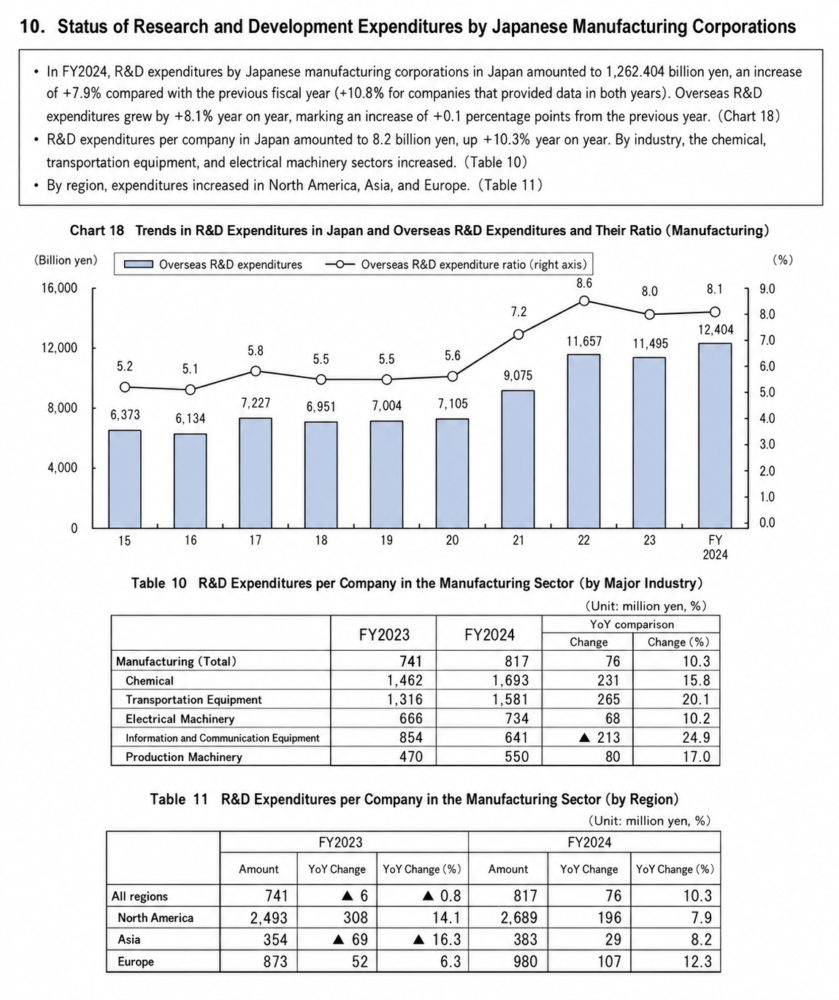
Trade is not the only indicator pointing toward Europe. Innovation itself increasingly follows the same trajectory. According to Japan’s Ministry of Economy, Trade and Industry (METI), overseas R&D expenditure by Japanese manufacturing affiliates reached ¥1.24 trillion (€6.70 billion) in fiscal year 2024 (an increase of 7.9% compared with the previous year). Overseas R&D now represents 8.1% of total manufacturing R&D spending, continuing a long-term upward trend.
More revealing still is where that investment is taking place. According to data from the Overview of the 55th Basic Survey on Overseas Business Activities (FY2024 Results), conducted as of July 1, 2025, by Japan’s Ministry of Economy, Trade and Industry (METI), to which we obtained access, Europe recorded the strongest increase in overseas R&D spending by Japanese manufacturers in 2024, rising 12.3% year on year. This compares with increases of 7.9% in North America and 8.2% in Asia, although North America remains the largest destination in absolute terms. This suggests that Japanese manufacturers are increasingly locating part of their innovation effort closer to the markets that influence future technologies and industrial standards.
Again, the trend mirrors what emerged repeatedly during our reporting trip. FDK is redesigning batteries around European sustainability legislation. Takiron sees European customers as a benchmark that strengthens its engineering capabilities. Muscle Corporation incorporates European regulatory requirements into product development, while Hasegawa is redesigning electrical safety equipment around IEC standards before commercializing it. Europe is therefore influencing Japanese industry not only through exports, but increasingly through the way technologies themselves are conceived and developed.
Supply-chain Resilience
The move toward Europe is also part of a broader reassessment of global industrial risks. This trend is not unique to Japan. Geopolitical tensions, trade uncertainty and concerns over excessive dependence on a limited number of regions are prompting manufacturers worldwide to rethink their international footprint and build new partnerships, explains Shiga-san,
“Geopolitical tensions and supply chain disruptions are accelerating diversification strategies among Japanese companies. Europe is increasingly seen as a stable and strategic region where companies can mitigate risks and build more resilient supply chains.”
Recent data suggest this reassessment is already underway. JETRO has already observed that more than 23% of Japanese companies operating in Europe are actively reducing procurement from China, while roughly one-third of Japanese companies with overseas operations are reviewing their global supply-chain strategies. GlobalData sees this not as a simple “China+1” strategy but as something more structural, details Ramnivas Mundada:
“Japanese firms are not simply chasing EU customers; they are rebuilding supplier redundancy on EU soil.”
Investment flows point in the same direction. According to Capital Economics, Japan’s outward foreign direct investment (FDI) has climbed to around 5% of GDP, the highest level in decades. Even more strikingly, Europe overtook the United States as the largest destination for Japanese outward FDI in 2025 for the first time since 2019. For Marcel Thieliant, the timing is unlikely to be accidental:
“It’s perhaps no coincidence that Donald Trump was president from 2016-2020, when Japan invested more in Europe than in the US. His return last year may have made Europe once again more attractive given the highly erratic nature of his policymaking and the fact that the import tariffs launched by him increased costs of imported components for Japanese subsidiaries operating in the US. And given that the sales of Japan’s overseas subsidiaries in China are shrinking rapidly due to intense local composition, they need to be looking elsewhere.”
Yet these figures require careful interpretation. Annual FDI flows can fluctuate significantly from one year to the next and do not necessarily signal a lasting strategic realignment. For example, surveys conducted by the Japan Bank for International Cooperation (JBIC) and the Development Bank of Japan (DBJ) still rank the United States and several Asian economies including India, Vietnam, Thailand and China ahead of most European countries as preferred long-term investment destinations.
Marcel Thieliant points out that,
“In JBIC’s latest survey on the attractiveness of overseas business, Germany ranks only 12th, France 13th and the UK 16th.”
But if Europe is neither Japan’s largest export market nor its preferred investment destination according to corporate surveys, why did virtually every manufacturer we interviewed describe Europe as strategically indispensable? The answer lies in the role Europe plays rather than in its size. Europe is not replacing Asia as Japan’s manufacturing base, nor is it becoming the country’s largest export destination.
Throughout our reporting trip, companies rarely presented Europe as their largest commercial opportunity. Instead, they described it as the market where technologies are validated, products are adapted to the world’s most demanding regulatory frameworks, and long-term industrial partnerships are built. Europe functions less as a destination for volume growth than as a platform for technological credibility.
That distinction also helps explain why companies from such different sectors all converge on remarkably similar strategies. Their objective is not simply to sell more products in Europe, but to strengthen their global competitiveness by succeeding in one of the world’s most demanding industrial environments.
As Ramnivas Mundada concludes:
“Japan’s industrial engagement with Europe has moved beyond opportunistic export activity into a more deliberate phase of structural anchoring, concentrated in sectors where precision, reliability and regulatory compliance command a premium over price.”
For him, robotics and industrial automation offer the strongest evidence of this shift. And he believes the weakening yen and intensifying China de-risking both point toward continued, selective deepening of Japan’s European footprint through 2026 and beyond.
Looking Ahead: The Institutions Behind the Strategy
The macroeconomic picture explains why Europe is becoming increasingly important. Trade patterns, foreign investment, overseas R&D and supply-chain diversification all point toward the same conclusion: Japanese manufacturers are anchoring themselves more deeply within Europe’s industrial ecosystem.
But companies rarely navigate this transformation alone. Behind every successful market entry stands an extensive support network of trade agencies, SME organizations and international business specialists helping manufacturers overcome regulatory barriers, identify partners and build visibility.
Our final reporting stop takes us back to Tokyo to meet the organizations orchestrating this quiet industrial diplomacy.
In Part 4: Inside Japan’s Export Machine: How an Entire Ecosystem Supports Expansion into Europe