

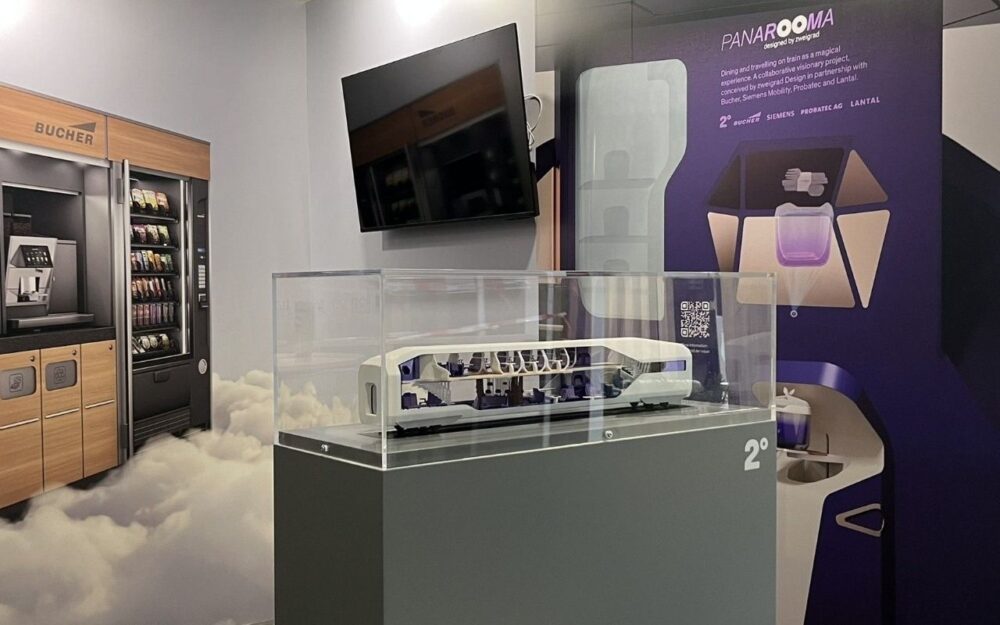
At InnoTrans 2026, a consortium led by zweigrad Design, Bucher Group and Siemens Mobility presented a new take on the restaurant dining car. Automate almost everything passengers never see, from cooking to waste disposal, so that the people on board can focus on hospitality. Nicole Scott reported from Berlin.
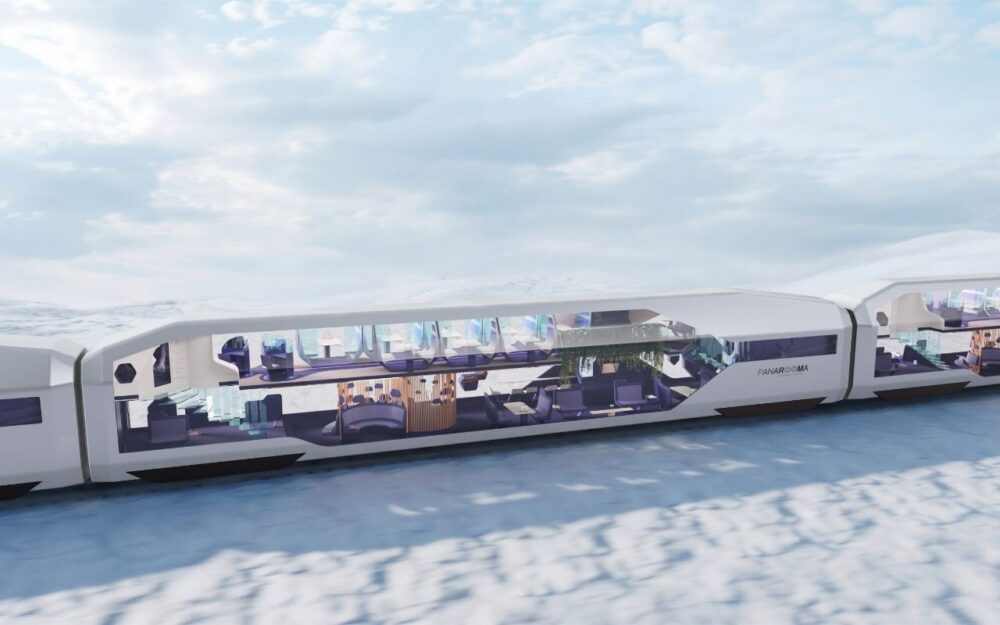
Panarooma is a design concept for a double-decker restaurant car that works less like a traditional dining car and more like a lounge built around a kitchen. Passengers choose between private booths, seats at a panoramic bar and quiet, screened workstations. It is designed for rail travel in 2035.
Restaurant cars are expensive to staff, and staff are getting harder to find. Panarooma’s answer is to move most of the work out of sight. zweigrad says it needs one host, where today’s dining cars need up to three employees.
Personalization starts at the door. Check-in is automatic, and preferences, controlled from passengers’ own devices or furniture interfaces, follow them through the journey. The AI won’t even offer dishes that clash with known allergies. And a “Needs Dot” throughout the carriage calls up the assistant when the host is busy.
A Galley That Runs Itself
At its core is a fully automated, two-deck galley co-developed with Bucher Group. This Swiss company has built lightweight aircraft galleys since 1953. Meals are precooked and sealed in purpose-built MealPods, each with a battery-powered heater in its base that the AI switches on in the galley so food arrives at serving temperature.
Most pods ride the “Food Lanes,” a delivery rail in the floor that works like a sushi conveyor belt. Except that each MealPod goes only to the seat that ordered it. A lift then raises the illuminated bowl through the table, turning service into a small ritual. Service robots cover the open lower-deck lounge, which has no Food Lanes, and handle overflow at peak times. For hygiene, one delivers meals; another collects dishes and waste.
Aircraft galleys are built around weight, fire safety and constant motion, with every insert locked against turbulence. A braking, cornering train poses many of the same problems. Bucher’s current train kitchen still needs a crew member to stock the fridges, load the steamer, make the coffee and empty the waste. Panarooma’s galley is designed to do it without one.
Bucher CEO Beat Burlet calls Panarooma,
“the natural evolution” [of its onboard catering work], “intelligent kitchen technology and self-service solutions that reduce the workload for staff while still delivering a premium, personal guest experience.”
Robots, Self-Service or No Bistro at All
We’re starting to see robots working on trains. Since June 2026, Vietnam Railways has been trialling a commercial restaurant delivery robot in the VIP carriage of its Red Flamboyant service between Hai Phong and Hanoi. It greets passengers, guides them to their seats and brings food and drinks to tables, working alongside the carriage’s single attendant. In a region where labor is cheap the KettyBot Pro is a tourism draw not a cost savings measure.
Europe is different. As with airline catering, rail meals are largely prepared off the train and reheated on board, because a train kitchen has little space and must absorb delays and swings in demand. Deutsche Bahn serves more than 18 million guests a year this way, and says the service barely pays for itself. DB has withdrawn the bistro cars from its classic Intercity trains and is replacing freezers with conventional fridges. As the dining car is already a reheating operation, automating its logistics is a smaller leap than it looks.
DB isn’t alone. SNCF has chosen self-service. On its next-generation TGV M, the lower deck of “Le Bistro” will work like a small supermarket, with self-service fridges, automatic payment terminals and microwaves, while an attendant restocks and advises. SNCF moves the logistics to the passenger. Panarooma moves them to machines.
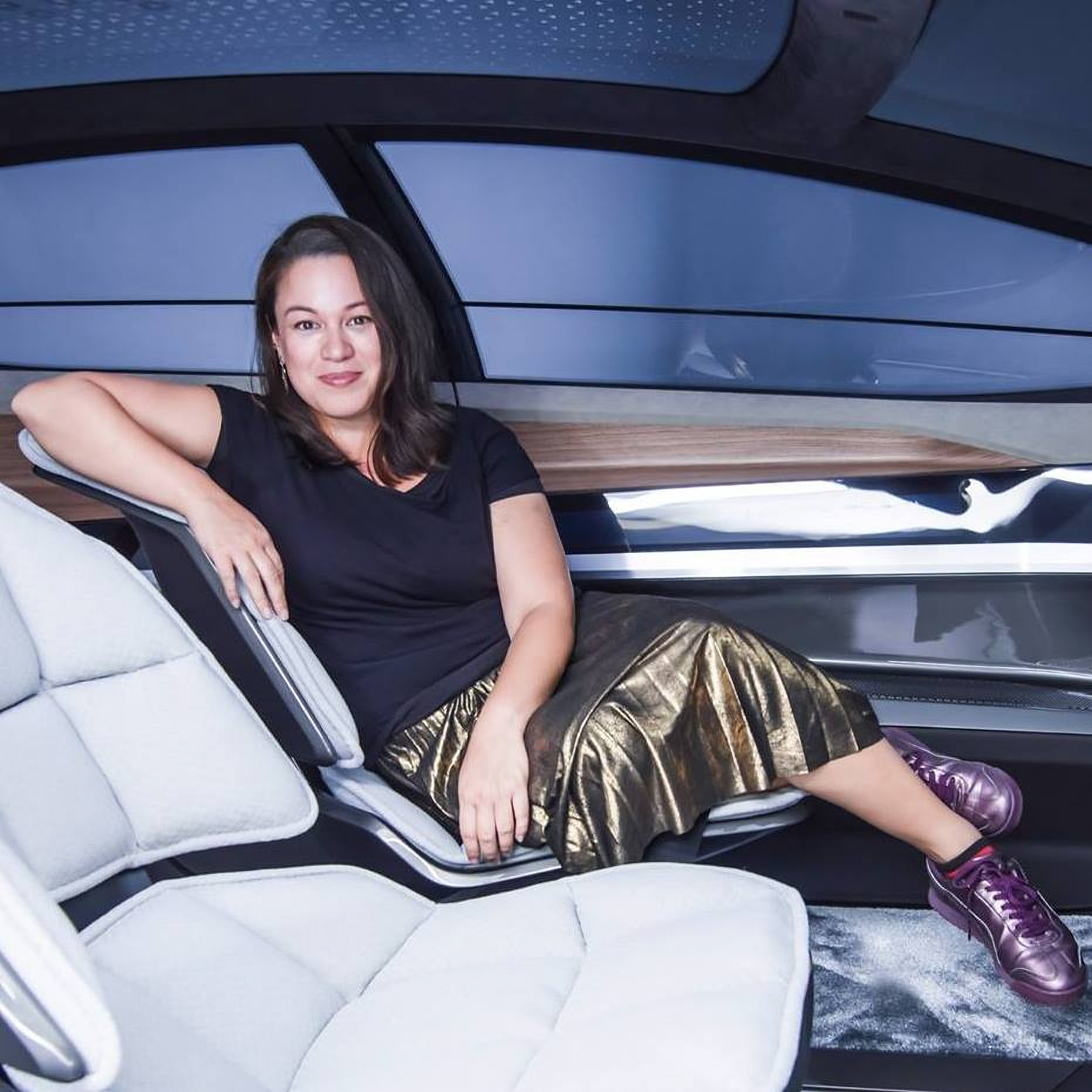
The EU wants high-speed rail traffic to double by 2030 compared to 2015. Rail has long competed on speed and price, but for zweigrad founder Birte Jürgensen:
“the real differentiator is the quality of the travel experience.”
If the journey itself delights, she argues, passengers will be far more willing to leave the car at home. If the industry makes full use of that potential, rail could become
“not only the most environmentally friendly, but also the most attractive way to travel.”
Panarooma was developed by zweigrad Design, Bucher Group, Siemens Mobility, Swiss textile maker Lantal and Bavarian seating and table manufacturer Probatec. Siemens contributed vehicle architecture and engineering and 3D-printed the 65-centimeter, 1:45-scale model shown at InnoTrans. It is still a concept, with no operator or price announced.