

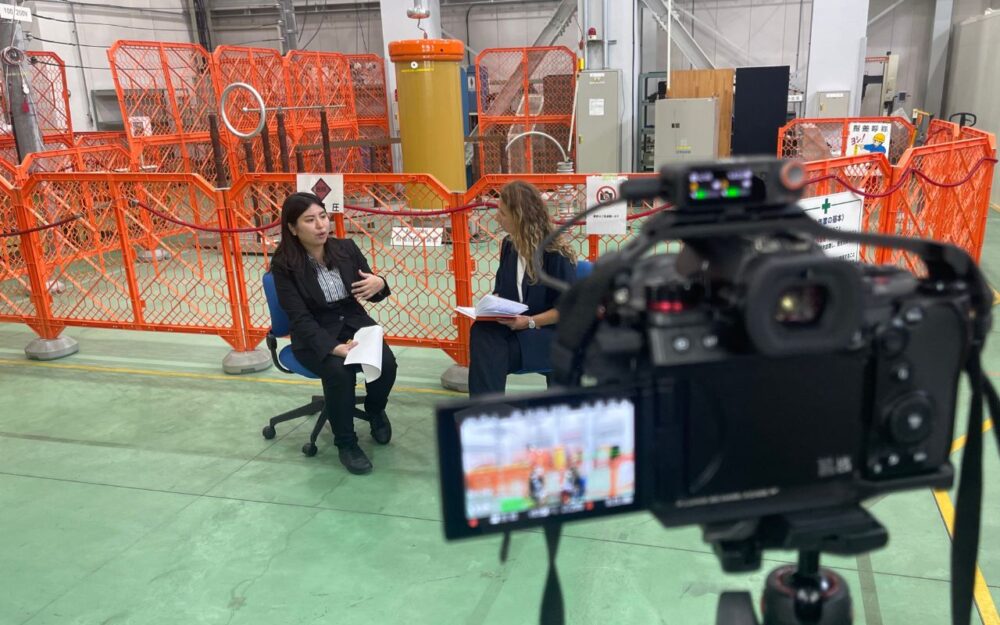

During a reporting trip across Japan, DirectIndustry met with industrial manufacturers, technology providers and export support organizations to better understand why Europe is becoming an increasingly strategic market for Japanese industry. For this episode, we met with Ayaka Maeda, International Sales Manager at Hasegawa Electric Co, manufacturer of electrical safety equipment. She explains why the company has recently turned its attention to Europe for the first time.
As global geopolitical tensions and supply chain disruptions reshape industrial strategies, Japan and Europe are strengthening their economic ties around shared priorities: innovation, green technologies and long-term industrial cooperation. For Japanese companies, Europe represents not only a major market, but also an ecosystem for collaboration and technological development.
Among the companies preparing this next stage of international expansion is Hasegawa Electric Co., a manufacturer specializing in electrical safety equipment. For nearly a century, the company has supplied Japanese power utilities, railway operators and industrial customers with high-voltage detectors and customized safety solutions designed for demanding working environments.
Unlike many manufacturers that develop standardized products, Hasegawa has built its reputation on working directly with end users, visiting worksites, understanding operational challenges and adapting its products to specific field requirements. Now, after establishing a dominant position in Japan, the company is preparing to enter Europe by developing products compliant with IEC standards and adapting its technology to European regulations.
In this interview, inside the company’s factory in Osaka, Ayaka Maeda of Hasegawa explains why Europe has become a strategic priority, the challenges of adapting Japanese products to European standards, and how nearly 100 years of experience working alongside Japan’s power and railway industries could become a competitive advantage in European markets.

Could you introduce Hasegawa and explain what is manufactured at this facility?
Ayaka Maeda: “Hasegawa Electric was founded in 1925 and specializes in electrical safety equipment, particularly voltage detectors used by professionals working around live electrical installations.
This facility includes a full-scale testing environment that closely replicates real power infrastructure. The testing utility poles are built at approximately two-thirds the size of actual utility poles and are capable of simulating Japan’s AC 6.6 kV distribution lines and AC 22 kV transmission lines. In addition, our high-voltage testing equipment is among the largest in Japan and enables dielectric withstand tests at voltages of up to AC 300 kV. This enables us to verify the performance and safety of our products under conditions that are very close to those encountered in the field.”
Who are your main customers?
Ayaka Maeda: “Our primary customers are electric power utilities, railway operators and construction companies. They rely on our products to ensure the safety of workers operating near energized electrical equipment.”
Hasegawa is a market leader in Japan. What has allowed the company to build this position?
Ayaka Maeda: “One of our biggest strengths is our approach to customization. Every customer faces different challenges. Some know exactly what kind of product they need, while others only know that they have a problem but are unsure how to solve it. In those cases, we visit their sites, observe how they work, identify potential improvements and develop products specifically adapted to their needs. This close collaboration is one of our key differentiators. Many suppliers simply manufacture products based on customer specifications, whereas we spend time understanding real working conditions before proposing a solution.”
How customer feedback has directly influenced product development?
Ayaka Maeda: “For example, one power utility told us that workers could not clearly hear the alarm on a voltage detector in noisy environments. Rather than simply replacing the product, we visited the site, observed the conditions and redesigned the alarm so it could be heard over longer distances and in more challenging environments. This kind of field-based development allows us to continuously improve our products based on actual customer needs.”
Why has Europe become a strategic priority for you?
Ayaka Maeda: “Over the past several years, we have expanded into markets across Asia, India and the Middle East. Europe is our next major objective because it represents one of the world’s most advanced industrial markets. There are many strong competitors there, but we believe it is an important step for our company.
We already hold the leading market position in Japan, but until recently we did not have products designed according to IEC standards, which are essential for Europe. Now that we have developed IEC-compliant products, we are ready to enter the European market.”
How challenging is it to adapt products to European standards?
Ayaka Maeda: “It has been very challenging. Japanese and European electrical standards are significantly different. Many of the testing methods and certification requirements used in Europe simply do not exist in Japan. To serve European customers, we had to develop products specifically designed to comply with IEC standards, which required substantial engineering and testing work.”
Do you also expect to adapt your products to European customer needs?
Ayaka Maeda: “We expect to customize products for European customers just as we do for customers in Japan. For example, voltage ranges differ from one country to another, so our detectors must be adapted accordingly. Customers may also request different colours to improve visibility or comply with their own internal safety procedures. Customization has always been part of our business model, and that will continue in Europe.”
What are your expectations for the European market?
Ayaka Maeda: “Our first objective is to establish a presence in Europe and build long-term relationships with European customers. Another reason Europe is strategically important is that IEC standards are widely adopted in many other regions around the world. By developing products for Europe, we also strengthen our ability to serve customers in other international markets.”
What are your strenghts on the European market?
Ayaka Maeda: “Our biggest advantage is our experience. For almost 100 years, we have worked directly with Japanese electric utilities, railway operators and industrial companies. This has allowed us to accumulate a great deal of practical know-how. Rather than simply manufacturing products, we work alongside customers in the field, understand their operational challenges and develop customized solutions. We believe this customer-oriented approach will help differentiate us in Europe.”
Are you focusing on specific European countries
Ayaka Maeda: “At this stage, we are looking at Europe as a whole. In Japan, our main customers have traditionally been power utilities and railway companies. In Europe, however, we also see significant opportunities in manufacturing and industrial facilities, so factories will likely be one of our initial target markets.”
How is today’s geopolitical environment influencing your international expansion?
Ayaka Maeda: “Rising transportation costs, particularly shipping routes through the Middle East, have increased logistics expenses. However, we believe our competitive position remains strong. Some lower-cost suppliers cannot always provide consistent product quality, while many European products are positioned at a higher price point. Our objective is to offer Japanese quality at a competitive cost, making Hasegawa an attractive alternative despite higher transportation costs.”
Railways are one of your markets in Japan. What can you bring to the European rail industry?
Ayaka Maeda: “Entering Europe represents an important milestone for our company. We have spent decades developing products together with Japanese railway operators and have accumulated extensive expertise in this sector. We hope to bring that experience to Europe while introducing European customers to the quality and reliability associated with Japanese manufacturing.”
Are trade fairs part of your European expansion strategy?
Ayaka Maeda: “Yes. Our target markets extend beyond railways to include power utilities, construction companies and industrial manufacturers. Trade fairs will be an important first step in understanding the European market and meeting potential customers. At the moment, we are considering exhibiting at A+A in Germany next year.”