


Here’s a quick but important observation: manufacturing has always depended on specialization. The ability to understand a material, master a process and consistently achieve demanding tolerances is built over years, sometimes decades. In advanced manufacturing, where applications are becoming more complex and performance requirements more exacting, that depth of expertise is arguably more important than ever. This is what Marino Chiappa, Division Director – Advanced Materials & Plastic at CMS explains in this article.
But specialization can also become a constraint if it leads us to view every production challenge through the lens of a particular technology. For me, the challenge for manufacturers is therefore to achieve specialization without rigidity. Or rather, retaining deep process and application expertise while remaining flexible enough to select, combine and adapt technologies according to an application’s actual requirements.
To use a musical analogy, think of legendary rock band, The Who. Keith Moon, John Entwistle and Pete Townshend each had an unmistakably individual approach. But it was the particular way those different strengths combined that created the band’s distinctive sound. Advanced manufacturing demands the same principle. Individual technologies need to excel at what they do best while working effectively with others.
The Changing Conversation
Historically, conversations between manufacturers and technology suppliers often began with a relatively defined requirement. A customer needed a machine to carry out a particular operation. Today, the starting point is more likely to be the manufacturing challenge itself. Customers are now under immense pressure to respond more quickly to their own markets. Development cycles are becoming shorter, design modifications can occur more frequently and future demand is sometimes unpredictable.
For a technology supplier, this changes the conversation. Before recommending a solution, we need to understand what the customer intends to manufacture, the material involved, required tolerances, production volumes and subsequent operations. We also need to understand the production capabilities the manufacturer already has. Only then can we determine the appropriate technology. Or, more often in the modern manufacturing ecosystem, combination of technologies.
This application-led approach is particularly relevant as the range of advanced manufacturing processes available to industry expands. Five-axis machining, AM, waterjet and ultrasonic cutting, thermoforming, robotics and automation all offer different capabilities. However, it would be a mistake to assume that one must necessarily replace another. Very often, much like the guys in The Who, their greatest value is realised when they complement each other.
From Competing Technologies…
Large-format AM provides a good example. Additive and subtractive manufacturing have sometimes been discussed as competing approaches. Yet the reality is that, for many industrial applications, they perform very different and highly complementary roles.
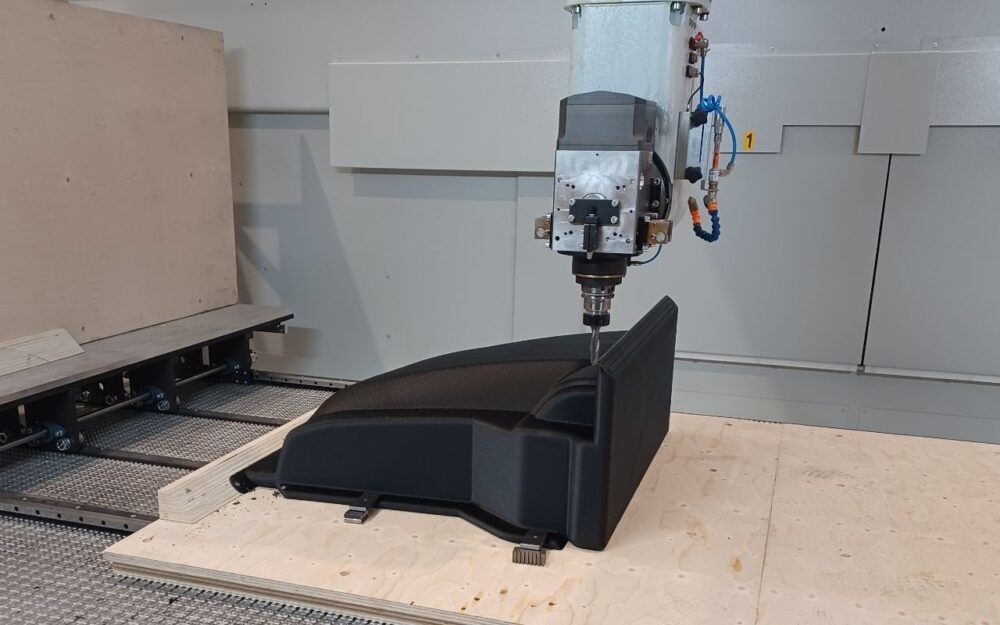
Large-format AM can also rapidly create an object close to its final geometry, providing geometric freedom while reducing the amount of material that needs to be removed. Five-axis machining can then provide the tolerances and surface quality required of the finished application, with polishing or other finishing processes following where necessary. The question then becomes how those processes should be configured.
For some applications, printing and machining within the same work envelope can reduce handling and setup, particularly with very large components. Elsewhere, a manufacturer that already possesses suitable milling capacity may gain more from a separate additive system. Robotic AM may offer another route.
The fact is that, when you look at it, there isn’t one universally correct architecture. Because there isn’t one universally identical manufacturing requirement.
Of course, this principle isn’t confined to large-format additive. US pattern-making specialist Liberty Pattern, for example, uses sand 3D printing alongside conventional foundry tooling. They retain hard tooling where it remains most economical while printing complex internal cores that are difficult to produce by conventional means.
…to Complementary Processes
This also changes the nature of manufacturing expertise. Knowing how to operate and optimize an individual process remains essential. But competitive advantage comes from understanding the relationships between processes. Where one technology’s strengths compensate for another’s limitations and how multiple operations can be integrated efficiently. Decisions made during design affect materials, process selection, machining requirements, automation and finishing. But treating these as isolated considerations can mean opportunities for efficiency or flexibility are missed.
That thinking should extend to investment decisions. The most advanced machine is not automatically the best investment if it duplicates an existing capability or fails to integrate effectively with the wider production environment. Often, greater value can come from adding a technology that performs a particular role exceptionally well and complements the equipment already in place.
Flexibility Has Commercial Value
This approach becomes particularly important as manufacturers contend with compressed timescales. Speed is often understood simply in terms of cycle time, i.e. producing a component faster. But there is another form of speed that is ever-more important: the speed with which a manufacturer can respond to a new requirement. Can a design modification be accommodated without a lengthy tooling process? Can a new solution be tested and moved into production quickly? And lastly, can the business economically accept a project that would previously have been impractical?
Evidently, the economics surrounding a process can be as important as its headline production rate. This is because reducing tooling lead times or accommodating late-stage design changes may have significant commercial value. Even where those benefits aren’t captured by a straightforward comparison of machine cycle times.
Material efficiency can change that calculation too, particularly as components increase in scale. This is evidenced in a project by a customer of ours that involved a calibration tool associated with aircraft-skin machining which measured more than 2 meters across and weighed 220 kg. By using large-format AM to build the required geometry rather than relying on a predominantly subtractive route, the application achieved a reported material saving of more than 80%.
The same principle applies more broadly. Manufacturers now need to evaluate technology according to what it enables the business to do. Rather than simply what the machine itself can do.
A Growing Industrial Maturity
When CMS entered this market in 2018, large-format additive was still associated strongly with prototypes and design objects. Its potential for tooling, moulds and patterns was recognized, but industry was still establishing where the technology could make a real, repeatable commercial impact. Since then, materials, software and processes have developed considerably. The range of fibre-reinforced thermoplastics has expanded, understanding of process parameters has improved and software provides greater control over areas such as material management, temperature and deposition strategy.
Evidence of this growing industrial maturity can be seen in aerospace, where BAE Systems has used carbon-fibre-reinforced PEI for high-temperature mold tooling, with a tool reportedly completing more than 250 autoclave cycles without degradation.
The future opportunity for AM lies in becoming more closely connected with machining, robotics, automation and software, rather than existing as an isolated production technology. In composites, for example, there is potential to integrate additive into final-part manufacturing through approaches such as lower-cost sacrificial tooling or cores used alongside automated fibre placement.
Manufacturing Beyond Technology Labels
Over the coming years, manufacturing will undoubtedly become more automated and software-driven. Digital twins will enable a greater number of processes to be simulated before physical production begins, while data and AI will support process control and decision-making.
Yet these technologies will not remove the need for manufacturing expertise. They make the ability to apply that expertise across different processes even more important.
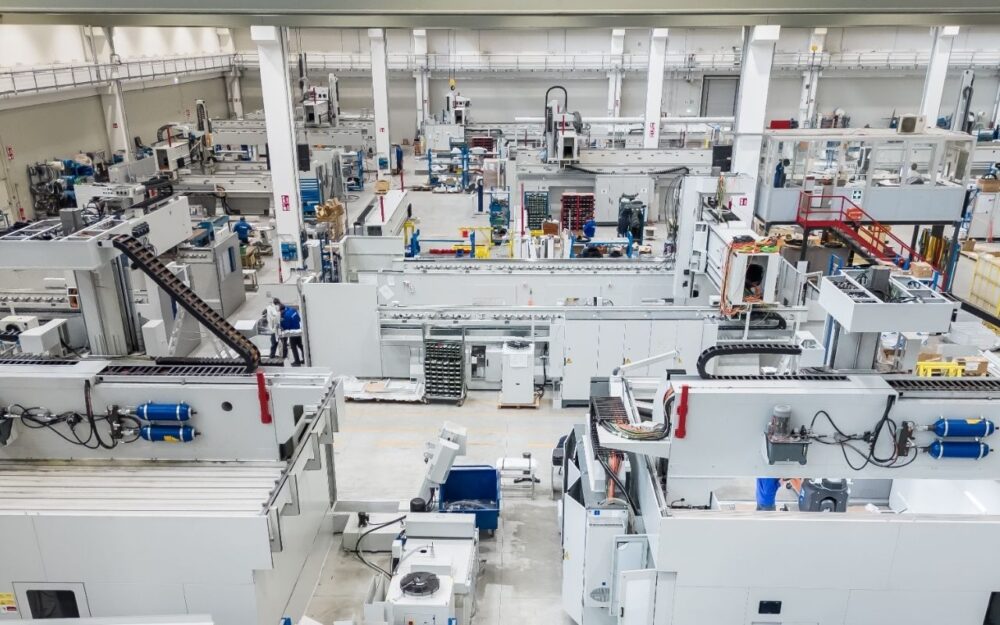
For me, the successful factory of the future will be defined less by the individual technologies it possesses than by how effectively it connects and deploys them. The competitive advantage will lie in being able to configure the right route to production and adapt that route as requirements change.