


This is Part 1 of DirectIndustry’s special reporting series Japan’s New Industrial Frontier. Over two weeks in June, DirectIndustry travelled from Tokyo to Osaka, visiting manufacturers, public agencies and export specialists to understand why Japanese industrial companies are increasingly looking toward Europe, not simply as an export destination, but as a market reshaping product development, industrial investment and long-term strategy.
Dante Swift and Anna Igonina contributed to this report.

Japan’s New Industrial Frontier
Japan’s New Industrial Frontier is a special reporting series produced by DirectIndustry after travelling across Japan, from Tokyo to Osaka, to meet manufacturers, export agencies and industrial experts. Across 4 episodes, we investigate why Japanese industrial companies are increasingly looking toward Europe. And what this strategic shift reveals about the future of global manufacturing.
When SoftBank Group announced plans to invest up to €75 billion in AI data centers in France, structured around 5 gigawatts of computing capacity, at the beginning of June, the scale alone made headlines around the world. But beyond its financial dimension, the announcement raised a broader question. Was this simply another high-profile investment by one of Japan’s largest technology groups, or the visible sign of a deeper shift in Japan’s industrial strategy toward Europe? Because, if Japan’s most aggressive technology investor is anchoring itself in Europe at this scale, what does it imply for the rest of Japanese industry?
To find out, DirectIndustry travelled across Japan, from Tokyo to Osaka, to meet manufacturers, technology companies and the public organizations supporting their international expansion.
The objective: to understand why, in a shifting geopolitical landscape, these companies are making Europe a strategic priority, and how they are doing so in practice. We looked at the innovations they highlight, the arguments they put forward against global competition, and the adaptations they accept in response to Europe’s regulatory complexity.
Over several days of interviews, a consistent message emerged. Whether they produce servo motors, advanced batteries or precision components, many Japanese industrial companies are no longer looking at Europe simply as an export destination. They increasingly see it as a strategic partner for long-term growth.
Lost in Translation

Tokyo, mid-June. Twenty-seven degrees, with a typhoon warning looming over the capital.
I have just arrived after a twelve-hour flight, during which I was lucky enough to see Mount Fuji from above. It is probably its own way of welcoming me to Japan. I know how rare it will be to see it so clearly again from the ground. At this time of year, the mountain often plays hide and seek beneath heavy summer clouds.
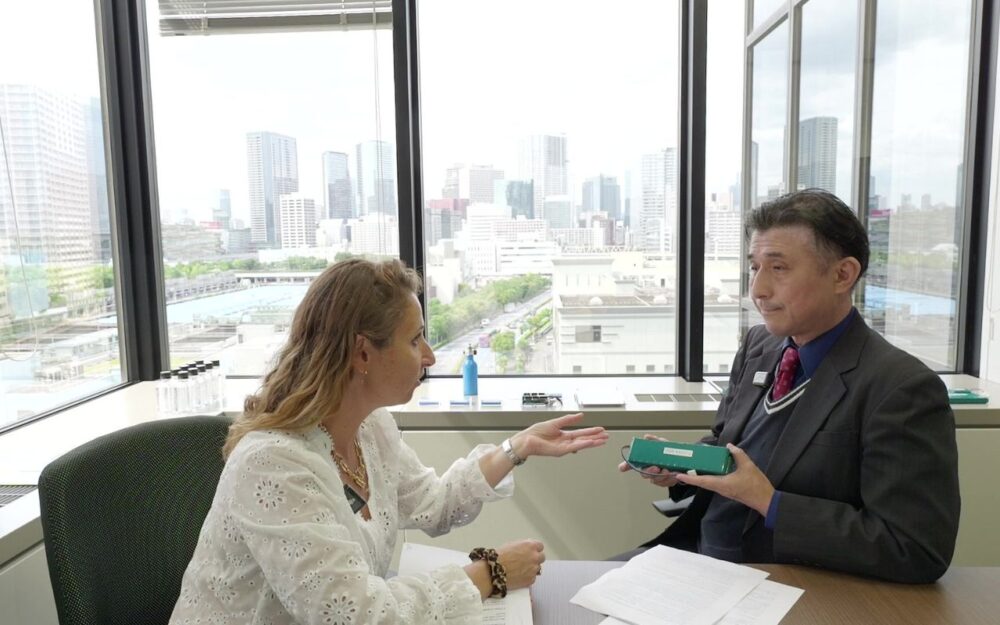
I meet my colleagues Anna Igonina and Dante Swift (respectively business manager /partnership coordinator and marketing strategist at our publisher VirtualExpo) in Shinagawa, in the heart of Tokyo’s industrial corridor. They both arranged for me an interview with Ichiro Torii, Manager Business Development at FDK Corporation, a long-established Japanese manufacturer of batteries and electronic components (read the full interview here).
FDK: Reliability, Regulation and the European Standard Effect
Founded over 70 years ago, FDK has evolved from manganese dry batteries into a diversified battery and electronics group covering nickel-metal hydride (NiMH), lithium, alkaline and next-generation solid-state technologies. While their NiMH batteries allow to maintain stable performance under extreme conditions, their lithium systems are designed for long operational lifetimes in remote infrastructure.
Across all product lines, the company’s priority is to ensure reliability in mission-critical environments. But for Ichiro Torii, Manager Business Development, the defining shift now comes from Europe itself:
“Europe is a globally influential market that defines standards in reliability, environmental compliance and product quality. Companies in this region demand high performance, highly reliable components, especially for applications related to infrastructure, mobility and sustainability.”
The company is therefore actively aligning its roadmap with European regulation, including the EU Battery Regulation (2023/1542), and the REACH Regulation, and developing PFAS-free solutions:
“Europe is leading the way in areas such as environmental impact reduction, regulation of hazardous substances (including PFAS), recycling and the circular economy. So, we are bringing high-reliability, environmentally responsible battery solutions fully aligned with Europe’s strict regulatory and sustainability requirements. For example, we are actively promoting PFAS-free nickel-metal hydride batteries.”
For the company, this regulatory pressure is seen as a structural driver of innovation. In fact, FDK is expanding into next-generation technologies such as all-solid-state batteries and ultra-compact Bluetooth modules, positioning itself in IoT and embedded applications. These are segments where European demand for high-reliability, low-footprint and regulation-compliant components is particularly strong.
FDK’s growing focus on Europe is also linked to broader geopolitical shifts. Supply chain instability, currency fluctuations and rising uncertainty are accelerating diversification strategies. For Ichiro Torii, this is a structural opportunity:
“While global demand has expanded due to electrification and digital infrastructure development, factors such as currency fluctuations and strong price competition previously made overseas expansion more challenging. However, recent trends, such as the depreciation of the yen and increasing concerns over supply chain concentration, are changing the landscape. More customers are now seeking to diversify their sourcing strategies to reduce geopolitical risk, rather than relying on a single country. We see this shift as a major opportunity.”
As a result, for him, Europe is becoming a central pillar of the company’s international expansion strategy.
This logic of adaptation to European industrial constraints is not unique to batteries. It reappears, in a very different technical domain, as we move further across Tokyo’s industrial landscape.
C.I. Takiron: Precision Motion and Europe-Facing Applications
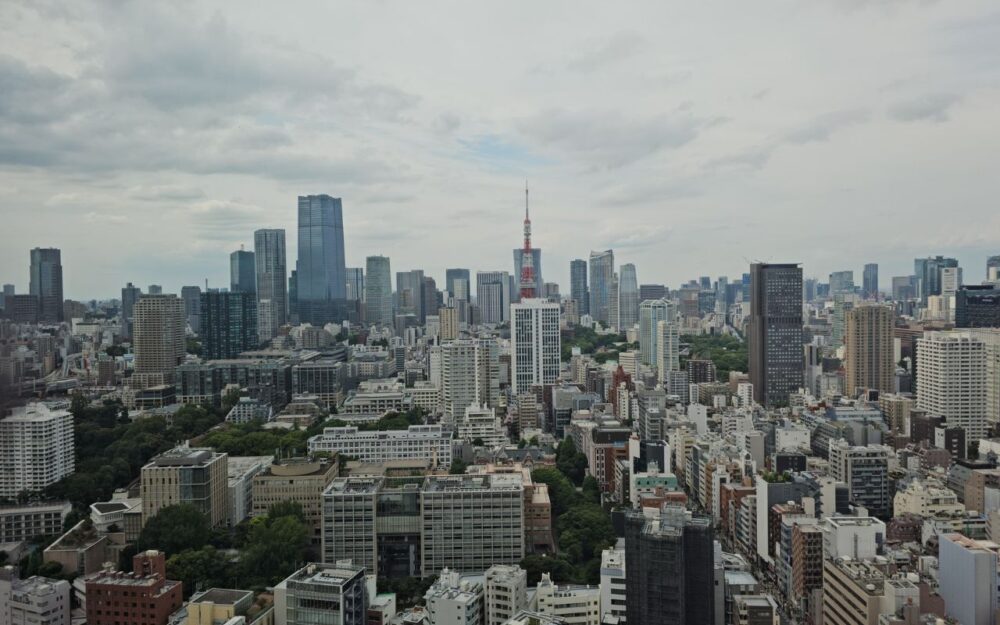
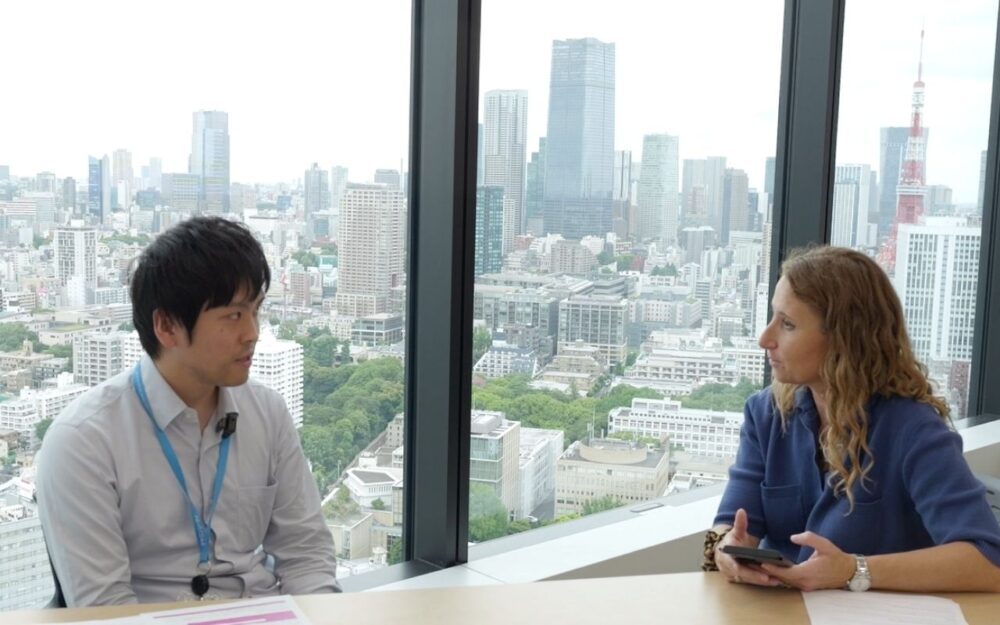
We are now on the twentieth floor of a Tokyo office tower. C.I. Takiron‘s headquarters offer a striking view over Tokyo Tower, a reminder of how closely Japan’s industrial future remains tied to the capital’s dense ecosystem of engineering, electronics and advanced manufacturing.
Here we meet Ryuta Yamanaka, Manager of the Electronic Devices Sales Group within the New Business Development & Promotion Department (read the full interview here) and Tetsuya Koizumi, R&D Engineer (read the full interview here).
Takiron specializes in small-diameter precision micromotors for applications where space, stability and responsiveness are critical, explains Koizumi:
“We offer a lineup of coreless and slotless brushless motors ranging from Ø4 mm to Ø22 mm. Our motors are widely adopted in the security field, where further miniaturization is increasingly required. One reason is that our motors can be designed to operate even at low temperatures of -40°C.”
The company positions itself in market segments where every millimeter matters: medical devices, optical equipment and high-precision industrial systems. While larger international competitors compete through broad catalogues, Takiron instead emphasises precision, reliability and application-specific engineering.
And, like FDK before, the company increasingly sees Europe as the place where these strengths are most valued. Ryuta Yamanaka explains:
“Europe is strategically important for us because it is a leading market for high-value applications. European customers typically place strong emphasis on reliability, safety, regulatory compliance and long-term quality assurance.”
For Takiron, Europe also functions as a benchmark that raises the company’s own engineering standards and global competitiveness:
“Working with European customers often means meeting demanding technical and documentation requirements, which in turn helps us strengthen our engineering, quality and market credibility worldwide.”
That perspective is already influencing the company’s roadmap. Rather than remaining a supplier of standalone motors, Takiron is gradually expanding toward integrated motion solutions by combining motors with gearheads, encoders and application-specific engineering support.
“We aim to bring compact, high-reliability precision micromotors to the European market, especially where space is limited and precision is critical.”
Here again, Europe acts as more than a destination for Japanese exports. It encourages manufacturers to move further up the value chain. As Yamanaka puts it:
“Innovation is not only about higher speed or smaller size. It is also about making products easier to adopt in real applications through stable quality, engineering responsiveness and gradual expansion toward higher-value configurations.”
The applications the company is targeting reflect this evolution. Medical devices, laboratory automation, robotics and, increasingly, humanoid robots are becoming key priorities. Koizumi believes Europe offers considerable room for growth:
“We believe there are still significant opportunities for our motors in the medical device field, given the size of the market and its continued growth. We believe the same is true for actuators for humanoid applications.”
Like FDK, Takiron also interprets today’s geopolitical environment as an opportunity rather than a setback. Ryuta Yamanaka explains:
“The current environment is increasing customer interest in reliable suppliers and quality-focused partners. In Europe especially, regulatory expectations, traceability and quality assurance are becoming even more important. We therefore see the current environment not only as a risk, but also as an opportunity to strengthen our position by emphasising reliability, quality stability and long-term partnership.”
TEAC: Europe’s Fragmented Industrial Landscape as an Opportunity
After meeting companies developing batteries and miniature motion systems for highly regulated industries, we now turn to another key strength of Japanese manufacturing: measurement and industrial instrumentation.
A few hours outside Tokyo, near the famous Sanrio Puroland theme park (also known as Hello Kitty Land), we visit TEAC’s showroom. Better known globally for its audio heritage, TEAC is also active in industrial measurement solutions. The company provides data acquisition and sensing technologies for manufacturers requiring high levels of precision and reliability.
For Rui Odawara, Executive Officer at TEAC, Europe represents a particularly attractive market not because of its size alone, but because of the structure of its industrial ecosystem:
“I think we have more chances in Europe than in the US. In Europe there are many countries, and many local manufacturers. These companies often need specialized solutions, but they do not always have the scale to develop their own electronics internally. So,our main business in Europe is to approach local manufacturers. This is where we see opportunities.”
For TEAC, Europe’s industrial diversity becomes a competitive advantage. A market made of specialized manufacturers creates space for companies offering highly targeted technologies and engineering support.
Looking Ahead: Southbound to Osaka
After three company visits across Tokyo, a pattern is already beginning to emerge. These manufacturers operate in very different industries. FDK develops advanced batteries. Takiron engineers micromotors. TEAC designs measurement and data-recording systems for industrial environments. Yet none described Europe simply as another export destination. Instead, they repeatedly referred to European customers as particularly demanding, European regulations as increasingly influential, and European industrial ecosystems as places where new technologies could prove their value.
At this stage of the journey, however, one question remained unanswered. Were these simply the ambitions of large Tokyo-based companies? Or was something broader unfolding across Japanese industry? The answer would begin to emerge 500 kilometers to the west.
In Part 2: Next stop Osaka.