


This is Part 4 of DirectIndustry’s special reporting series Japan’s New Industrial Frontier. Behind Japan’s renewed focus on Europe lies a coordinated ecosystem of public institutions, regional SME organizations and private consultancies working to help manufacturers navigate regulation, find partners and build visibility across European markets.
Dante Swift and Anna Igonina contributed to this report.

The Challenge of Market Entry
Having the right technology is only part of the equation. One of the most striking patterns that emerged from our interviews is that Japanese companies rarely questioned the attractiveness of Europe itself. Instead, many reflected on their own ability to gain visibility, establish connections and build a lasting presence in the region.
Several executives acknowledged that their technologies are often well aligned with European market needs, but that increasing brand awareness, identifying the right partners and navigating complex regulatory environments remain significant challenges.
As Mr. Ichiro Torii from FDK explained:
“FDK’s strengths in reliability and environmental responsibility are therefore highly aligned with European market expectations, making Europe a strategically critical region for our growth. At the same time, we recognize that our brand presence in Europe remains limited and we are committed to strengthening our engagement in this market.”
To address this challenge, FDK and other Japanese manufacturers can rely on a powerful institutional ecosystem designed to bridge this gap and support their international expansion. Japan has indeed developed a sophisticated export support framework aimed at accompanying companies far beyond product development.
Government agencies, SME support organizations and specialized internationalization consultancies all play complementary roles, helping companies navigate European regulations, identify local partners, increase their market presence and reduce the risks associated with overseas expansion.
If the first part of our journey explored why Japanese manufacturers are increasingly looking toward Europe, the next section examines how this shift is being structured and supported. It begins with the organization at the heart of Japan’s economic diplomacy: JETRO.
JETRO: Building the Bridge Between Japan and Europe
Back in Tokyo aboard the Nozomi Shinkansen, the journey East is once again punctuated by fleeting views of Mount Fuji, still half-hidden behind the summer clouds. This time, lunch consists of a tamago sando, Japan’s iconic egg-salad sandwich.
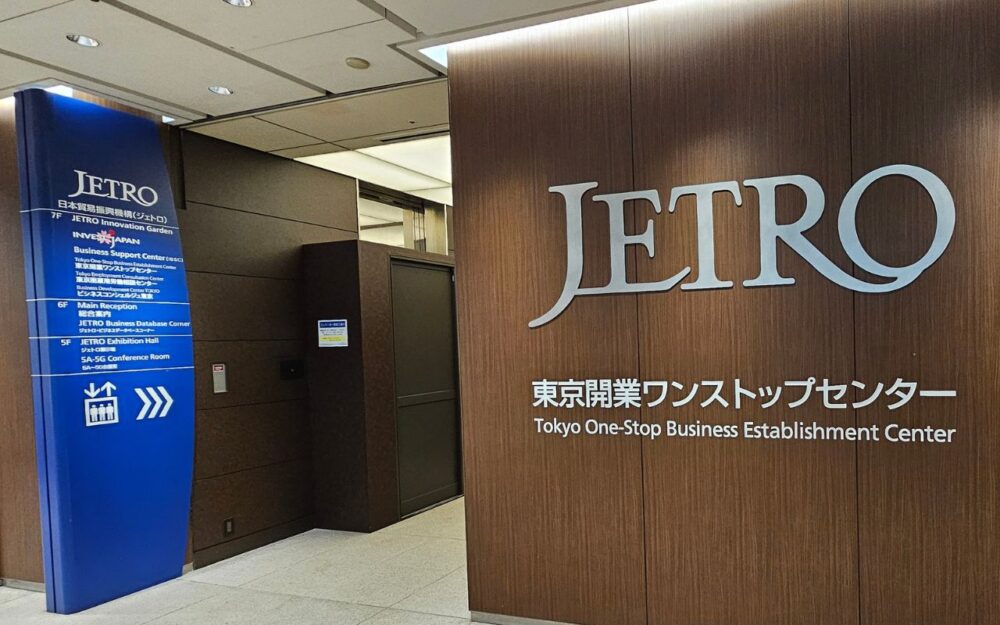
Our final stop takes us to Roppongi, where we meet Daisuke Shiga, Deputy Director at the Japan External Trade Organization (JETRO), inside the organization’s Tokyo headquarters (read our full interview here).
Created in 1958 during Japan’s post-war export boom, JETRO was initially established to help Japanese companies identify overseas markets and gather commercial intelligence. Today, operating under the Ministry of Economy, Trade and Industry (METI), it has become one of the country’s principal instruments for economic diplomacy, supporting Japanese companies abroad while attracting foreign investment into Japan.
With its global network of more than 70 overseas offices across over 50 countries, alongside offices in every Japanese prefecture, the organization is sometimes described as Japan’s economic “eyes and ears” abroad. Its role is becoming increasingly significant. Japan remains the world’s fourth-largest exporter, and in 2024 the country’s exports of goods surpassed ¥100 trillion (€539.2 billion) for the first time. This milestone reflects the combined efforts of national institutions such as JETRO and regional organizations, including Tokyo SME (read our full interview here), which work together to help Japanese companies expand internationally.
Through initiatives coordinated by METI, JETRO and SME agencies, more than 20,000 companies have already enrolled in national export assistance programs launched in recent years, with more than 2,800 firms successfully entering overseas markets by late 2024.
The companies we met throughout this reporting trip were all beneficiaries of one of these programs. Daisuke Shiga explained to Dante Swift what this support involves:
“JETRO supports companies through business matching, connections with local innovation ecosystems and advisory services. We also assist startups through acceleration programs, particularly in cooperation with European acceleration hubs. In addition, we provide market intelligence and regulatory guidance to help companies better understand local requirements and reduce barriers to entering European markets.”
This echoes almost every conversation we had during this journey. FDK spoke about navigating Europe’s battery regulations. Hasegawa is redesigning its products around IEC standards before making its first commercial push. C.I. Takiron considers European documentation requirements as a way to improve its engineering worldwide. Muscle Corporation closely follows European regulation before integrating new functions into its servo motors.
For JETRO, the next phase of Japan-Europe cooperation will increasingly revolve around sectors already encountered during our reporting: batteries, robotics, advanced materials, digital technologies, green energy and precision manufacturing.
Glohai: Making Japanese Industrial Expertise Visible
While public institutions help companies understand markets and overcome structural barriers, business consultancy firm Glohai focuses on the final step: ensuring that Japanese technologies are visible, understood and connected with the right European partners.
Many of the companies we met possess highly competitive technologies. Several are already supplying critical industries worldwide. But outside specialized industrial circles, very few European buyers have ever heard of them.
FDK has decades of expertise in battery technologies. C.I. Takiron develops precision motors for highly demanding applications. Hasegawa has nearly a century of experience in electrical safety. Yet outside Japan, specialized industrial excellence does not automatically translate into international recognition.
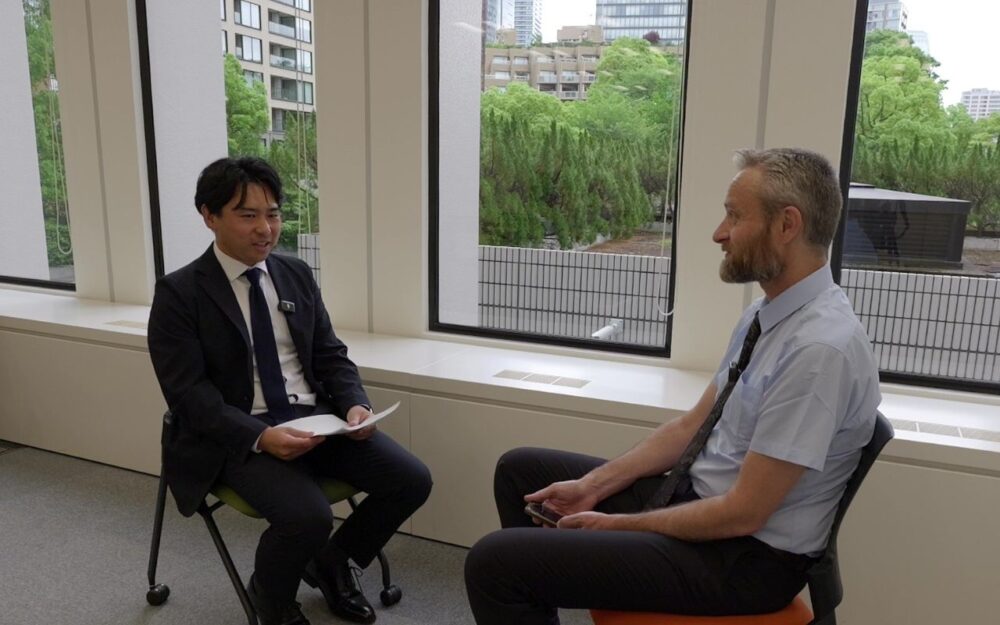
For Japanese companies, this represents both a challenge and an opportunity. Their reputation for quality and reliability already provides a strong foundation. The difficulty is making that value visible to potential customers who may not yet know the company, explains Moto Kaizu, Glohai’s Business Development Director (read the full interview here),
“Japanese companies often create exceptional products and technologies. The challenge is helping international customers discover them, understand their value and ultimately build trust in the company. Successful international expansion depends on two key elements: visibility and execution. Visibility means getting noticed, while execution means turning opportunities into real business results.”
This is where Glohai enters. The company supports Japanese manufacturers in building their presence overseas, combining digital marketing, business development and local market expertise. For Moto-san, the challenge begins with understanding how European customers evaluate potential suppliers:
“Compared with markets such as the United States, European companies tend to spend more time researching and evaluating before starting a conversation. They want to understand not only the product itself, but also the company behind it: its technology, experience, reliability and long-term commitment.”
For Glohai, international expansion therefore requires adapting the way companies communicate, market and build relationships.
“We help Japanese companies bridge the gap between Japan and global markets by understanding local customer needs, developing the right market strategy, adapting communication and connecting companies with the right customers and partners.”
The company’s approach combines digital tools, including platforms such as the ones developed by our publisher VirtualExpo, social media, LinkedIn and online advertising, with business development activities aimed at generating concrete commercial opportunities.
Today, Glohai supports more than 300 Japanese companies.

Final Insight: Europe Is Becoming Japan’s New Industrial Benchmark
When we began this journey, the question was whether Japan’s growing interest in Europe was simply a series of isolated investment decisions or the sign of a deeper industrial shift. After travelling from Tokyo to Osaka, meeting manufacturers, engineers and the organizations supporting their international expansion, the answer appears clearer.
Japan is not turning toward Europe because it represents an easy market. It is doing so because Europe increasingly rewards the very qualities that define Japanese industry: precision, reliability, engineering discipline and long-term thinking.
As Moto-san summarizes:
“Today, more companies are thinking strategically about how to diversify their global presence and identify new growth opportunities. Europe is becoming a very attractive market for Japanese companies. It is a large market where quality, innovation, sustainability and long-term partnerships are highly valued.”
The lesson is that Europe is increasingly becoming a reference system. For Japanese companies, meeting European expectations means adapting products, improving documentation, strengthening sustainability strategies and developing closer relationships with customers. These efforts require investment, but they also create a form of industrial validation. A technology that succeeds in Europe is often perceived as being ready for the most demanding global markets. This explains why Japan’s European strategy extends far beyond individual companies.
The geopolitical context is accelerating this movement. After decades in which globalization rewarded cost efficiency and scale, Japanese manufacturers are betting on a different equation, one where reliability, compliance and engineering excellence become competitive advantages again. Japan is not only looking West to sell more. It is looking West to build differently, to build part of its industrial future with Europe.