



Manufacturing strategy used to be mostly about cost. Now it gets tied to tariffs, sanctions, shipping routes, energy exposure, and election cycles. A sourcing decision can suddenly become a production continuity problem.
If low-cost consumer goods arrive late, companies absorb the delay and move on. If semiconductor components arrive late, production lines stop. Revenue forecasts move. Customers start escalating. That difference is driving a lot of the nearshoring discussion now.
Most manufacturers are not abandoning globalization entirely. They are simply trying to reduce how much damage one disruption can cause.
What is Nearshoring?
Nearshoring means moving manufacturing or supplier operations closer to the end market.
Nearshoring is moving production or sourcing to a country that is geographically close to your primary market, rather than to wherever labour is cheapest.
For U.S. companies, that often means Mexico under USMCA. In Europe, it may mean Poland or the Czech Republic to stay within the broader EU manufacturing ecosystem.
The operational advantage becomes obvious the moment something breaks:
- Engineering teams can resolve production issues more quickly
- Site visits become realistic.
- Supplier communication tightens because fewer teams sit between the problem and the people fixing it.
It works because a production issue left unresolved for two days can push delays into procurement, logistics, inventory planning, and customer delivery schedules very quickly, as we touched on above.
Nearshoring shortens those loops.
Nearshoring shortens those loops and changes how inventory gets planned. Shorter transit times mean smaller, more frequent production runs, instead of committing to large batches months before you know what demand actually looks like.
That flexibility matters when forecasts turn out wrong.
What is Globalization?
Globalization follows a different logic: manufacture wherever capability, supplier depth, and economics are strongest.
That model built some of the deepest industrial ecosystems in the world.
- Electronics manufacturing in Shenzhen.
- Semiconductor production across Taiwan and Malaysia.
- Automotive supply chains spread across Europe, Asia, and North America.
Those ecosystems took decades to mature.
Gavin Yi, CEO and Founder of Yijin Solution, sees this firsthand in precision manufacturing and tooling supply chains. For him,
“A lot of companies underestimate how much hidden coordination sits inside mature manufacturing ecosystems until they try moving production somewhere else. The factory is only one part of it.
You also need tooling suppliers, secondary processing, engineering support, quality systems, logistics coordination, and people who already know how to work together under production pressure. That is much harder to recreate than many sourcing plans assume.”
That is why many manufacturers still depend on them.
If a company needs advanced PCB assembly, specialised tooling support, or highly technical components at scale, the strongest supplier network may still sit thousands of miles away.
But the tradeoff is operational complexity.
Global manufacturing works well when conditions stay stable.
Once disruptions start stacking, especially in times like these, it could all fall apart.
Geopolitical Factors Influencing Manufacturing Choices
Manufacturing decisions now depend as much on geopolitical stability as they do on cost and production capability.
Tariff pressure
The U.S.-China Section 301 tariffs were manageable for a while. Painful, sure. But manageable.
The 2024 expansion into EVs, batteries, and semiconductors changed that. Companies in those industries had to answer a harder question: was concentrating production inside one geopolitical region still defensible, or just familiar?
Gregor Emmian, Deputy Chief Digital Growth Officer at Rise, puts it plainly:
“Manufacturers used to model disruption as a short-term interruption. Now they are treating geopolitical exposure as an ongoing operational variable. Investors are asking different questions, too. They want to know how dependent companies are on one supplier region, how quickly production can shift, and what happens if shipping or trade policy changes suddenly.”
A sourcing model that works at one duty rate can unravel fast when costs rise across components, freight, and downstream production simultaneously.
Shipping instability
The Red Sea disruptions pushed vessels around the Cape of Good Hope, adding both time and cost to Asia–Europe routes that global supply chains had never priced in.
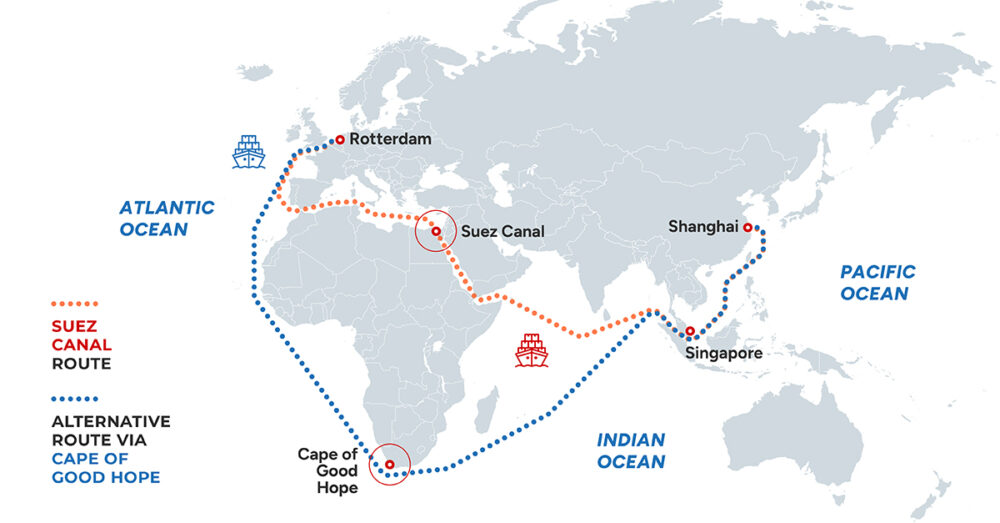
UNCTAD documented the damage. Container spot rates climbed. But the deeper problem was that schedules stopped being reliable for weeks at a stretch.
Just-in-time doesn’t survive that. Inventory arrived late. Production sequencing broke down. Procurement teams scrambled for buffer stock at the same moment everyone else was doing the same thing.
The operational response was predictable: larger buffers, more supplier redundancy, more regional sourcing. Efficiency gave way to resilience.
That shift also changed how warehouses are designed. Companies put more investment into inventory visibility, automation, and faster retrieval because delays are much harder to absorb once products start backing up across multiple facilities.
In larger operations, tools like a vertical lift module can reduce picking delays and keep inventory control intact when supply chains stop behaving.
Energy risk
Russia’s invasion of Ukraine made energy concentration risk concrete in a way it hadn’t been before.
European manufacturers had to reckon with how exposed their operations were to regional energy systems they’d assumed were stable. In energy-intensive industries, pricing volatility was severe enough to affect production economics directly.
Site selection conversations changed. Energy infrastructure now gets scrutinised the way labour costs used to be, because unstable power pricing can erase cost advantages elsewhere in the operation, especially in advanced manufacturing, where uptime is constant.
Government intervention
Industrial policy stopped being background noise.
The U.S. CHIPS and Science Act, Europe’s Chips Act, and the Inflation Reduction Act are structural interventions. They’re designed to move semiconductor fabs, EV supply chains, and battery production into specific geographies, and they’re working.
Subsidies, compliance requirements, and regional sourcing incentives now sit alongside demand forecasts when companies make expansion decisions. In some sectors, where a government wants production to go matters as much as where customers are.
Compliance pressure
The Uyghur Forced Labor Prevention Act forced a reckoning in sectors that had never thought hard about supplier traceability.
Regional agreements like USMCA, RCEP, and CPTPP created more predictable trading environments, but they also came with documentation expectations that companies had to build systems around.
Ryan Beattie, Director of Business Development at UK SARMs, a company that sells bodybuilding research chemicals, describes what that looks like in practice:
“In regulated industries, you cannot separate supplier reliability from documentation anymore. Customers want to know where ingredients come from, how products move through the supply chain, and whether sourcing standards can hold up under scrutiny. Weak visibility creates operational risk very quickly once regulations tighten.”
Rethinking site selection
Ten years ago, the conversation was labour cost, taxes, and transport access. Those still matter.
But the checklist is longer now: sanctions exposure, energy stability, what a trade policy change after an election looks like, whether production can continue if a supplier region closes off, how fast sourcing can shift. These aren’t contingency exercises. They’re the actual questions.
What are the Benefits of Nearshoring?
The biggest advantage is lead time reduction. When you rely less on ocean freight, you deal with fewer port delays, fewer customs bottlenecks, and less volatility in shipping costs.
You also gain more flexibility because you are not locking yourself into massive inventory commitments months before demand becomes clear.
That flexibility matters even more for businesses handling short production runs or fast-changing order volumes.
Companies producing custom t-shirts or managing bulk apparel fulfilment often need suppliers and production timelines that can adjust quickly when demand shifts unexpectedly instead of sitting behind long offshore lead times.
The communication side changes too. When suppliers are nearby, your engineering team can move through problems much faster. You can:
- Walk the production line, inspect failed components in person, and adjust specifications without dragging revisions across weeks of late-night calls and back-and-forth emails.
- Review an issue in the morning, adjust specs, and test another production run the same week instead of waiting days between updates.
- Recover faster when disruption hits.
- Qualify replacement suppliers more quickly, transportation becomes easier to manage, and problems are less likely to spread across multiple countries and shipping routes.
Sustainability pressure is pushing some manufacturers in the same direction, too. As regulations like the EU’s CBAM expand carbon reporting requirements, logistics distance and transportation emissions start affecting operating costs directly, not just sustainability reporting.
What are the Challenges of Nearshoring?
Nearshoring does not remove risk. It changes the risk profile:
- Labour costs are often higher than in traditional offshore hubs.
- Skilled manufacturing talent can be harder to scale quickly in fast-growing nearshore regions.
- Infrastructure becomes a bottleneck when industrial growth outpaces power, transportation, or real estate capacity.
Mexico shows that tension clearly. Demand for nearshore manufacturing has grown rapidly, but infrastructure and power capacity have struggled to keep pace in some industrial areas.
The transition itself is expensive, too. Suppliers need requalification. Tooling may need relocation or rebuilding. Validation processes restart. Manufacturing ecosystems that matured offshore over decades cannot always be recreated quickly nearby.
And some specialised components still are not available regionally at comparable scale or quality.
That is why many companies pursuing nearshoring remain partially dependent on global supply chains for critical inputs.
What are the Advantages of Globalization?
Scale remains the biggest advantage. Global manufacturing networks provide access to lower-cost production, specialised supplier clusters, and engineering capability that may not exist domestically. That matters in practical ways.
If a manufacturer suddenly needs advanced PCB assembly, specialised tooling support, or highly technical components on short timelines, the strongest supplier network may still sit inside established Asian manufacturing hubs.
Those ecosystems are difficult to replace because they are not just factories. They are entire industrial environments built around logistics providers, subcontractors, workforce expertise, and accumulated process knowledge.
Globalization also allows companies to regionalise products while maintaining centralised manufacturing efficiency. For many industries, abandoning those efficiencies entirely would create major operational disadvantages.
What are the Challenges of Globalization?
Distance amplifies problems.
You see a similar issue in healthcare and regulated medical services, where continuity matters just as much as cost control. Providers offering trt online services, for example, depend heavily on reliable fulfilment, consistent supplier coordination, and uninterrupted access to treatment because delays affect customer trust very quickly once care becomes inconsistent.
Lead times stretch. Oversight weakens. Communication slows. Small disruptions move through multiple supplier layers before companies even realise there is an issue. The pandemic exposed that clearly.
Factory shutdowns, shipping delays, and transportation bottlenecks showed how quickly long supply chains could stall once multiple disruptions happened simultaneously.
Quality control becomes harder too when supplier oversight depends heavily on remote coordination and infrequent site visits.
Then there is regulatory complexity. Manufacturers operating across multiple countries must navigate changing compliance requirements, trade restrictions, political instability, and industrial policy at the same time.
Those risks evolve faster than sourcing contracts do.
Case Studies: Companies Adapting to Geopolitical Changes
Apple has been moving more production out of China. In fiscal 2024, it assembled about $14 billion worth of iPhones in India roughly 14% of global volume. It also expanded AirPods and Apple Watch production in Vietnam to spread supply chain risk across more regions.
TSMC is doing something similar. The company is building advanced semiconductor fabs outside Taiwan, including major projects in Arizona backed by U.S. CHIPS Act incentives. It is also expanding capacity in Dresden to strengthen semiconductor production in Europe.
The LEGO Group is pushing production closer to demand, too. It is building facilities in Vietnam and Virginia. The Virginia plant was announced as carbon-neutral while also helping LEGO serve North American markets more directly.
Automakers are restructuring EV and battery supply chains around U.S. regional sourcing rules. That includes:
- Suppliers expanding assembly operations in Mexico under USMCA
- Companies reducing exposure to shipping disruption
- manufacturers spreading production across multiple regions
Tesla’s Nuevo León plant announcement fits that broader shift. The pattern is clear:
- Less dependence on one region
- More backup capacity
- Supply chains built to handle disruption better
Future Trends in Manufacturing: Navigating Geopolitical Landscapes
Most manufacturers are not moving fully toward nearshoring or fully back into globalization. They are building more flexible supply chains instead. That usually means:
- Regional production where speed and resilience matter
- Global sourcing where specialised capability still dominates
Technology is making that easier to manage.
MES platforms, IIoT systems, connected supply chains, and digital twins give companies better visibility across distributed operations. When disruption hits, you can shift production faster instead of waiting for delays to spread through the network first.
Governments will keep influencing where manufacturing capacity gets built, too, especially in:
- Semiconductors
- Batteries
- EV supply chains
Manufacturing capability is increasingly treated as economic security, not just industrial growth. Sustainability pressure is becoming harder to separate from operations as well. Policies like the EU’s CBAM and broader Scope 3 emissions tracking are pushing companies to rethink:
- Transportation distance
- Energy sourcing
- Logistics exposure
- Packaging decisions
Labour economics is shifting too.
Automation is reducing some offshore labour advantages, while regions with stronger infrastructure and deeper technical talent pools are becoming more attractive for advanced manufacturing investment.
The Shift Is Already Underway
The rules of manufacturing geography are being rewritten. Cost still matters, but stability, proximity, and policy now sit alongside it in every serious expansion decision.
Companies that built supply chains around pure efficiency are rebuilding them around resilience. That process is slow, expensive, and largely irreversible.
The manufacturers moving early have more options. Those waiting for clarity may find the decisions have already been made around them.