

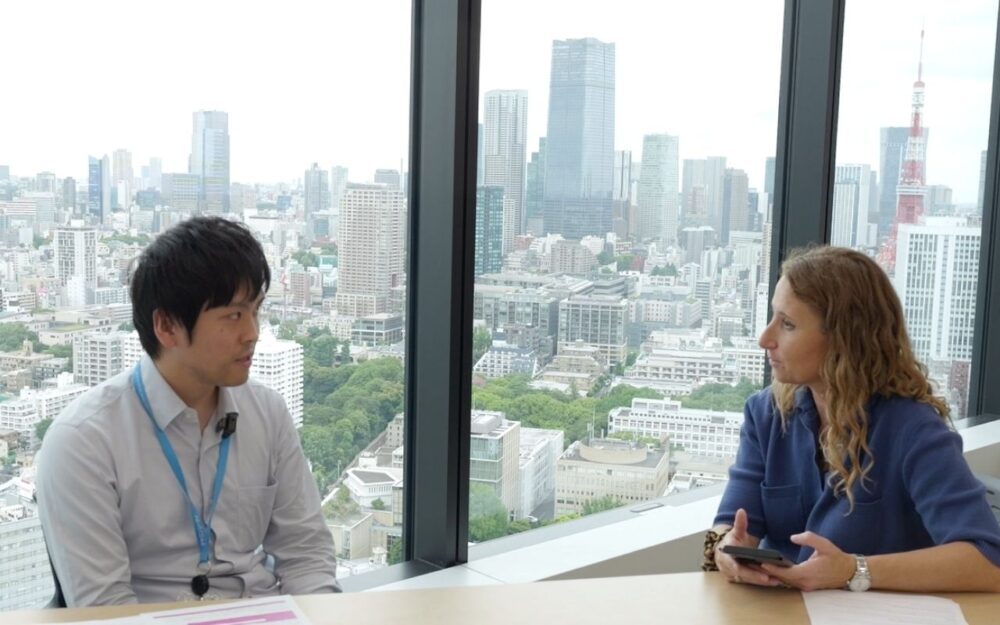

During a reporting trip across Japan, DirectIndustry met with industrial manufacturers, technology providers and export support organizations to better understand why Europe is becoming an increasingly strategic market for Japanese industry. For this episode, we met with Tetsuya Koizumi, R&D Engineer at C.I. Takiron, a Japanese manufacturer specializing in miniature motors and motion-related technologies.
As industrial equipment, medical devices and robots become increasingly compact, the demand for smaller motors capable of delivering high performance continues to grow. C.I. Takiron has developed coreless and slotless brushless motors ranging from just 4 mm to 22 mm in diameter, drawing on miniaturization technologies developed through its long experience in vibration motors. The company primarily develops customized solutions tailored to individual customer requirements.
Miniaturization, however, comes with significant engineering challenges. Maintaining torque while reducing motor size requires advances in winding technology, thermal management and efficiency, while further downsizing also raises questions around brush life and performance. At the same time, manufacturers are facing growing pressure to reduce their reliance on scarce materials such as dysprosium and terbium and to develop more sustainable products.
In this interview, Tetsuya Koizumi explains how C.I. Takiron is pushing the limits of motor miniaturization, from high fill-factor windings and thermal management to rare-earth reduction. He also discusses the company’s plans to develop micro actuators integrating motors and other components, as well as the opportunities Takiron sees in Europe, particularly in medical devices and humanoid robotics.

How do your coreless micromotors differentiate from competing products?
Tetsuya Koizumi: “We offer a lineup of coreless and slotless brushless motors ranging from Ø4 mm to Ø22 mm. Based on our existing product lineup, we design products tailored to the specific requirements of each individual customer. Leveraging the compact design technologies we developed through our past vibration motor business, the small-diameter motors we created at that time are still used today in a wide variety of applications, as they continue to meet the needs of increasingly miniaturized end products.”
Maintaining high torque output while making motors smaller is a challenge. How have you addressed it?
Tetsuya Koizumi: “One approach is the study of high fill-factor winding. In addition to conventional coil winding technologies, we have been examining how to increase the number of windings as much as possible, and this approach has already been applied to some of our products. In addition, we are currently studying how to transfer the heat generated by the windings more effectively to the outer casing.”
What are the main applications for your motors?
Tetsuya Koizumi: “Our motors are widely adopted in the security field, where further miniaturization is increasingly required. One reason is that our motors can be designed to operate even at low temperatures of -40°C.”
How far can motor miniaturization be pushed in this technology?
Tetsuya Koizumi: “Our smallest coreless motor is currently a Ø4 mm motor. We believe the main technical barriers to further miniaturization are brush life, and optimization of motor efficiency.”
Are rare-earth-free motors an area of interest for your company?
Tetsuya Koizumi: “Yes, this is an area of interest for us. Depending on the customer and the application, we already have products that can support HER-free requirements. Our work on alternative materials such as ferrite is still at an early stage and will be a future initiative.”
Do you plan to develop your own drivers and controllers to offer fully integrated motion control solutions?
Tetsuya Koizumi: ‘Both in-house development and external collaboration are currently under consideration. There are many possible approaches, but in any case, our technology roadmap includes the development of modules using motors, and we aim to create micro actuators unlike anything currently available in the market.”
How flexible are you in customizing motor designs to meet specific customer requirements?
Tetsuya Koizumi: “We determine whether to proceed with development for each project based on an internal project evaluation sheet. This evaluation sheet scores projects based on factors such as project size, profitability, development workload, and initial investment. Based on this score, we decide whether to move forward.
In addition, during development meetings involving both sales and engineering members, participants are encouraged to speak freely. In some cases, promising customers or applications that cannot be fully judged through the evaluation sheet alone may be assessed and decided on the spot.
Ultimately, we aim for product development in which the customer, sales team, and development team all move forward with the same shared commitment.”
How is your company responding to growing environmental and sustainability requirements?
Tetsuya Koizumi: “Our initiatives include: aking materials lead-free, reducing the use of scarce resources such as Dy and Tb, developing high-efficiency motors with lower current consumption, and in the future, developing actuators that can contribute more broadly to society.”
Why are you interested in entering or expanding in the European market?
Tetsuya Koizumi: “We believe there are still significant opportunities for our motors in the medical device field, given the large market size and its continued growth. We believe the same is true for actuators for humanoid applications.”
How is your company ensuring compliance with EU regulations and standards?
Tetsuya Koizumi: “For motors, the main relevant regulations are RoHS and REACH compliance. Our response includes preparing declarations of non-use of restricted substances, material certificates, and chemSHERPA documentation.”