

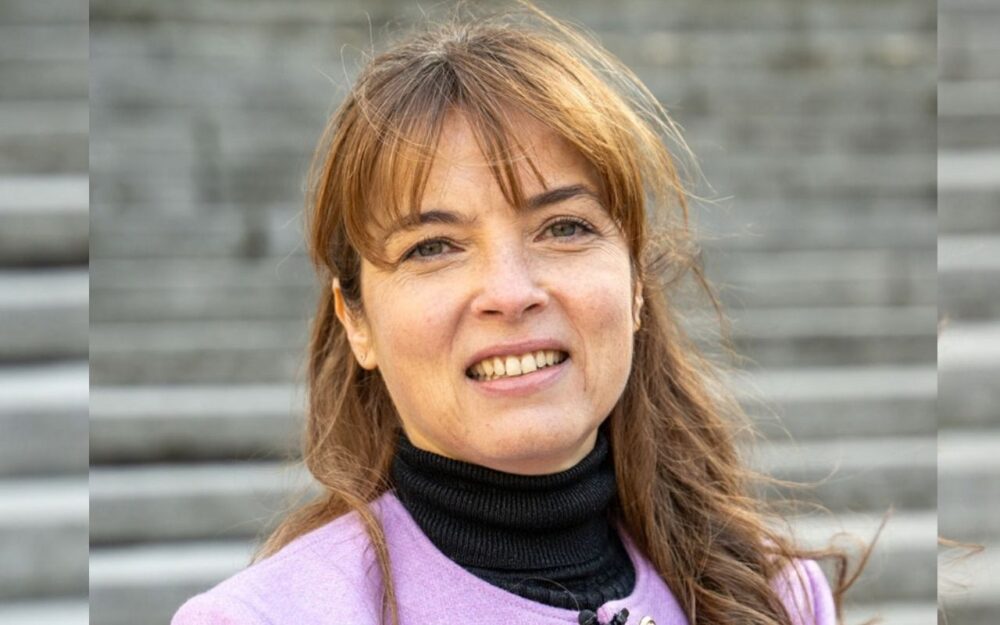

As France seeks to revive its nuclear industry, the sector faces several challenges: adapting to climate change, maintaining energy sovereignty, renewing its nuclear fleet and, above all, finding the skills it needs. For Emmanuelle Galichet, a lecturer and researcher in nuclear science and technology at CNAM for the past 25 years, France’s ability to maintain a civilian and military nuclear industry will first and foremost depend on its ability to train the engineers, technicians and professionals it will need over the coming decades.
Nuclear power: a strategic issue for both civilian and military purposes
A few weeks ago, you were the guest of honor at the IGPSC Congress in Biarritz, where you spoke about the challenges facing the nuclear industry, a highly strategic sector for France.
Emmanuelle Galichet: “Indeed. Energy is clearly the central issue of the 21st century. It is at the heart of everything: the economy, geopolitics, the environment, and so on. Nuclear power is therefore strategic in its civilian dimension, but it is also, obviously, strategic in its military dimension. We must never forget that. Civilian and military nuclear power cannot be separated. When a government decides to shut down civilian nuclear power, it puts the military side at risk because, fundamentally, they rely on the same engineers, the same researchers, the same technicians, the same skills and the same training.”
You are now warning about the shortage of skills in the industry, which could prove costly for the sector and even put it at risk?
Emmanuelle Galichet: “If we go back to the Messmer Plan and the human organization behind it, nothing can be achieved without properly trained men and women, in the right fields and with the right level of qualifications. The education system as a whole, not just higher education but schools in particular, must once again become strategic infrastructure.
The drastic decline in educational standards means that today, only around 27% of a generation reaching the baccalaureate has taken the right subjects to pursue science and technology. If you then consider that around 40% go into medicine, you can see that there is not much left for industry.
Today, industrial sectors are competing with one another. They are constantly looking for people because there is a shortage of skills. And there is clearly competition between industrial sectors: everyone wants 100,000 people over the next ten years.The electricity grid, the rail network, the Navy, Defense, SNCF, renewables, aerospace, automotive, nuclear power… All these sectors need 100,000 people and €100 billion over the next ten years. That is frightening, isn’t it?”
Nuclear plants facing climate change
What is also worrying is seeing nuclear power plants shut down this summer. Several French nuclear reactors were temporarily shut down or operated at reduced power due to successive heatwaves, lower river flows and even jellyfish. In your view, is this a foretaste of what the nuclear industry will structurally face in a context of climate change?
Emmanuelle Galichet: “There were three plants involved, representing less than 1% of annual production. This was not a technical problem, but the result of regulations designed to protect river biodiversity, which led to these plants being temporarily shut down. [EDF reduced the output or shut down certain reactors to avoid discharging water that was too warm into rivers, thereby complying with the regulatory limit of 28°C.]
These are therefore regulations designed to preserve biodiversity, and rightly so. There is no issue with that. Simply put, our industrial facilities must now take their natural environment into account, which was not the case when they were built in the 1970s. And this applies not only to nuclear power. We have an environment that we need to pay attention to.”
So it was not a question of river water being too warm, given that these plants are located along rivers?
Emmanuelle Galichet: “These are open-loop plants located on rivers that are sensitive to temperature.”
But is this linked to climate change and the heatwaves we experienced this summer?
Emmanuelle Galichet: “Yes, of course. The increase in river temperatures and ambient temperatures, as well as lower river flows, seem to be strongly correlated with climate change.”
So, if this year’s shutdowns were not related to technical problems but to compliance with regulations, could the fact that nuclear plants are located along rivers, whose flows are expected to decrease and whose temperatures are expected to rise, eventually lead to technical problems? Is the industry therefore, so to speak, at risk during certain periods of the year?
Emmanuelle Galichet: “No. This will require engineers to adapt the industrial facilities. It will not require engineers or companies to shut them down. There are already nuclear plants around the world operating in deserts, such as Palo Verde. They do not have a river nearby. They use treated wastewater from the city of Phoenix for their cooling towers, for the cold water source.
Taishan is located in a tropical area. There are nuclear plants in South Africa. Egypt is currently building nuclear plants. Barakah, in the United Arab Emirates, is in a tropical region, and so on.”
In France, however, we chose to build many nuclear plants near rivers.
Emmanuelle Galichet: “Yes, but that is not a problem. We still need a water source. So it is better to locate them near a river. However, it is preferable to use a closed-loop system with cooling towers.”
Is that what adapting the industrial facilities means?
Emmanuelle Galichet: “Yes. And when you look at the six next EPRs, the EPR 2s, the two relatively straightforward adaptations are either to locate them by the sea, where you have a high dilution factor and therefore no problem, or to use a closed-loop system, meaning cooling towers. There is no technological barrier to doing this.”
But we are realizing that we need to adapt in this way?
Emmanuelle Galichet: “Absolutely. But in fact, since the 2003 heatwave, EDF has developed two programs, one short-term and one long-term, to adapt the nuclear fleet.”
Sovereignty: how much of the value chain should France control?
Another issue linked to climate change is sovereignty. France has a civilian and military nuclear program that provides a degree of independence, particularly in energy, and which represents a geopolitical asset in the current context. In your view, which links in the nuclear industry’s value chain must we absolutely retain or regain control over? We have engineering and maintenance capabilities, but skills are becoming increasingly difficult to retain. And we do not produce the fuel ourselves. Nuclear projects span decades, and we are reaching the end of a cycle, with an aging nuclear fleet, while new generations of reactors are being launched. How do you see France’s nuclear independence and sovereignty over the next 20 or 30 years? What should we focus our efforts on if we want to remain in control?
Emmanuelle Galichet: “When it comes to nuclear power, we are actually somewhat fortunate in France. Not everyone is, but we are, to some extent, because we have invested in recycling and enrichment.
We have the entire upstream and downstream fuel value chain on our territory. We do not have uranium mines, but from there onward, we have the entire process of transforming the raw material into fuel on our soil. And that is very important. Not every country has that. Even the United States is more dependent on external countries than we are.
There are several strategies when it comes to raw materials. And it is not just about uranium. In all industrial sectors, as you know very well, there is lithium, cobalt, rare earths, and so on. There are many raw materials where Europe is not strong, and France has really not been as effective as China, which has locked down the supply chain.
In nuclear power, the primary raw material for fuel is uranium. We do not have deposits in our soil that can be extracted at a reasonable cost. But if the uranium market increases dramatically, there may eventually be mines that become worth reopening.”
Where would that be?
Emmanuelle Galichet: “Our mines are in the Massif Central. They were closed in the 1980s, I believe.”
Is there a strategy to reopen these mines?
Emmanuelle Galichet: “No. We do not need much uranium because, thanks to physics, it has an extremely high energy density. One hundred grams of uranium is equivalent to 1.5 tonnes of oil. It is really very little. So we do not need much of it to produce a great deal of electricity and energy.
The strategies today are therefore not focused on reopening mines. Instead, they focus on diversifying long-term contracts with countries that have uranium mines. EDF’s strategy today is to have uranium suppliers with which it has long-term contracts, preferably countries such as Canada and Australia. There is also Kazakhstan, and Mongolia is about to enter the market. What is interesting about uranium is that it is fairly widely distributed around the world. It is not quite like hydrocarbons, where there are large concentrated areas. Uranium can be found in many places, with extraction costs that vary.
EDF’s strategy today, and therefore the French government’s strategy, is to diversify in the short term. In the long term, the nuclear industry’s strategy is obviously to move towards fast-neutron reactors. In these reactors, instead of using uranium-235 for fission, uranium-238 is used to produce plutonium-239, which fissions very efficiently with fast neutrons.This is therefore a completely different technology from the pressurized water reactors, using thermal, or slow, neutrons that we have today.”
We were very strong in this field 20 years ago with the Superphénix program, a French fast-neutron breeder reactor project designed to produce more fissile material than it consumed while recycling nuclear waste. Could we revive such a project?
Emmanuelle Galichet: “We no longer have the skills, so we would have to rebuild everything. Once again, with the education system, I am afraid that with the generations currently entering the workforce and those who will follow, we may no longer have the ability to do it.
But, in terms of materials, since that is what we are talking about, we have around 370,000 tonnes of uranium-238 in various forms, coming from recycling or from the upstream part of the fuel cycle, and 70 tonnes of plutonium in various forms and isotopes.
All of this would make it possible to build a number of fast-neutron reactors and, gradually, to continue the strategy of the fleet we have today to produce plutonium, then gradually switch to fast-neutron reactors that are breeder reactors and could, based on current electricity consumption, provide around 2,000 years of consumption.”
Data centers and growing electricity demand
Another issue linked to sovereignty is the expansion of data centers in France and the fact that we are attracting American, Japanese and Korean companies to our territory to build data centers, particularly because we have relatively abundant, low-carbon and affordable electricity. Is this a positive development for the nuclear industry?
Emmanuelle Galichet: “For the French nuclear industry, yes. If we want to be able to make the case for building new reactors, maintaining the existing fleet and extending its operating life, then if there is a need for electricity, obviously shutting down reactors becomes much more difficult.
The energy transition is based on three absolutely central pillars. The first is energy efficiency. This means working with industrial innovation to consume less energy, and less electricity, for the same service provided. The second is sovereignty. And the third pillar is the electrification of uses.
Since electricity has many low-carbon sources, electrifying uses means that even if we try to reduce our overall energy needs, the share of electricity in our energy mix will increase. It currently stands at 25%, and all scenarios project it to reach 50% of the energy mix. We will therefore inevitably need more electricity.
We need to talk about the energy mix and about the needs of the French population. People need electricity, of course, but they also need heat. The second energy vector is heat. They also need energy for transport. Today, this comes from hydrocarbons, but that needs to shift toward electrification. Tomorrow, with two energy vectors (electricity and heat) we should be able to meet all the needs of French society. We know how to decarbonize electricity. Our energy mix is more than 90% low-carbon. Heat, on the other hand, is still more than 60% produced from hydrocarbons, mainly gas, with much of the remainder coming from wood.”
Building reactors adapted to climate change
To talk about future construction: we discussed at the beginning of this interview the need to adapt to climate change. Will the way we build our next reactors also take climate change into account, in addition to the safety requirements inherent to the industry? How is the industry preparing for this? What types of equipment or construction features will incorporate this new constraint from the outset?
Emmanuelle Galichet: “Yes, you are absolutely right. Climate change needs to be ‘by design’. Engineers have used the IPCC’s calculations and scenarios for 2100 as the environmental conditions for nuclear plants.
This concerns external temperatures, which in particular means adapting air-conditioning systems. You know that you cannot have people working in temperatures above 30°C. Everything is therefore taken into account: increasing the number of air-conditioning systems, thicker walls, simply to ensure that people can work in suitable conditions. All safety requirements are obviously adapted accordingly. Water quantities, reservoirs and so on are also adapted. And we should not forget that it was the French who built Taishan.”
Towards 2050
Last question: do you think that, by 2050, we will still be able to consider nuclear power a pillar of France’s sovereignty? What conditions would need to be put in place today for it to remain a pillar, both in civilian and military terms?
Emmanuelle Galichet: “It takes skills. Skills are a long-term issue. I have a roadmap showing, in broad terms, how this should be done. The first step is to identify the strategic industrial sectors, then develop curricula with the appropriate experts, rather than relying solely on education inspectors, so that their needs can be taken into account. The industrial companies should not be the ones designing the curricula on their own either. Teachers like me from higher education, and people working in educational engineering, need to redesign the curricula. Then, based on those curricula, teachers need to be trained so that they can, in turn, train the students. Once you have done these three things — deciding which sectors are strategic, listening to the needs of industry, redesigning the curricula and training teachers — you can start training students properly.”