

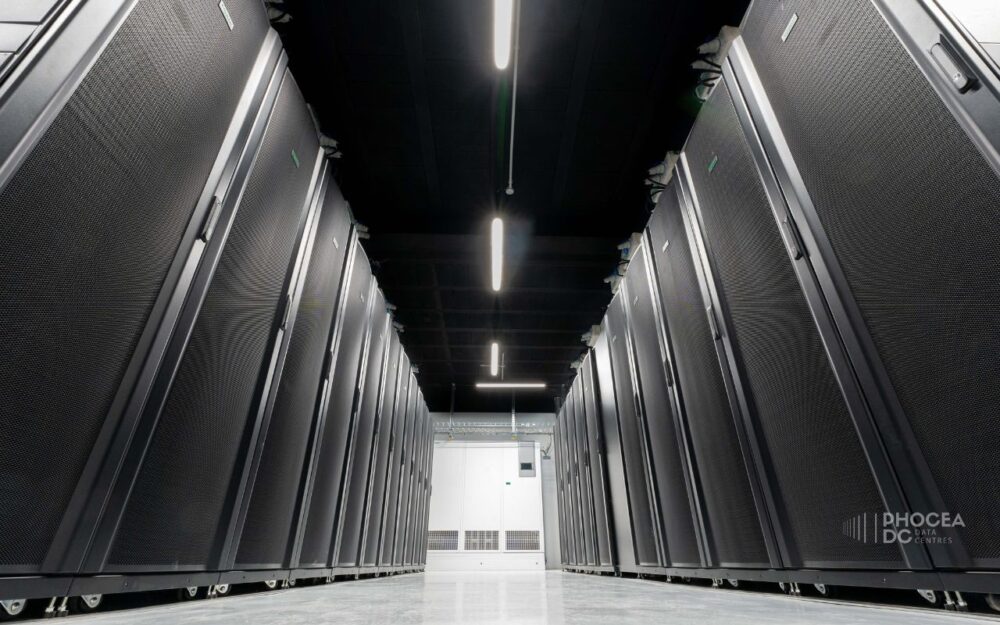

Marseille-based data center operator PHOCEA DC, whose facilities in central Marseille we recently visited, is scaling up. Following an initial €5 million funding round in 2023, the company has announced last week the entry of pan-European infrastructure fund Marguerite into its capital, alongside an investment plan of more than €120 million. Rather than competing with hyperscalers, PHOCEA DC aims to develop a network of local Edge data centers. Integrated into the city, they are designed to recover and reuse their waste heat. We spoke to its founder, Damien Desanti.
The data center market is currently engaged in a race to expand capacity, driven in particular by the explosive growth in demand associated with AI. Alongside hyperscale projects of several hundred megawatts, PHOCEA DC is advocating a different approach. the company aims to deploy smaller-scale facilities, located closer to where the demand is and designed from the outset to integrate into their urban environment. (Read our report from PHOCEA DC’s first data center, which we visited in June.)
This is precisely the model that the new €120 million investment is intended to develop in Marseille. According to Damien Desanti, founder and CEO of PHOCEA DC:
“Data centers already exist. But today, in 2026, there are the very large ones, the hyperscalers, which are deploying billions. That’s not where we are. We are focusing on Edge data centers, which have always existed, with lower power capacities. The challenge is to build the Edge data centers of tomorrow: Edge facilities located in cities and integrated into the urban fabric.”
€120 Million to Build Four Data Centers
The investment is led by Marguerite. This pan-European infrastructure fund invests in digital infrastructure and incorporates ESG criteria into its investment strategy. Combined with bank financing, the transaction gives PHOCEA DC the means to launch an investment program worth more than €120 million. This is a significant amount for the company. But Damien Desanti is keen to put it into perspective within the broader data center market:
“€120 million is not much in the data center industry. I want to put that into perspective because it’s important: €120 million is not about going into hyperscale. It is about financing 12 megawatts. That means four 3 MW data centers.”
The stated objective is therefore to develop four sites in Marseille over the next five years, with a combined capacity of 10 to 12 MW, rather than a single large-scale campus. The second site is already under development, while the other locations are still being secured.
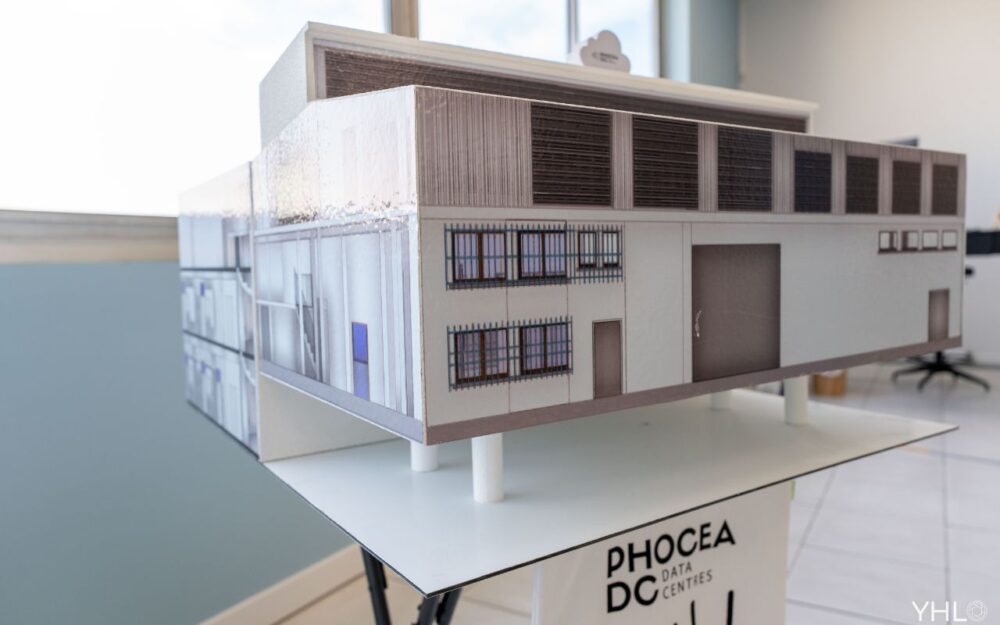
An Edge Data Center Designed as Urban Infrastructure
For PHOCEA DC, the Edge model is about more than simply installing servers in a smaller building. The company wants urban integration to become an integral part of both the technical and economic model.
“An Edge data center is about several things, primarily integration in terms of acoustics, the redevelopment of abandoned land and waste heat recovery. The aim is to prove that this is viable, that we can work with local authorities, and that it is a resource-efficient and profitable model.”
This approach means looking for existing buildings that can be refurbished rather than systematically building on undeveloped land. More importantly, it requires sites to be selected according to their immediate surroundings. Waste heat recovery is therefore closely linked to the choice of location.
“The goal is precisely to find sites that meet all the criteria, particularly the redevelopment of brownfield sites in order to revitalize a neighborhood, while also making waste heat recovery possible for a nearby user.”
A data center located in a residential area consisting mainly of individual homes, for example, will have few outlets for its waste heat. But a site near an industrial area, a swimming pool, a school or a district heating network serving residential buildings could provide a direct outlet for the recovered heat.
PHOCEA DC is already working on a project that illustrates this approach. The heat generated by a 3 MW data center could provide heating for between 1,000 and 1,200 social housing units.
Marseille as a Testing Ground
For PHOCEA DC, Marseille provides a particularly interesting environment in which to test this model. The city is both a major international Internet hub, the sixth largest in the world, thanks in particular to its submarine cable connections. But it is also a territory facing land and energy constraints. It is also a metropolitan area that has already begun addressing the issue of data center integration. Desanti is referring in particular to the moratorium adopted by the City of Marseille on new data center projects and to the roadmap subsequently adopted by the Aix-Marseille-Provence metropolitan authority.
“Marseille brings together all the strengths and all the tensions surrounding data centers. So it’s a very good testing ground.”
For PHOCEA DC, these initiatives could provide the starting point for a framework that could be replicated in other cities.
“This is where we are building something: we validate it, we test it and we say, it works, we can do it. So let’s apply the recipe elsewhere. That’s what can be replicated in other major cities.”
The company wants to demonstrate that a network of local data centers can meet the digital needs of a metropolitan area while addressing constraints that are becoming increasingly important: energy consumption, local acceptance, noise, land use and waste heat recovery.

Complementary to Hyperscalers
PHOCEA DC does not present its model as an alternative to hyperscalers. The two types of infrastructure address different needs.
Large campuses can provide the massive computing capacity required for certain artificial intelligence and cloud applications. Edge data centers, by contrast, are better suited to use cases where proximity matters: low latency, business continuity, regulated data hosting and IT services for local organizations.
“I don’t see a city that won’t have a data center tomorrow. The industry of tomorrow is built on digital technology. There will always be a need for local data centers of a certain size. Deploying data centers in cities is the condition: these data centers must bring not only value through digital services, but also value at a societal level.”
With its €120 million investment program, PHOCEA DC is now looking to take its model from demonstration to scale.