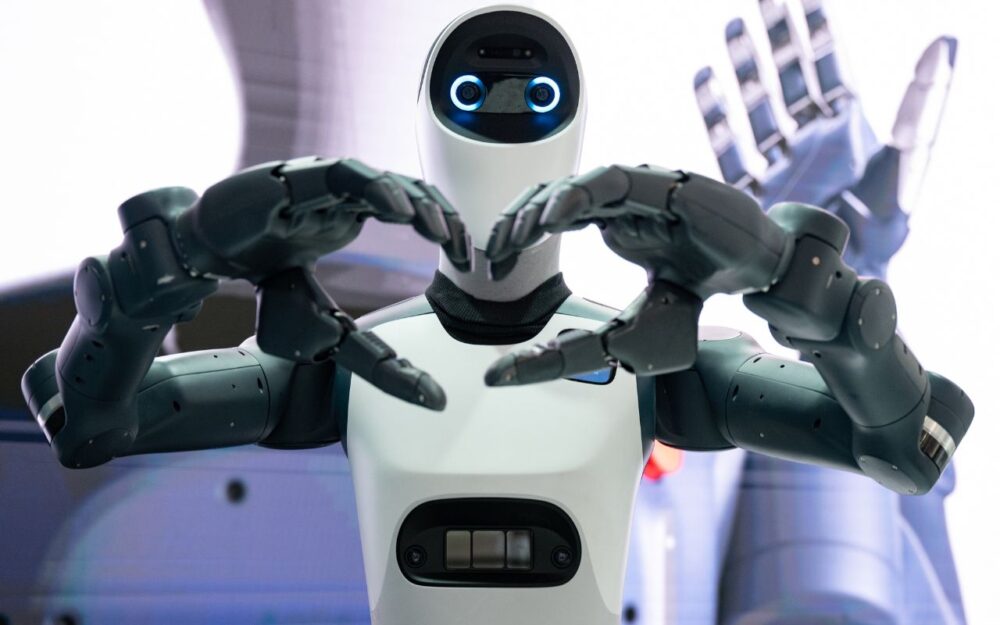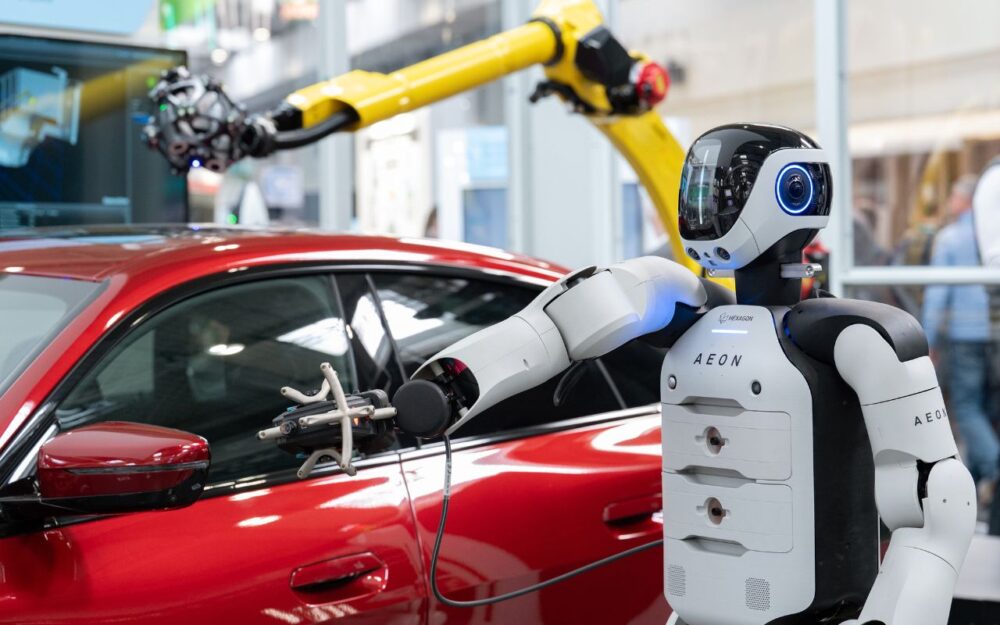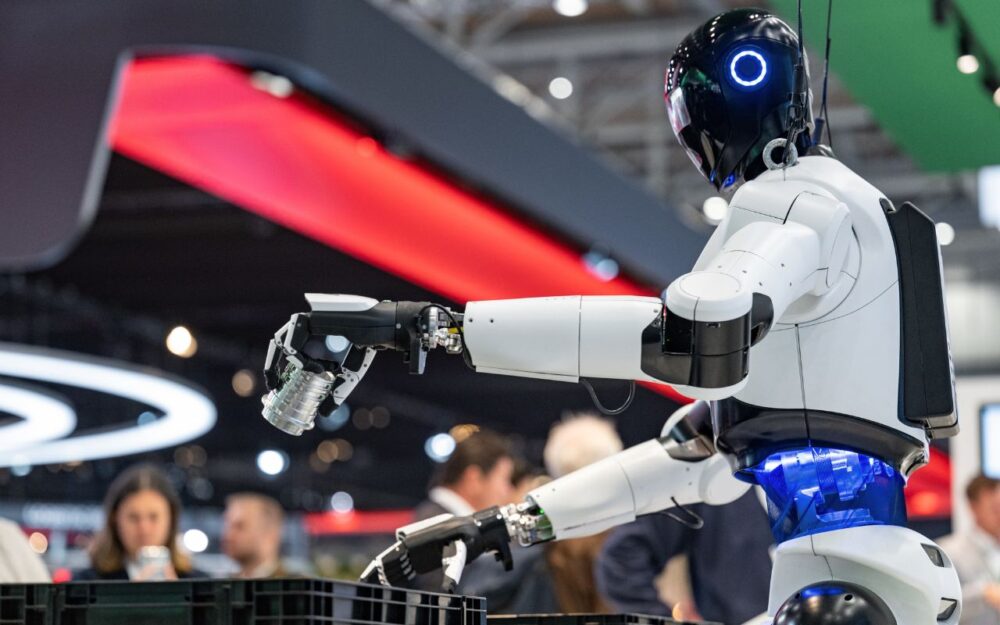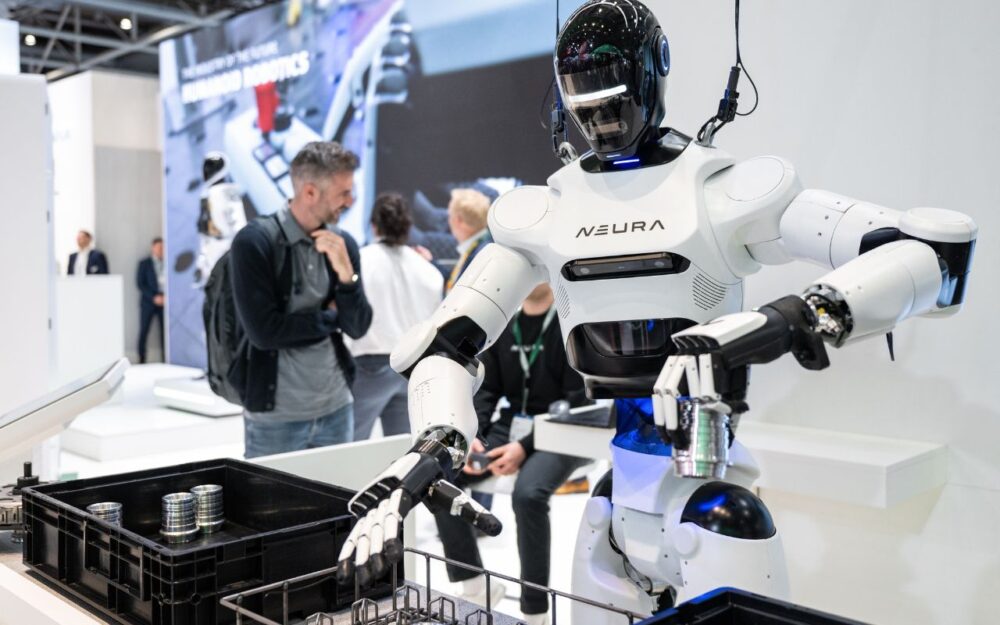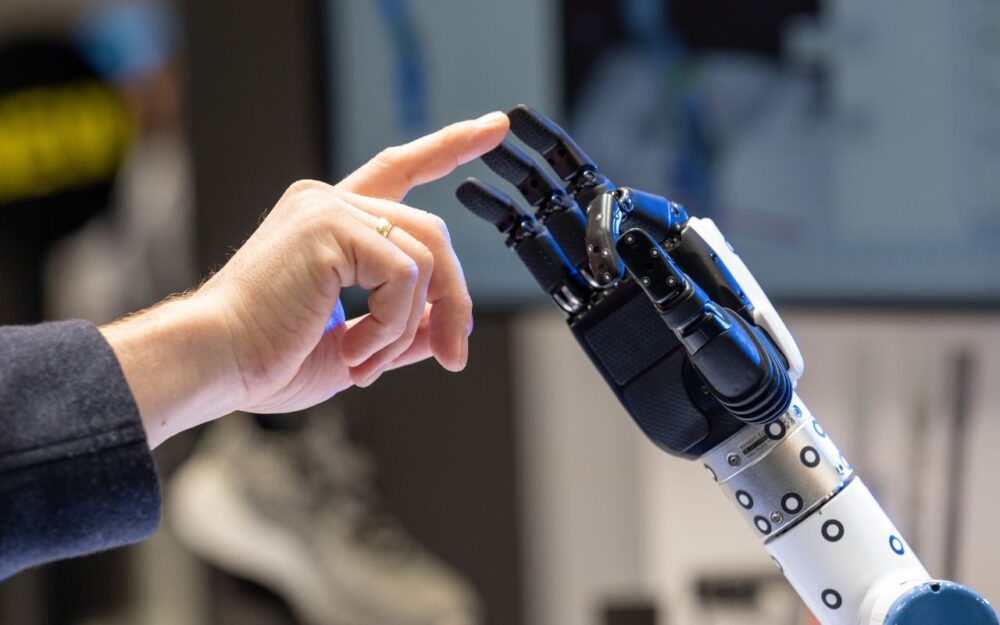


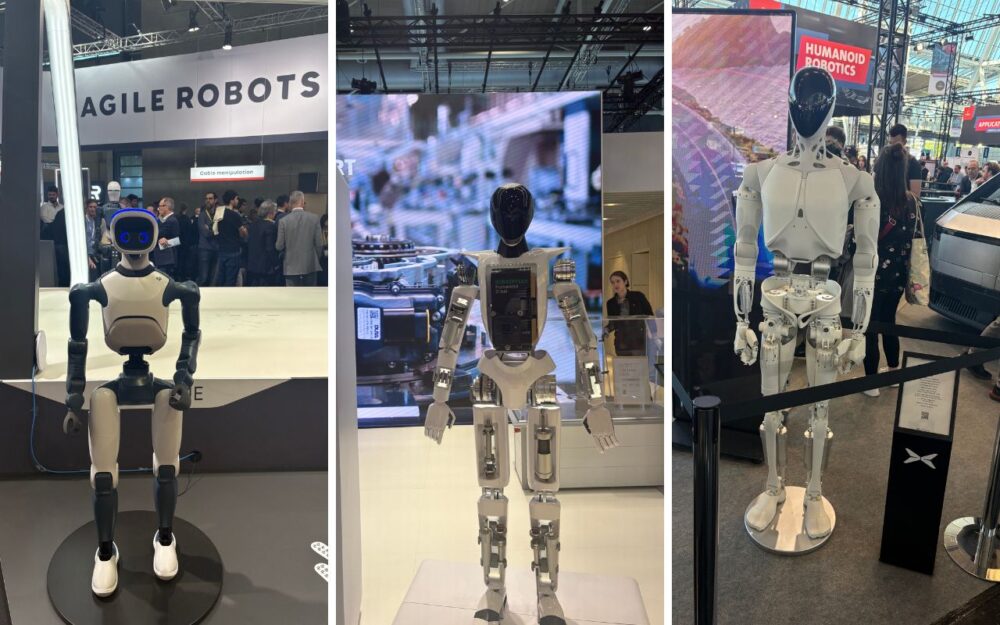

Humanoid robots showcased at Hannover Messe 2026 demonstrate their readiness for assembly, logistics and industrial support tasks.
Humanoid robots are moving out of research labs and into real industrial environments. At Hannover Messe 2026, companies such as Agile Robots, XPeng, Schunk and Schaeffler demonstrate how humanoid systems are beginning to deliver tangible industrial value. It ranges from assembly and inspection to internal logistics, material handling and precision gripping.
Humanoid Robots at the Turning Point of Industrial Adoption
For the first time, humanoid robots are presented not as futuristic concepts, but as production-ready tools designed for integration into existing factory environments. More than 15 exhibitors showcase systems capable of automating complex workflows. And the focus was clearly shifting from spectacle to robustness, integration capability and economic viability. The central question is no longer whether humanoid robots can work in industry, but where they create the greatest value compared to conventional automation. And how quickly they can be scaled across sites.
Several exhibits also highlight how innovation is increasingly bridging traditional industry boundaries. Platforms originally developed in the mobility or automotive context are now evolving into humanoid robotics solutions for manufacturing and service applications. For some companies, Hannover Messe marks their first entry into a technology-driven industrial arena.
The humanoid platforms on display are designed for real-world use rather than controlled demonstrations. Initial applications include industrial support tasks, logistics assistance and guided service functions, with series production targeted for later this year. Key development priorities include safe human-robot collaboration and the ability to transition from predictable demo settings to dynamic, real-world environments.
Regional differences are becoming visible as well. While Europe is advancing cautiously, application-driven deployment in China is progressing more rapidly, supported by strong policy incentives. Hannover Messe 2026 offers a valuable platform to compare these approaches and assess humanoid robotics as an emerging enabler of industrial transformation.
Agile Robots: Agile One and the Rise of Physical AI
Agile Robots place industrial applicability at the core of its humanoid development. The robot they presented at Hannover Messe, Agile ONE, is designed explicitly for real-world factory scenarios by combining advanced robotics hardware with Physical AI.
Developed and produced in Germany, Agile ONE follows a modular architecture that integrates dexterous robot hands, mobile platforms, and a proprietary software stack. This modularity allows the system to be configured for different industrial tasks without redesigning the entire robot. That is a key differentiator compared to monolithic humanoid concepts.

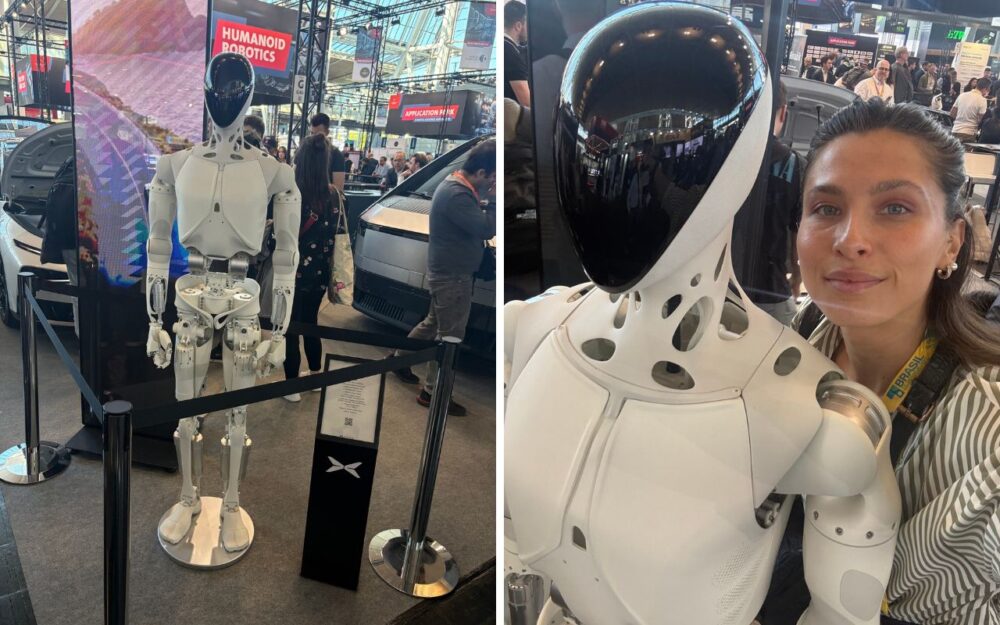
Xpeng: Iron Brings Automotive-Grade Scaling to Humanoid Robotics
Xpeng applies its automotive manufacturing expertise to humanoid robotics with IRON, a humanoid system designed from the outset for scalability and industrial deployment. Technically, IRON reflects this ambition: standing 1.73 meters tall and weighing 70 kilograms, it features 60 joints with 62 degrees of freedom, powered by a 2,250 TOPS AI computing architecture and an all-solid-state battery. Its human-like “spine” structure is engineered for stability and dynamic movement.
What differentiates Xpeng’s approach is real-world deployment. IRON is already being tested within Xpeng’s own EV manufacturing facilities, where it performs tasks such as precision assembly and internal material transport. These in-house deployments allow Xpeng to validate humanoid performance under true production conditions rather than controlled lab environments.
To support industrial scaling, Xpeng is constructing a 110,000 m² production facility in Guangzhou, aimed at enabling full-scale humanoid robot manufacturing by the end of 2026. By transferring automotive-grade hardware standards, quality control processes, and software integration practices into humanoid robotics, Xpeng positions IRON as a system designed not just to work but to be produced at volume.
According to Janik Jülch, Marketing Events, Sponsoring, CX at XPeng Motors Germany,
“We’re bridging mobility and robotics. The focus is no longer on demonstrations, but on scalable use cases, with series production planned by the end of the year.”
Schunk: Industrial Dexterity Through Modular Humanoid Hands
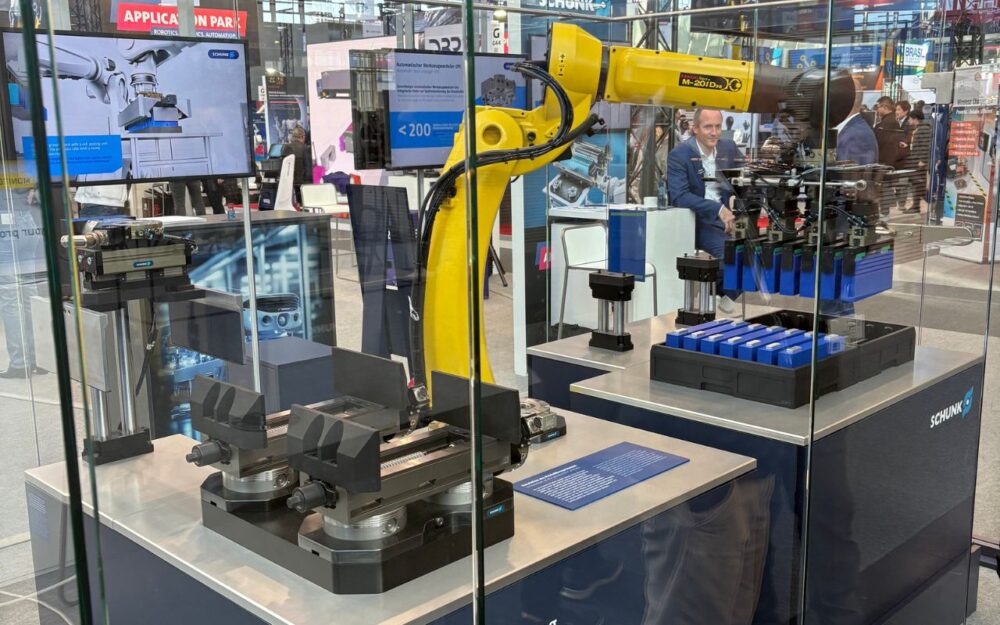
Rather than building a full humanoid system, Schunk focuses on one of the most critical bottlenecks in humanoid robotics: dexterous, reliable manipulation. Through its spin-off Schunk Humanoid Robotics GmbH, the company develops a modular five-finger robotic hand with an integrated wrist, based on long-standing research from the German Aerospace Center (DLR).
The hand is designed as an industrial end-of-arm solution that can be integrated into humanoid robots from various manufacturers. Its strength lies in precise handling of sensitive components; a task where traditional grippers often reach their limits. Typical use cases include assembly operations, electronics manufacturing, and applications requiring human-like dexterity.
By working closely with DLR, Schunk focuses on transferring advanced research into proof-of-concept systems that comply with industrial standards, accelerating time-to-market for humanoid manipulation technologies.
Schaeffler: Actuator Platforms as the Backbone of Humanoid Robots
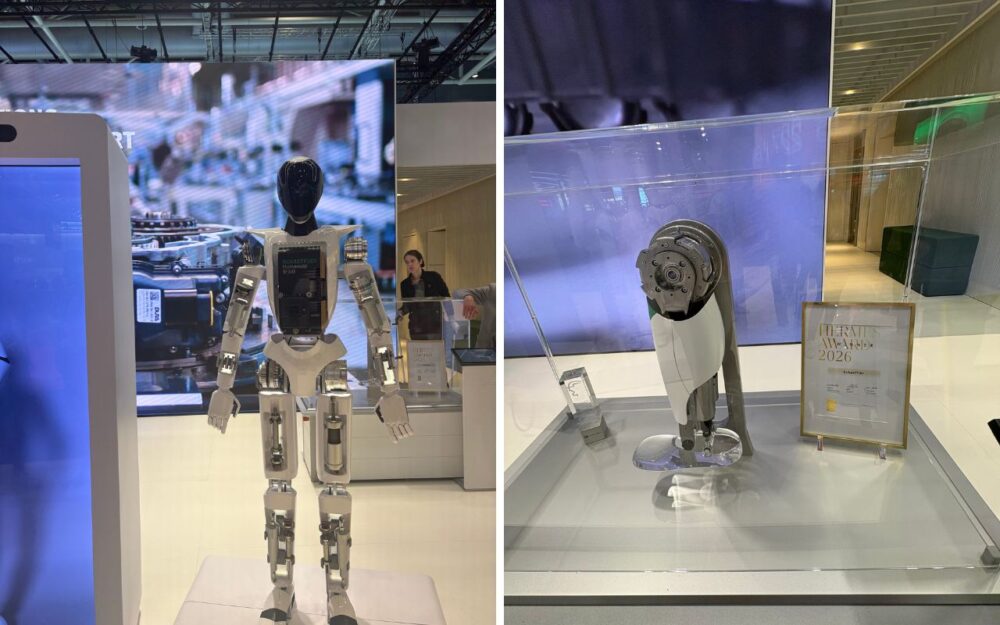
Schaeffler addresses what many consider the most critical technical constraint in humanoid robotics: actuation. At Hannover Messe 2026, the company showcases its highly integrated actuator platform, which received the Hermes Award 2026 for innovation. The actuators are up to 20% more compact than comparable solutions. They are thermally stable under continuous load, and capable of delivering torque levels of up to 250 Nm, making them suitable for humanoid joints.
These actuators integrate power electronics, sensors, and gearing into a single compact unit. Given that actuators can account for up to half of a humanoid robot’s total system cost, Schaeffler’s platform has significant economic implications. By reducing size, complexity, and cost, it enables humanoid robots to become more affordable and robust for industrial deployment. Schaeffler is already preparing the global rollout of the platform. The company is working with humanoid robotics startups and planning internal deployments across its own manufacturing sites.
According to Uwe Motzkau, Manager Application Engineering Industrial Machinery at Schaeffler AG,
“Schaeffler’s roots lie in the automotive industry and component supply. While we are traditionally strong in linear motion, we increasingly focus on combining linear and rotational technologies to enable complex industrial applications.”
Hannover Messe 2026 makes one trend clear
Humanoid robots have moved beyond experimentation and are entering the phase of industrial validation. With advances in actuation, manipulation, and scalable production, the focus is shifting from technical feasibility to economic impact and deployment speed. As components mature and use cases sharpen, the question for industry is no longer if humanoids will be adopted, but where they create the greatest operational value.
Watch more photos of humanoid robots at the fair