



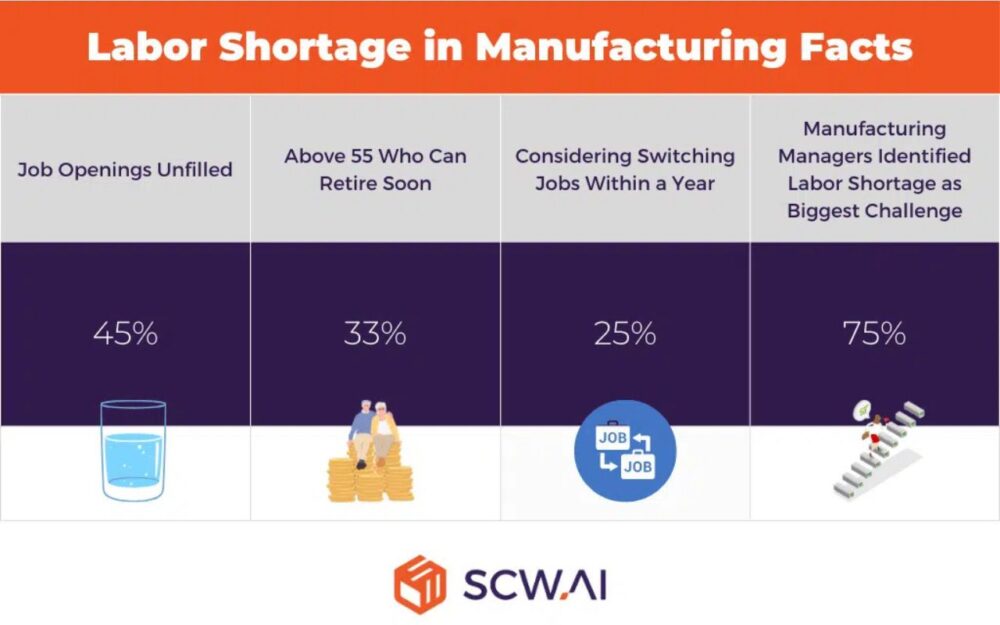
Deloitte and The Manufacturing Institute project 2.1 million unfilled US manufacturing jobs by 2030. Behind that number are delayed shipments, experienced workers doubled up on roles they can’t fully cover, and growth plans revised because of overstated headcount. AI is now showing up on the shop floor as a practical answer to that problem by making the existing employees more effective.
Understanding Skilled Labor Shortages in Manufacturing
The median US manufacturing worker is in their mid-40s, several years older than the broader labor force. Retirement doesn’t just create a vacancy. It drains process knowledge that took decades to build like calibration instincts and failure pattern recognition from seeing the same machine break the same way four times.
Fewer young people are coming in behind them, and the training infrastructure at smaller manufacturers hasn’t kept pace with how fast automation and controls systems change. The pipeline is narrowing from both ends.
AI Tools and Technologies Transforming Manufacturing
The most useful thing AI does on a manufacturing floor is take work that shouldn’t require skilled judgment and just handle it, like:
- Material moves
- Machine tending
- Repetitive assembly
- Quality checks that a vision system runs faster and more consistently than a tired person at the end of a long shift
Cobots and computer vision can do what they’re good at and free up the people who actually know things to troubleshoot and make the calls that require someone who has seen a failure mode before.
Global robot installations hit a record in 2022 with more than 500,000 new industrial robots deployed worldwide. Cobots specifically work well in high-mix, low-volume environments because they’re easier to program and safer to run alongside people.
Predictive maintenance is where most teams see the clearest, fastest returns. Machine learning models watch sensor data and flag bearing wear, temperature drift, pressure anomalies before any of it becomes a stoppage.
McKinsey estimates that kind of early intervention can cut machine downtime 30-50% and extend equipment life by 20-40%. Those numbers hold because the alternative (waiting for failure) is expensive in ways that compound fast. Less firefighting means the same team ships more, giving manufacturers greater flexibility as they pursue global diversification strategies and expand into new markets.
Computer vision doesn’t fatigue. BMW deployed AI-based visual inspection across multiple production steps to catch anomalies and give workers faster feedback.
The World Economic Forum’s Global Lighthouse Network documents sites combining AI, IoT, and advanced analytics hitting double-digit productivity and quality gains while cutting waste and energy.
The pattern in every strong case is the same: one line, one problem, prove it, then scale. Team cohesion matters in high-pressure environments where turnover is high and morale is fragile.
Challenges and Considerations When Adopting AI
Most AI pilots fail before the technology even gets a chance. Ask yourself these questions before you start.
Is your data actually ready? Models are only as good as what feeds them. Sensors need to be production-ready, networks need to be reliable, and someone needs to exist who can translate between what the data shows and what the floor actually needs. That person is hard to find and easy to lose.
Can you prove the ROI before you scale? The cost lands first, sensors, software, integration, training. The payback comes later. Implementations that survive that gap built a concrete scorecard from day one:
- Downtime avoided
- Scrap reduced
- Throughput gained
- Safety incidents prevented
Vague efficiency promises don’t hold up when finance asks questions. Specific numbers do. The workforce side is where most rollouts either earn trust or destroy it.
A predictive maintenance system installed without explanation becomes a surveillance tool in the minds of the people working next to it. Workers who understand why a tool exists use it. Workers who feel it was installed over their heads find ways around it.
Future Outlook: AI and the Evolution of the Manufacturing Workforce
The World Economic Forum’s 2023 Future of Jobs report projects that by 2027, technology adoption will both create and displace roles across the economy. In manufacturing that means automation technicians, data-literate quality engineers, multi-skilled operators who can work across systems.
The takeaway is: pair senior people with early-career hires so they can pass on their wisdom. Bring AI into the equation as a supplement initially, not a lazy catch-all.
That’s how institutional knowledge actually moves, through proximity to someone who has seen the failure modes and remembers what they meant.