

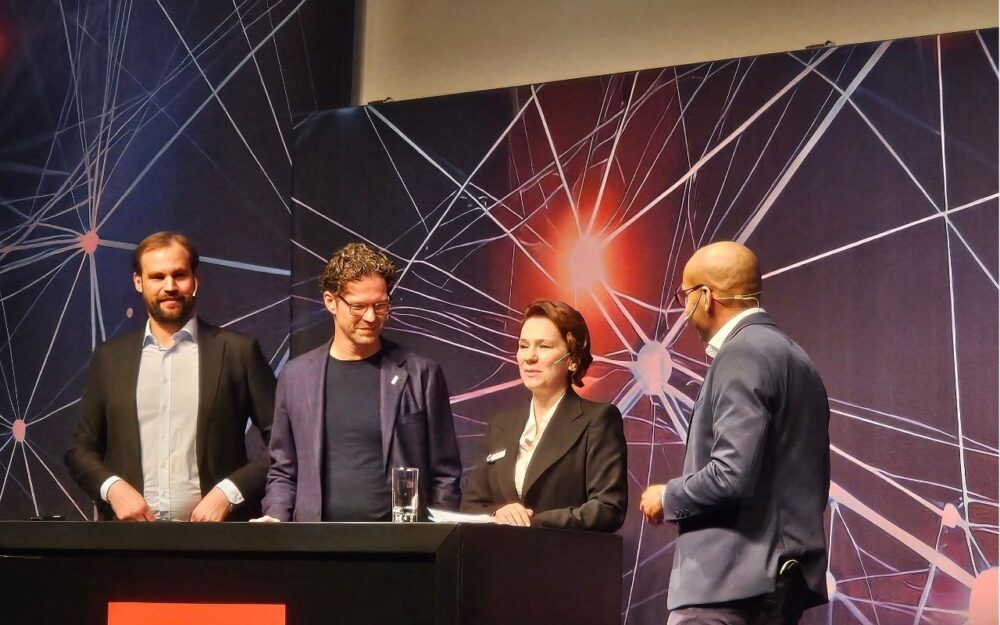

During Hannover Messe press preview, an event we attend every year, Norbert Jung from Bosch Connected Industry, Lilija Kucinskaja from German Edge Cloud and Sven Parusel, from Agile Robots, came together to address a deceptively simple question: what separates AI projects that deliver ROI from the 95% that don’t? In other words, how can AI actually be implemented in factories to deliver measurable value?
The manufacturing sector is at a crossroads. Cost pressures are intensifying, experienced workers are retiring — taking decades of operational knowledge with them — and market volatility has never been higher. At the same time, AI has emerged as a genuine technological force, promising to address exactly these challenges.
But there’s a hard truth that every business leader needs to confront before they invest: according to a MIT study we have often talked about in this media outlet, 95% of AI projects in manufacturing today do not deliver economic value. 5% do. The question is no longer “Should we implement AI?” — it is “How do we become part of the 5% that actually succeeds?”
At Hannover Messe press preview, three leading voices in industrial AI — Lilija Kucinskaja, Product Owner AI & Analytics at German Edge Cloud, Norbert Jung, CEO of Bosch Connected Industry, and Sven Parusel Head of Research Partnerships at Agile Robots — offered a frank and practical roadmap. Here is what we learned.
1. Start with the KPI, Not the Technology
The most consistent message from all three panellists was that AI implementation must begin with a specific, measurable business objective. Not with the technology itself, Norbert Jung, CEO of Bosch Connected Industry explained:
“The 5% that deliver results know exactly what KPI they want to improve. They get there with domain know-how about how the process needs to change, and they have the data foundation right.” —
Before any AI vendor is selected or any data pipeline is built, the leadership team must define:
- Which operational metric are they targeting?
- What is their current baseline?
- What improvement would justify the investment?
This discipline — uncommon in practice — is what separates successful deployments from costly pilots that go nowhere.
2. Leadership Must Be Visibly Committed
For Jung, it all starts with leadership:
“Leaders need to be in the game. If that’s not there, you’re not going to reach the benefits of AI.”
AI transformation is not an IT project. It requires cross-functional change, investment in data infrastructure, and a willingness to redesign processes. None of that happens without senior sponsorship.
Companies that delegate AI to a technical team without executive ownership consistently underperform. The leaders who will win are those who personally understand the strategic stakes and drive adoption from the top.
3. Data Quality and Semantic Context Are the Real Foundation
A recurring theme was what Jung called the “data growth paradox”: the volume of industrial data has doubled. Yet, the business value derived from it has not. The reason is structural.
Most operational data sits trapped in siloed systems — PLCs, MES, ERP platforms — each designed for a specific function and lacking any shared context. A temperature reading means nothing without knowing which machine, which product, and which process it belongs to. Without a semantic layer, data cannot be translated across functions, let alone fed usefully into an AI model.
Lilija Kucinskaja, Product Owner AI & Analytics at industrial SaaS solution provider German Edge Cloud put it plainly:
“Before we talk about using data for AI, we need to talk about data at all — about digitisation itself.”
For many manufacturers, especially SMEs, the first step is simply making existing data visible and connected. That alone surfaces inefficiencies previously invisible, and creates immediate, tangible value.
Sven Parusel, Head of Research Partnerships at Agile Robots reinforced the quality-over-quantity principle:
“You probably don’t have enough data. But it needs to be good data. High-quality data is what allows you to train new foundation models that actually work on the shop floor.”
You could also be interested in this article
4. Avoid the DIY Trap
Jung also warned explicitly against the instinct to build AI capabilities entirely in-house. The ‘DIY trap’ is a significant risk — particularly for mid-sized companies.
Indeed, the landscape of AI models and frameworks is changing at a pace most industrial companies cannot sustain. Add regulatory compliance and cybersecurity requirements, and building from scratch becomes a serious liability. Maintaining internal expertise across all of these dimensions is neither efficient nor sustainable for most manufacturers.
The more effective path is to partner with industrial AI specialists who maintain compliant, production-grade infrastructure — allowing manufacturers to focus their energy on the domain expertise and process knowledge that is genuinely proprietary to them.
5. The Use Cases Already Delivering Results
The panel shared concrete deployments generating measurable returns today.
Agentic AI for Night-Shift Line Recovery
One use case presented by Bosch Connected Industry is centered on agentic AI. When a production line stops at night, the expert who would normally diagnose the problem is unavailable. An AI agent, trained on data from multiple sites and production lines, can now provide diagnostic guidance in real time — with the same quality as a senior expert.
And the value goes further as this is not simply a diagnostic chatbot. The agent also writes back into the shift log, triggers the maintenance agent to update the maintenance schedule, and activates a continuous improvement agent — a chain of coordinated actions across multiple functions, all from a single incident.
For Jung,
“We think that the answer is in bringing AI machines and humans together in a manufacturing co-intelligence.”
AI-Powered Robotic Assembly
Agile Robots talked about gearbox assembly performed by a dual-arm humanoid robotic system using AI vision and AI-driven control algorithms. The system integrates computer vision for object detection with intelligent motion control — enabling complex assembly tasks at a precision and consistency that manual processes cannot match at scale.
For Parusel,
“This is really interesting applications that we see now and we see that many customers see the potential and want to benefit from particular implementations of AI on different levels.”
The Digital Industrial Engineer
German Edge Cloud presented a use case that centers on a different type of AI value: codifying and operationalizing human knowledge. Their ‘digital industrial engineer’ augments the work of engineers by making tacit expertise — documents, historical decisions, troubleshooting know-how — searchable, applicable, and actionable in live production contexts.
This addresses a challenge that purely data-driven AI cannot: the knowledge that lives in people’s heads and in unstructured documents, not in databases, detailed Kucinskaja:
“Not only structured, numeric data is a source of information. Knowledge is also in documents and in the heads of employees. Digitizing this knowledge and making it actionable in the process is a strategic factor.”
The insight for SMEs is particularly significant: knowledge locked in employees’ heads is as valuable a data source as any sensor reading.
6. The SME Imperative: A Step-by-Step Path
Speaking about SMEs, SMEs form the backbone of the European industrial network Kucinskaja said:
“ I think AI in Germany is an industrial reality for large companies. small and medium enterprises are adopting AI very selectively and carefully.”
And for good reason. They face the same challenges as large corporations with a fraction of the resources. Therefore, Kucinskaja outlined a pragmatic, staged adoption path for them in 4 steps:
- Digitise — Connect disparate data sources across the factory into a single, unified view.
- Contextualise — Add semantic layers so data from different systems can be understood together.
- Share — Exchange relevant data across the supply chain with machine builders and partners.
- Augment — Layer AI use cases onto this foundation, starting with high-impact, low-risk workflows.
Crucially, she emphasised change management: companies need to involve everyone in this process and move at a pace they are comfortable with. Sustainable AI adoption requires employee buy-in, not just executive mandates.
The Bottom Line
AI in manufacturing is not a future possibility — it is a present reality for those who approach it correctly. The gap between companies that succeed and those that stagnate comes down to a handful of fundamentals:
- Define the KPI you want to move before choosing any technology.
- Build leadership commitment at the executive level.
- Invest in data quality, connectivity, and semantic context as the true foundation.
- Start with high-value, proven use cases rather than broad experimentation.
- Partner strategically rather than building everything in-house.
- Bring SMEs along — because a competitive European industrial ecosystem depends on it.
As Parusel put it:
“We need to succeed. If we don’t participate in this movement, we will have big problems.”
The stakes are high — but so is the opportunity for those ready to move deliberately and intelligently.