


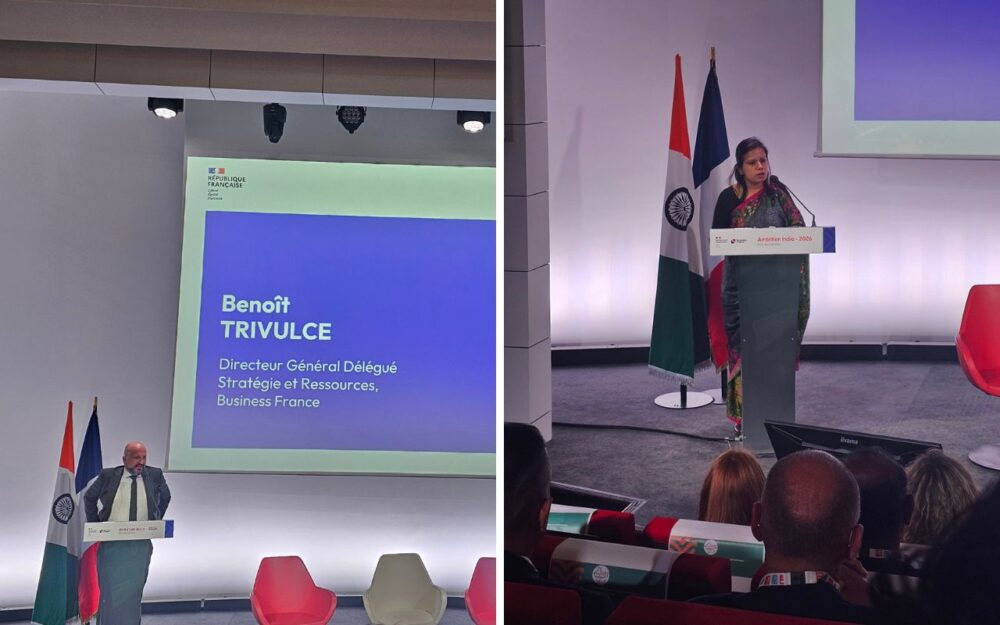
With a population of 1.4 billion and annual growth hovering around 6%, India is becoming a central player in global trade. Europe, and France in particular, are keen to seize this momentum. This was the core focus of the Ambition India forum. Organized by Business France in Paris last week, it gathered public and private stakeholders to explore the synergies between the two regions at a time of profound global realignment. The discussions took place just months after the announcement of a landmark trade agreement between the European Union and India, setting the tone for a new phase in bilateral relations.
The FTA
The EU-India free trade agreement dominated conversations throughout the forum. This ambitious deal, covering nearly 2 billion people and roughly a quarter of global GDP, aims to significantly reduce tariffs, by up to 90% across a wide range of sectors. While the agreement has been signed, it is not yet in force, with ratification expected by late 2026 or early 2027.
In a world increasingly shaped by fragmentation and shifting alliances, the EU and India are beginning to see each other as key partners in shaping a new economic order. As Eenam Gambhir, Deputy Chief of Mission at the Indian Embassy in France observed,
“We are witnessing the end of an era and the creation of a new world. And the partnerships we choose today will shape both our economic trajectories and the global order itself.”
On both sides, the objective is ultimately the same: to create a safer and more predictable business environment for companies. This is precisely why Business France used the forum as a platform to bring together Indian and French companies, encouraging dialogue and concrete business engagement.
As Benoît Trivulce, Deputy CEO for Strategy and Resources at the French agency, put it:
“International agreements don’t create markets, but they accelerate business presence by making it more secure. Today, if you’re French, you need to go to India. And if you’re Indian, you should be investing in France.”
The numbers already point to a deepening relationship. Around 150 Indian investors are active in France, while more than 5,500 French exporters operate in India each year. At the European level, according to the European Commission, nearly 6,000 European companies are already present in India, while the EU’s stock of foreign direct investment in the country reached €132.8 billion in 2024. The objective now is to demonstrate that India is not only vast, but also accessible, including for mid-sized industrial firms from France and more broadly from Europe.
The New India: A Driver Of The Global Economy?
Despite its scale, India remains surprisingly underexplored in European business circles, noted Sophie Sidos-Vicat, President of the French Foreign Trade Advisors:
“We hear all day about China and the United States, but we forget what is, in my view, the biggest market: India. With the FTA, real, tangible opportunities will emerge.”
But does that mean India is becoming the new China? Estelle David, South Asia Director at Business France and based in Delhi, whom we spoke to on the sidelines of the forum, was categorical:
“India is not the next China. It is something different. It’s even the next India, I would say. A distinct, rapidly evolving economic power with its own model and trajectory.”
And this model is the result of a profound economic transformation. As Rajib Das, Principal Advisor, Department of Economic Research at the Reserve Bank of India explained, the country has undergone a complete repositioning:
“India was once seen as a vulnerable economy… that has now completely changed.”
Post-pandemic, India has indeed maintained growth rates close to 7%, supported by a unique combination of demographic expansion, policy reform, and institutional stability. But, as Das emphasized, demographics alone are not enough. What truly sets India apart, he believes, is the broader ecosystem:
“A resilient and open financial sector, strong democratic institutions, and a highly skilled workforce, particularly in digital and engineering fields and AI. We have a large base of graduates with strong coding capabilities. That’s a key driver of innovation.”
India is also emerging as a major production and innovation hub. Large-scale investments in infrastructure, from highways to solar energy and industrial corridors, are accelerating the country’s industrial transformation.
One striking example is the Ganga Expressway, inaugurated last month by Indian Prime Minister Narendra Modi. Stretching nearly 600 kilometres, it connects western and eastern Uttar Pradesh and is designed not just as a transport axis, but as a full-fledged economic corridor.
Manufacturing is also expanding rapidly and diversifying, aligning India more closely with global value chains. Across the country, a network of mega industrial corridors, including the Delhi-Mumbai Industrial Corridor, is connecting factories, logistics hubs, and ports to reduce costs and integrate India more deeply into global supply chains.
In an interview we conducted shortly after the signing of the FTA, Loïc Benatar, President of the logistics company Nexline did not hide his enthusiasm for an agreement he sees as highly promising. While acknowledging the logistics challenges ahead, he considered none of them insurmountable:
“In terms of logistics investment, there is a great deal happening, and many things are set to evolve: domestic planning, multimodal offerings, and so on. I firmly believe this agreement will further focus infrastructure providers and shipping lines on improving their multimodal offering, which will help better connect more isolated regions.”
An Economy That Attracts (and Retains) Capital
One of the most interesting developments is India’s evolving relationship with global capital. The country is not only attracting investment, it is also retaining it, Nivruti Rai, Managing Director of Invest India explained:
“While investors repatriate profits from India, those funds are often reinvested back into the country as direct foreign investment.”
This cycle reflects a growing level of confidence. Rai illustrated this with a compelling example:
“I share with you an example of a bank which invested six billion dollars in India, repatriated six billion, and still maintains six billion invested in the country. So if we do our investment very carefully, the returns are tremendous.”
Such patterns signal that India is therefore increasingly viewed as a long-term, reliable investment destination. Investment flows are concentrating in sectors aligned with global demand and technological transformation. Renewable energy, infrastructure, electronics, semiconductors, automotive, and digital technologies are all attracting significant capital. For Rai,
“There is massive digitalization underway, and growth is increasingly driven by technology.”
At the same time, India is moving up the value chain. The rise of Global Capability Centers (GCCs) illustrates this evolution. Initially established as operational hubs, these centers are now taking on strategic roles within multinational organizations.
As Giselle Barboza explained:
“They are evolving into second headquarters.”
These GCCs now contribute directly to innovation, R&D, engineering, data management, and high-value strategic decision-making for global corporations.
An Opportunity For Europe
In this context, the EU-India FTA represents a powerful catalyst. For Ezechiel Kahn, Head of Trade Policy Office at the French Treasury, the agreement reflects a shared commitment to building balanced, rules-based trade relations in an increasingly uncertain global environment.
“The economic potential is significant. Trade between the EU and India currently stands at around €120 billion and could more than double in the coming years. The agreement is also expected to generate approximately €4 billion annually in tariff savings.”
The agreement indeed provides for the gradual liberalization of approximately 99% of Indian exports to the European Union and 96% of European exports to India over a ten-year period following its entry into force.
Beyond tariffs, the deal addresses key structural barriers. It will improve market access, streamline regulatory conditions, and strengthen legal protections, particularly in areas such as intellectual property and taxation. European companies will benefit from a more predictable and secure business environment, with equal treatment alongside domestic firms.
Strategic sectors for France, including aerospace, chemicals, pharmaceuticals, machinery, cosmetics, and wines and spirits, stand to gain directly from these changes.
Preparing To Seize The Opportunity
Yet unlocking India’s potential requires preparation. As Giselle Barboza cautioned:
“India is not an easy market, but India is rewarding if you plan well.”
Companies must begin now, refining their market entry strategies, choosing the right local partners, and navigating a regulatory environment that, while improving, remains complex.
One French company we met at the forum develops solutions aimed at increasing the value of wind energy projects through advanced digital and simulation technologies. Its management is actively targeting both the Indian and French markets to expand internationally.
Asked which market they believed would materialize first, the answer came without hesitation: India.
“China still seems more difficult to approach today. India appears, despite everything, to be a more accessible market.”
Still, as Vice President, Franco-Indian Chamber of Commerce and Industry Pierre-Marie Relecom warned, entering India also means accepting the logic of long-term investment and delayed returns:
“The fact is, whenever you go to India, you have to think long term if you want to capture the real opportunities. You need to be prepared to invest with a ten-year horizon, even if profitability does not come immediately. But in the end, those who stay committed can achieve very strong returns.”
Another point, however, that was not discussed during the forum is the fact that India still faces significant internal challenges, particularly corruption.
Despite its economic rise, the country continues to struggle with structural weaknesses. According to the Transparency International Corruption Perceptions Index 2025, India ranks 91st out of 182 countries with a score of 39/100, below the global average. The ranking reflects both progress, particularly through the digitalization of public services but also the persistence of institutional and bureaucratic fragilities.
An Indian industry analyst living in London whom I met at another press event summarized the paradox this way:
“India is a market of the future, with a young population, strong dynamism and ambition carried abroad by a very popular prime minister. But the country remains highly corrupt.”
She cited the example of a Western company that ultimately chose to cease operations in India because of corruption-related issues.
Still, in a world marked by uncertainty and growing geopolitical confrontation, Europe must look toward India, just as India must look toward Europe, if both want to reduce their dependence on China and the US. The two regions increasingly need to join hands.
And for European companies, the real question is no longer whether they should engage with India, but how quickly they can do so.