


AI Judgement Station applications can learn from the best human inspectors and support the less experienced, becoming both an automation solution and a consultant to elevate overall inspection performance. Content provided by Yamaha.
In surface-mount assembly, interest in AI is intense, particularly around automated optical inspection (AOI). The leading electronics manufacturers already expect their equipment suppliers to be able to provide well developed AI tools. On the other hand, some are cautious about how to adapt to working with AI while maximising its potential for accelerating workflow and removing human error. From either standpoint, using AI as an inspector in SMT assembly can realise several known strengths. It includes its unfailing attention span, consistent judgement, and faster decision making.
An Inspector for Life
Retaining skilled inspectors to check boards rejected due to AOI No-Good (NG) judgements is a well-known challenge for electronic manufacturing businesses. The work is repetitive yet stressful, demanding sustained high throughput while also imposing high responsibility. A single defective unit leaving the factory puts the employer’s reputation at risk.
The issue for production managers is that the typical human engagement cycle follows a familiar sequence. An inspector joins the team and begins to gain knowledge and experience by analysing large numbers of AOI images labelled either OK or NG. While expertise grows, familiarity and the repetitive nature of the work can produce fatigue. A familiar pattern is that inspectors achieve a high level of proficiency and then begin to seek a different role within the company, or may leave altogether. The value of their expertise, within the team and the enterprise, is then lost.
Managers can break this cycle by training AI to become an expert that is always present, always attentive, and permanently engaged. If deployed in a suitable way, the trained AI can effectively store the acquired experience of the inspection experts that have worked in the team and become a consultant, ready to support new inspectors joining in the future.
Training for the Secondary Judgement Process
One way to achieve this is to infuse AI into the workstations where inspectors review the assemblies rejected after AOI. Any units found to be falsely identified as defective can be directed back into production to complete their build, while those with verified defects may be sent for rework.
When adopted in the secondary judgement process, AI first joins the inspection team as a recruit and must learn “on the job” from the company’s experienced inspectors. When rejected assemblies arrive, human inspectors review the AOI data and images to apply their own judgement. If their decision shows the AOI has flagged a false NG, the board can be sent forward to complete the remaining production processes. As the AOI images and the human inspector’s decisions are saved, the AI server uses this accumulated data to train inspection models. As the training continues, using data acquired day by day, the accuracy of the models improves, and the AI can begin to support human judgement during live inspections.
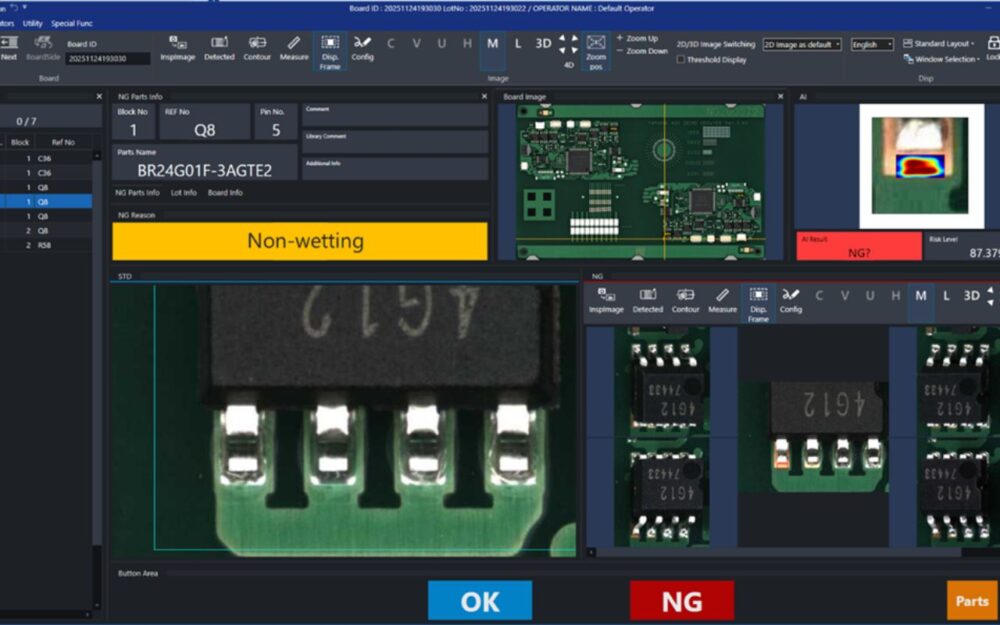
Training the models this way can quickly reach a level of confidence sufficient to assist human inspectors in their decision making. When inspecting a defect site, the AI Judgement Station can present the AI’s opinion with an associated confidence score, as shown in figure 1. This level of support can be particularly valuable for less experienced inspectors, letting them rely on the AI for assistance with difficult cases, helping to refine their own expertise, and at the same time improving both accuracy and throughput.
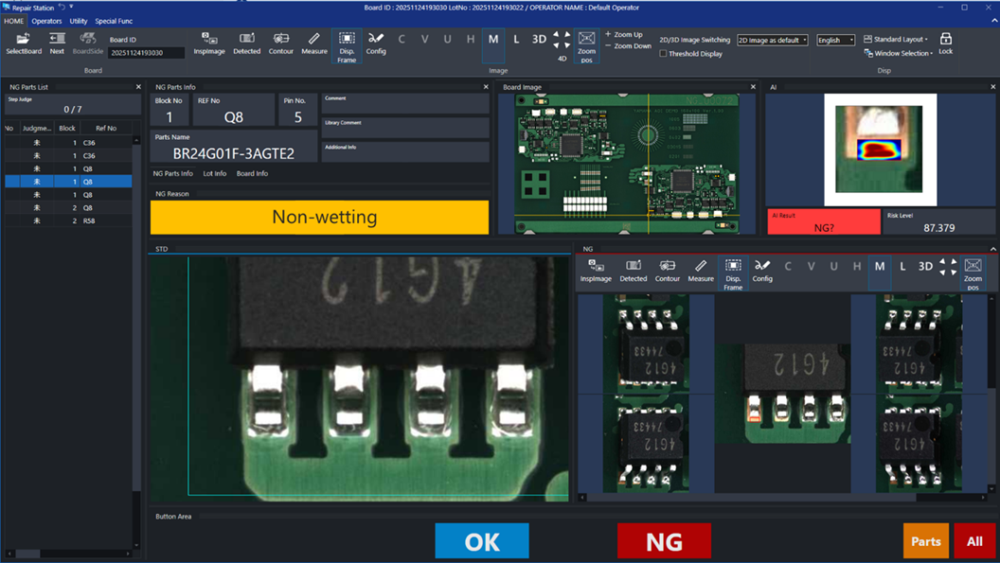
As each model reaches a stable confidence value, indicating that the accuracy has become close to perfect, the AI becomes ready to provide automated judgement for specific component types and defects. At this stage, the best judgement of AI combines with the human inspector’s skills to ensure the process becomes faster while maintaining high accuracy and reducing operator fatigue.
Where to Begin
Software applications with features like these are now entering the market and are extremely effective for checking soldering defects such as insufficient solder or inadequate wetting flagged by 2D AOI inspections. Yamaha Robotics created its AI Judgement Station environment with the goal to let customers create and train AI models independently using their own production data. After selecting suitable samples for training, users can leverage features of the software to generate the AI models automatically and subsequently train the models within a machine-learning framework using the data collected from daily inspection shifts. Users can verify the accuracy as the training progresses to identify when the model has become stable. After analysing enough OK images and 30 or more NG images, the model can achieve a level of accuracy suitable to begin assisting human inspectors with their visual analysis. This can be accomplished in a short timeframe, although more images deliver further improvement. After processing over 1000 images, the model quality can become extremely high. AI judgements take approximately one second per inspection.
AI and OCR
One aspect where AI can already provide reliable human-like judgement and effectively relieve the inspector’s workload is in optical character recognition. Conventional rules-based machine vision can misread characters that are low contrast, obscured by scratches or other damage, or obscured by foreign material. These are common hazards in a surface-mount assembly environment. And this can affect important markings like component values, date codes, polarity marks, and board identification.
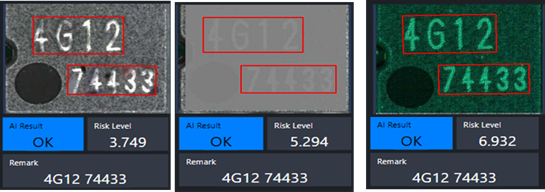
By making inferences based on previous learning, in the same way humans can determine characters when legibility is poor, AI can overcome these problems. The Yamaha AI Judgement Station package embeds pre-trained AI-OCR models. These can be used out of the box with no further tuning or training needed.
Inline Automated Judgement
As AI becomes embedded in the company’s practices, working with different human inspectors, the number of models created to cover different components and defect types continues to increase and training reaches a high level of confidence. Through this progression, fewer automated inspections require visual inspector confirmation. As reliance on human experience diminishes, the secondary judgement process can become fully automated and may finally be integrated inline.
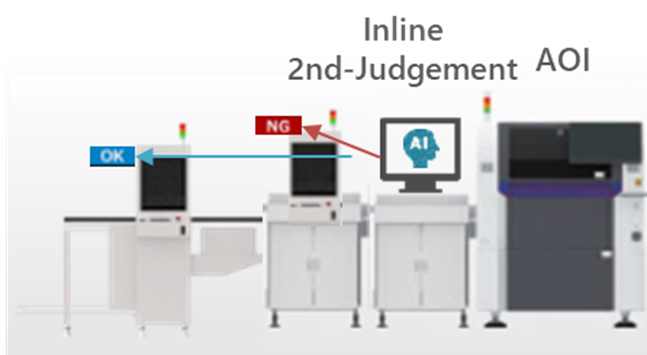
By working with human visual inspectors, providing guidance and offloading decision making where needed, this is consistent with both proactive and cautious approaches to introducing AI in inspection. Cautious adopters can maintain human oversight in place to avoid missed defects and over-inspection in the next process, while at the same time reducing the workload placed on inspectors. On the other hand, packages like Yamaha’s AI Judgement Station present a roadmap to full automation to satisfy the most demanding customer requirements.
Conclusion
As industries worldwide work out how to leverage the strengths of AI in manufacturing processes, surface-mount assemblers are applying the technology to increase productivity in optical inspection. In addition to assisting with creating model libraries and generating programs for inline AOI systems, AI is also enhancing inspection to identify falsely rejected boards.
A three-level approach, using AI to assist, partially automate, and then fully automate the secondary judgement process effectively trains a permanently resident inspection expert to handle this repetitive and demanding task with consistently high speed and accuracy.