
Chinese service robot maker Pudu has opened a European headquarters in Germany. Its showroom, training center, repair workshop and warehouse support the partners that sell its six robot product lines across the region.
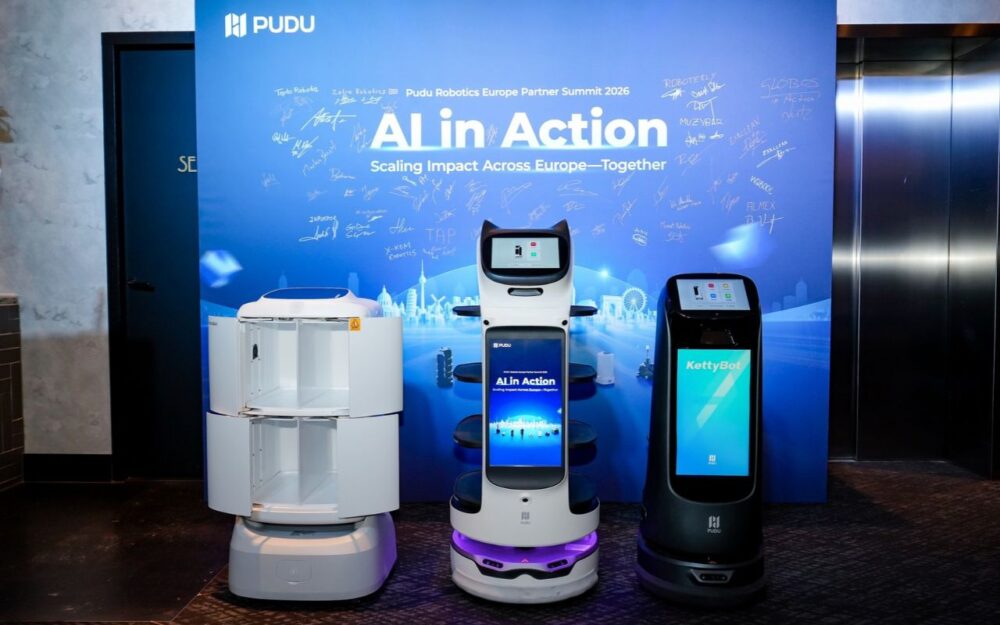
Europe is now Pudu Robotics’ biggest market, with revenue up more than 60% a year over the past two years, and the Shenzhen company is putting down roots to match. Its new headquarters in Neuss, near Düsseldorf, serves partners whose customers range from EDEKA supermarkets to Paris Charles de Gaulle Airport. Days after it opened, Pudu showed all six of its robot product lines together for the first time at its partner summit in Amsterdam.
Robot Training and Repair for Europe
Every Pudu robot in Europe reaches its customer through a partner. Tier-one distributors buy the robots and handle sales and first-line service, while Pudu backs them with training, repairs, spare parts and a solution team that joins projects from the first trial to daily operation. Pudu counts that service network among its biggest advantages in the region.
Neuss and a warehouse in Rotterdam keep robots and parts in stock for faster delivery. Nearly 50 sales staff and 40 technicians support partners across the region. According to Bella Sun, Pudu’s vice president and general manager for Europe,
“Selling a robot is one thing. Keeping them running well on the customer side is another. If a customer or partner needs help, we can offer faster support. If they need training, we can offer faster training to their service team and sales team.”
Six Robot Product Lines on One Shared AI Brain
Most service robots are still programmed one product and one project at a time. And an industrial robot can take months to map and commission on a new site. Longer jobs are a weak spot too. Pudu’s own deployment data shows conventional systems can fail up to 40% of the time on continuous tasks longer than 30 minutes.
Pudu’s fix, which it calls “One Brain, Multiple Embodiments”, is a single AI model, PuduFM, trained on a decade of real-world deployment data. It runs every robot it makes, from delivery robots to humanoids. PuduFM pairs a vision-language-action model, which turns camera images and instructions into movement, with a “physical intuition” model that predicts how objects will behave, such as how hard to grip a cup before it slips.
Running on top of the model, PuduAgent breaks each job into steps and checks every move for collisions or instability before the robot acts. It also pulls skills, such as riding a lift, from a library that every Pudu robot shares. Pudu plans to run PuduFM and PuduAgent in what it calls the first fully robot-serviced hotel, near Shenzhen, with public trials from late 2026 with a 2027 opening.
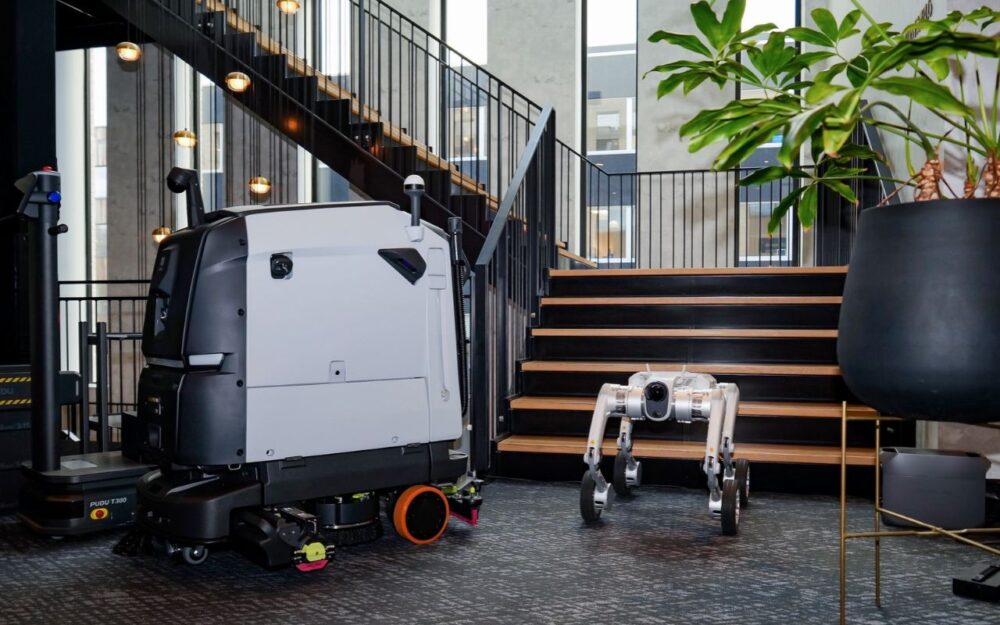
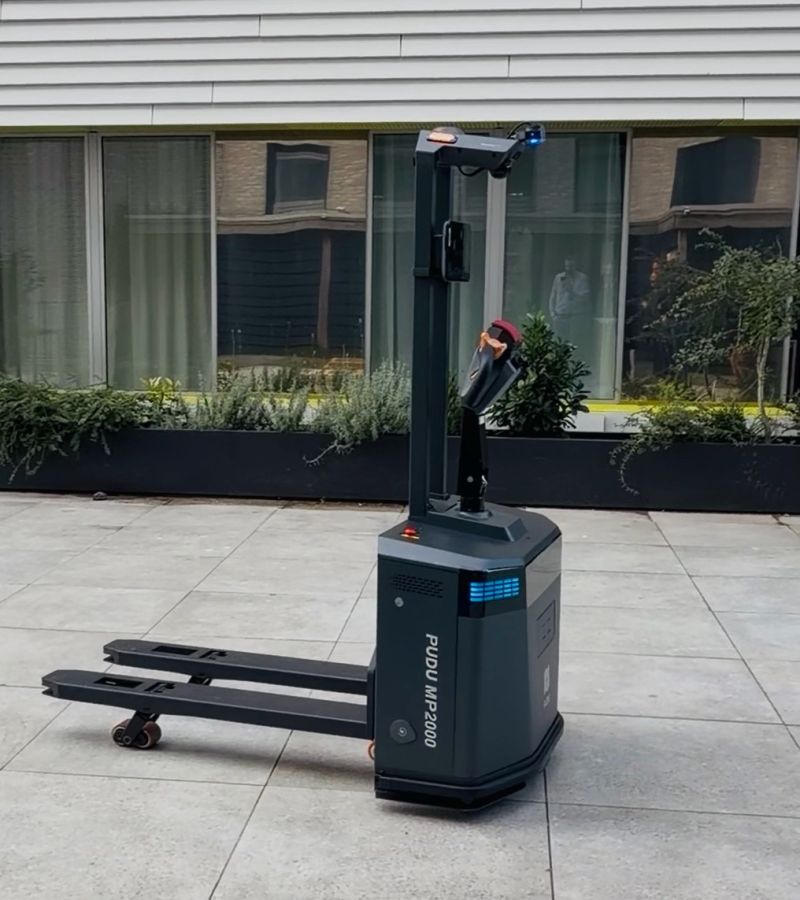
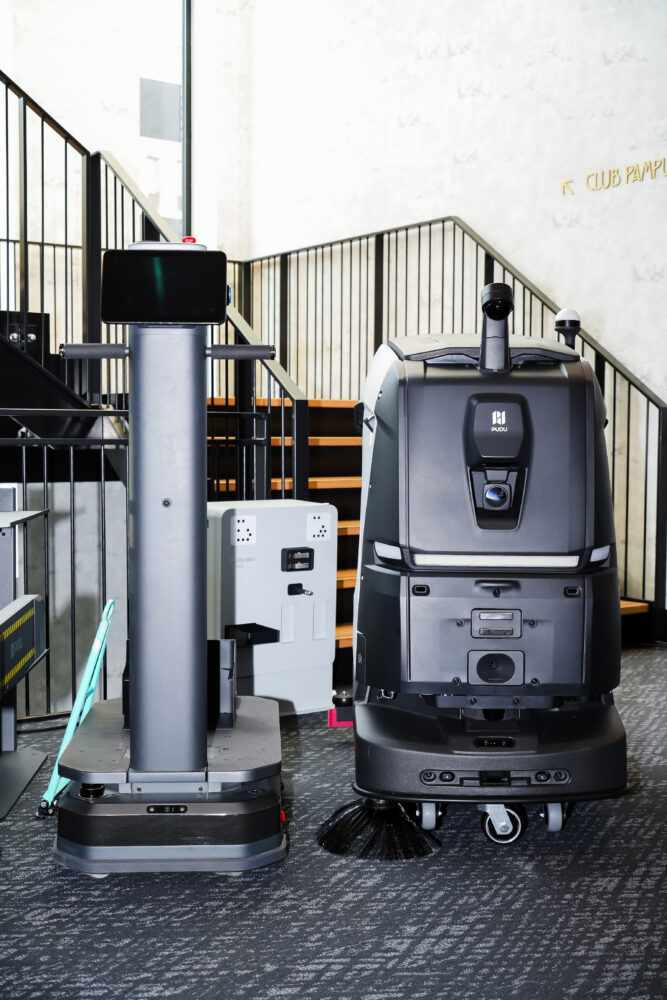
The same system runs across all six of Pudu’s product lines. This includes the BellaBot Pro delivery robot for restaurants and hotels and the CC1 Pro, which sweeps, scrubs, vacuums and mops in one machine. In factories and warehouses, the MP2000 moves pallets of up to 2 tonnes, finding its way with 3D LiDAR and cameras rather than reflectors or QR codes.
Pudu’s D-series includes the D7, a two-armed semi-humanoid that lifts up to 14 kg and feeds data from every task back into PuduFM, so it keeps learning after deployment. Outdoors, the GT mowers tend golf courses and sports fields, while the TOMO S, Pudu’s first home robot, looks after domestic lawns.
AGI and the Limits of Today’s Robots
For all that growth, founder and CEO Felix Zhang is honest about how far the industry has to go. For him,
“Most customers won’t find robots useful until we have AGI.”
By his count, robots can so far do only about 1,000 of the 20,000 tasks people perform. And they have reached less than 5% of the customers who could use them.
“So we are at the very beginning. We have a lot of work to do.”