
Although the hydrogen energy hype in Europe may have passed, exhibitors at the 2026 Hydrogen Technology World Expo in Hamburg, Germany offered some clues on how to make Europe’s hydrogen industry ready for the future. Our reporter Fintan Burke was on the ground.
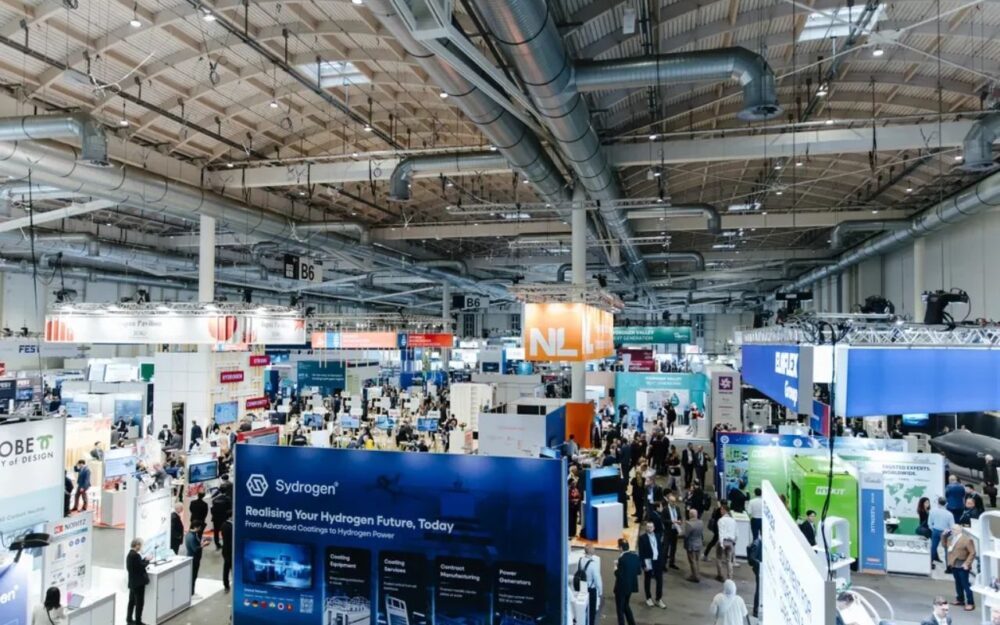
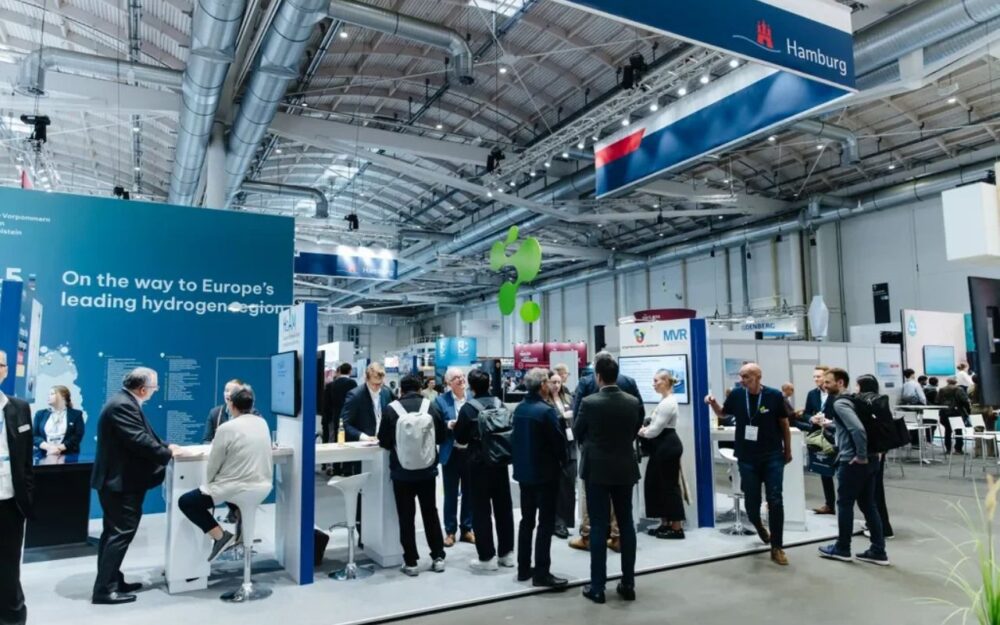
The expo took place from 19 to 21 October and gathered over 1000 exhibitors of hydrogen technology from around the world. In total over 20 000 people attended the event, exploring the latest technology behind a market worth €217.77 billion in 2026, according to Fortune Business Insights.
The Hype is Gone?
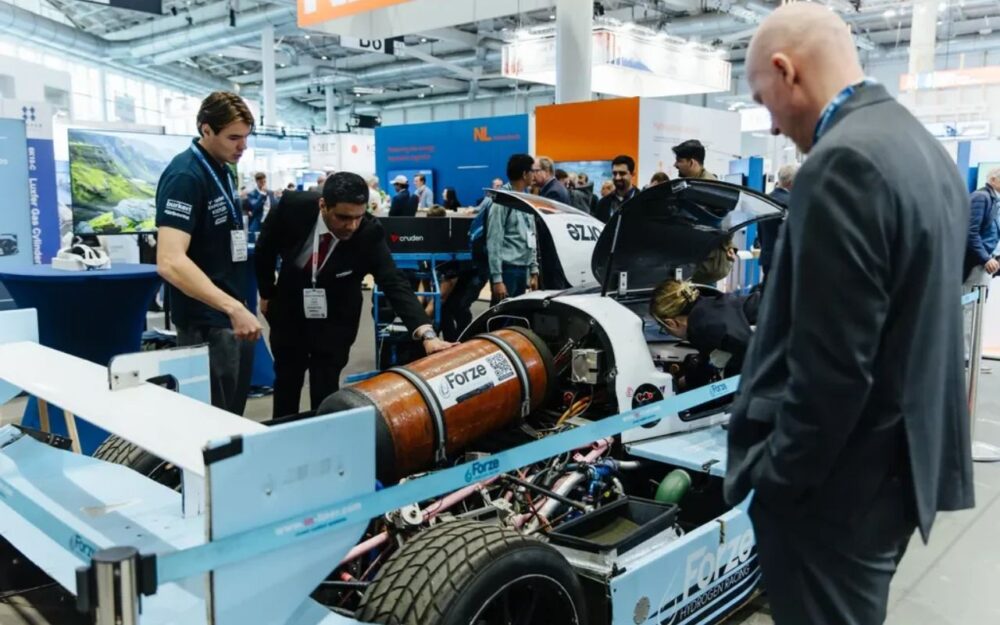
In fact some of the exhibits showed just how far technology in this area has progressed. At one stall Poland’s EVAN Nowe Technologie and Japan’s Taisei Corporation presented a world premiere of their mobile energy system called H2ALLINONE. It combines solar, wind and hydrogen technologies to provide an independent power supply. At another stall the Dutch company Forze Hydrogen Racing showed off its Forze IX hydrogen racing car, developed by students at Delft University of Technology.
But despite these impressive feats, many at the conference note that appetite for hydrogen technology in Europe has dipped in recent years compared to the sector’s “hype” period in the early 2020s. Speakers and attendees at the expo listed several reasons for this, including hydrogen’s high price compared to legacy fuels like petrol, and waning political support.
Many also said that the dip was now over, and that the market was now playing the long game to make a sustainable hydrogen sector a reality for the future. DirectIndustry spoke with exhibitors at the conference to find ways in which Europe’s hydrogen energy industry can prepare for the long term.
Reliable Policy
A constant refrain in the conference is that companies wish for more reliable policies from national and European governments. Kimmy Pultz Bauer from the Danish equipment company Hytor says that after the bubble burst, his company needed to rethink how it used its resources after projects were cancelled. For him, more reliable policies from national and European governments is vital:
“Somebody needs to own those kind of things and there needs to be a motivation to start the projects. We haven’t seen that. Everything is being pushed two years, three years, or four years out in the future. Until somebody comes and builds a large-scale hydrogen production facility, companies will be holding back for investments in our own resources until we see those big projects.”
Credible Long-term Demand
The European Commission’s European Hydrogen Observatory shows that hydrogen demand was still high in 2024, the most recent year that information is available. In 2024 total hydrogen demand was 7872 kilo tonnes. The big consumers were refineries and the ammonia industry, with consumers in Germany, the Netherlands and Poland having the highest demand. But that 2024 figure represents a 1% fall from the previous year, and in 2022 total hydrogen demand was above 8000 kilo tonnes.
Nonetheless businesses on the ground see demand for hydrogen now stabilizing. Establishing long-term demand that the industry can rely on is now a priority. Sebastian Rieder is the CEO of operations at Plating Electronic, which develops and manufactures of DC and pulse-reverse power supplies, rectifiers, and other industrial electronics. He remains optimistic that the market is becoming more reliable for businesses like his:
“We see that it’s stabilizing more. We are looking positively in the future that there will be a new business. There will be projects in the future where you have systems up to five megawatts because it fits to the demand of the industry.”
However, he says that stable demand needs to come along with stable costs of production. Many exhibitors we spoke with note that the green energy from wind or solar that powers the hydrogen-producing electrolyzers is still far too expensive compared to hydrogen made using fossil fuels, says Rieder:
“The rules [and] regulations have to be decreased. Coming to the electrolyser system, you have a lot of margin because you have fees and taxes. I think there should be a focus to reduce for specific purposes the price per kilowatt hour.”
Sharing Risk
To reduce that price even further, speakers at the expo say that Europe’s hydrogen industry need a better-connected supply chain between hydrogen producers, suppliers, and customers. Erhan Erdoğan Groß from the energy company ENERTRAG says that a potential customer may already be interested in renewable hydrogen, but it is difficult for them to commit to long-term contracts with substantial volumes because it is a big financial decision in a relatively young market. For him,
“A risk that is sometimes overlooked the coordination risk because production, infrastructure, and customer facilities all need to be ready at once. So if one part is missing, the others have a problem.”
To fix this, he suggests that long-term contracts across the supply chain, a reference price for hydrogen based on a credible index, and trans-national European projects that can buy equipment and services across the continent.
“We should actively support this opportunity. If you want Europe to remain a technology leader, supplier, European companies need opportunities to particularly. to particularly participate in projects that are built around the world.”
Coordination in the Whole Value Chain
This latter point on better coordination across the value chain rings true for Tania Simon, the Global Product Specialist at the electrification and automation company ABB. This is especially true as new customers ask for different requirements, she says:
“New businesses like data centres are pushing a lot for electrification field development. I see that the requirements that we had six months ago are not totally valid today, so in six months there was a change of requirements that was quite concrete, meaning that our breakers have to be as versatile as possible.”
She would like to see companies come together in technical committees could share best practices and standards to deliver hydrogen more efficiently. Doing so could also help them to coordinate sector-wide responses to new demands and requirements:
“Working on hydrogen can be a merging point for this technology in which companies must be involved. I think also at the university level we should involve companies in the technological development.”
The next hydrogen world expo is already being planned for next year, which brings with it another opportunity for Europe’s hydrogen business to prepare for the long term.