
Industrial heat has long been one of manufacturing’s toughest decarbonization challenges. But as electric heating technologies mature and thermal energy storage gathers momentum, electrification is becoming an increasingly compelling proposition.
A Hot Opportunity
From brewing beer and drying paper to producing chemicals and forging steel, heat is fundamental to manufacturing. Much of it is still generated by burning fossil fuels. Yet the potential for change may be greater than many manufacturers across the industrial spectrum realize. Recent research mapping industrial heat demand across the EU found that 53% of process heat is required below 400°C — temperatures that are largely addressable with commercially available electric technologies.
Dr. Michael Golek, Manager Media Relations at engineering and technology multinational GEA, points to research commissioned by Agora Industry suggesting that currently available technologies could electrify more than 60% of European industrial energy demand that has not yet been electrified. Food and beverage, dairies, breweries, paper, textiles and parts of the chemical industry are among the most promising sectors.
“Low and medium-temperature applications offer particularly straightforward opportunities: hot water, cleaning, pasteurisation, blanching, drying, and the supply of low-pressure steam.”
Doron Brenmiller, CEO of industrial thermal energy storage specialist Brenmiller EU, sees a similar opportunity. For him,
“A significant share of industrial heat demand can already be electrified with commercially available technologies.”
H identifies processes requiring steam, hot water and heat up to around 300°C as particularly attractive.
The case for doing so is no longer purely about carbon. Oxford University researchers recently argued that industrial electrification has become an economic security issue, with fossil fuel dependence leaving manufacturers exposed to geopolitical disruption and volatile energy prices.

You could also be interested in this article
Choosing the Right Technology
Electrification doesn’t mean replacing every gas boiler with the same electric alternative. Industrial heat pumps can be particularly attractive at lower and medium temperatures because they move and upgrade existing heat, rather than simply converting electricity into heat. GEA says its systems can supply hot water at up to 95°C, while heat pumps can potentially provide process heat at substantially higher temperatures depending on their design.
Electric and electrode boilers provide another relatively straightforward route, particularly where factories already rely on steam. Resistance heating and induction can tackle other applications, including some requiring far higher temperatures. For Golek,
“These technologies are largely complementary. Selection starts with the process, not the equipment.”
His advice is to consider temperature, load profile, available heat sources, controllability, space, grid connection and electricity prices together. A heat pump might provide efficient baseload heat, for example, while an electric boiler or resistance system covers higher temperatures and peaks.
Doron Brenmiller agrees.
“Manufacturers should evaluate the cost and performance of the whole system, including integration and operation, rather than selecting equipment on efficiency alone.”
That system-level approach matters because the biggest obstacles to electrification increasingly lie beyond the heating equipment itself.
A Question of Economics
Electric technologies can already reach very high temperatures. The harder question is often whether using them makes financial sense, explains Brenmiller:
“Temperature is no longer the main barrier in many applications. The larger obstacles are often electricity prices, grid capacity, connection costs, and integration into existing factories.”
European electricity can remain expensive relative to natural gas, while factories designed around fossil-fuel boilers may lack the electrical capacity required for large new loads. Grid connection upgrades can add both cost and delay.
Agora Industry reaches a similar conclusion. Its 2026 analysis found that low-temperature heat can already be cost-competitive in favorable circumstances, particularly because of the efficiency of heat pumps. Wider electrification becomes more attractive as the electricity-to-gas price ratio falls, however, highlighting the importance of electricity taxation, grid charges and carbon pricing.
For manufacturers, the lesson is to look beyond the purchase price of an electric boiler or heat pump. GEA recommends first reducing heat demand and losses, then using available waste heat directly, before electrifying the remaining demand with the smallest practical temperature lift. Hybrid systems can handle peaks where necessary.
Can Storage Change the Equation?
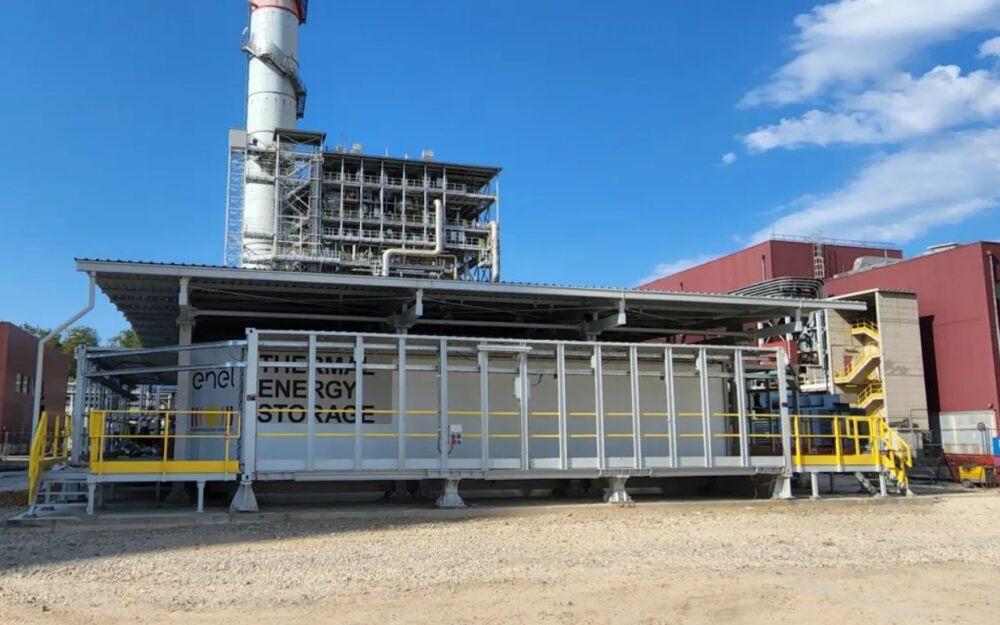
This is where thermal energy storage becomes particularly interesting. Instead of requiring electricity at precisely the moment a factory needs heat, storage can separate the two. Electricity can be consumed when it is cheaper or more abundant, converted into heat and stored until production requires it.
At UK-based clean-tech engineering company Caldera, Marketing and Partnerships Manager Bianca Sassow describes the company’s technology as a “storage boiler”. Electricity heats an aluminium-composite solid storage medium to 500°C, with the stored thermal energy subsequently used to produce steam, she explains:
“The key innovation is that the system decouples the draw of energy from the use of the steam on site.”
The system can therefore charge overnight — when electricity is cheaper, when onsite solar generation is producing surplus power, or when abundant renewable electricity is available on the grid. Its control software responds dynamically to market price signals to optimize charging.
This flexibility can potentially address another major constraint: grid capacity. Sassow says some manufacturers considering direct electric boilers discover that their existing grid connections lack sufficient headroom, requiring expensive upgrades. By spreading electricity consumption across different periods, storage can reduce those peaks:
“A lot of the costs surrounding electrification surround the grid upgrade costs.”
She adds hat Caldera can sometimes
“reduce quite significantly and sometimes eliminate [that requirement].”
Brenmiller sees the same potential:
“Thermal storage allows factories to buy electricity during lower-price periods, store it as heat, and use it when production requires it.”
At beverage producer Tempo, for example, Brenmiller says its installation now supplies all of the site’s steam demand, replacing heavy fuel oil.
The broader economics are becoming increasingly compelling. McKinsey estimates that in several European markets, day-ahead electricity prices are already lower than gas — including CO₂ costs — for up to 40% of the time. The company’s modelling suggests that eight-hour thermal energy storage systems could deliver annual investment returns exceeding 15% in most of the six European countries assessed by 2030.
Storage Isn’t a Silver Bullet
These figures don’t mean every factory in Europe should install thermal storage. The strongest cases tend to combine predictable heat demand with sufficiently large fluctuations in electricity prices. Doron Brenmiller cautions that consistently expensive electricity, limited price differences, inadequate grid capacity, capital costs and energy losses can all undermine the case:
“The investment proposition rests on the savings and flexibility delivered across the entire energy system, not electricity arbitrage alone.”
GEA makes a similar point: storage works best where demand and load profiles are predictable and price differentials are sufficient. It should therefore be designed alongside electricity procurement, grid connections, production planning and heat-generation equipment, rather than being considered in isolation.
For some manufacturers, meanwhile, the most practical route may be gradual, says Bianca Sassow:
“We recommend a gradual transition. The current market favors hybrid solutions as a stepping stone towards full electrification.”
What would this mean in practice? A heat pump might handle steady baseload demand while thermal storage responds to peaks. Alternatively, existing gas equipment might initially remain in place while the easiest portion of steam demand is electrified.
Towards the Electric Factory
Five years from now, factories across Europe are unlikely to have abandoned fossil fuels altogether. But their heat systems could look markedly different.
Dr. Michael Golek expects fewer fossil boilers providing baseload heat, more industrial heat pumps, greater recovery of waste heat and growing use of thermal storage and digital energy management. Hybrid systems will remain important where grids, security of supply or very high temperatures make full electrification challenging.
Doron Brenmiller likewise expects factories to combine grid electricity, renewables, thermal storage, heat pumps and conventional backup, rather than relying on a single technology.
For manufacturers considering the transition today, the key question is therefore shifting. It is increasingly less about whether industrial heat can be electrified, and more about how it should be electrified. And whether the entire energy system around a production process makes the investment attractive.
As Bianca Sassow puts it, industrial steam has traditionally been one of the hardest areas to decarbonize. But manufacturers are increasingly discovering that “the solutions are out there“. The electric factory may not arrive overnight. But in many sectors, the technology needed to start building it is already here.