


While AI is driving the largest capital expenditures the tech sector has ever seen, there is a somewhat quieter yet potentially more impactful tech shift unfolding far from most boardroom discussions: the quantum revolution.
During the last decade, quantum computing and quantum technologies have moved steadily from theoretical physics into real engineering. Applications are taking shape in drug discovery, encryption, logistics, secure communication, defense, and beyond. If in AI Europe is lagging behind and has largely ceded ground to the United States and China, in the quantum race the Old Continent is one of the most favored contenders.
According to Prof. Dr. Tommaso Calarco, the Director of the Institute for Quantum Control at Forschungszentrum Jülich and a current advisor to the European Commission on quantum policy:
“In quantum technologies, Europe is in a much better position than in artificial intelligence, where essentially we have missed the train and are dependent on technologies offered by providers from across the ocean. If we continue with the right political and economic initiatives that we have set in motion, we will manage to maintain our excellence.”
The Quantum Flagship
Prof. Calarco is one of the co-authors of the Quantum Manifesto. In 2018, this document was instrumental in pushing the EU to fund its Quantum Flagship initiative. The program, which is now approaching its natural conclusion, was launched with the goal of coordinating Europe’s quantum efforts at scale. The aim was to build an industrial and scientific ecosystem where none existed.
It also wanted to foster the production of European-made quantum hardware to deploy within European infrastructures, with the broader goal of translating Europe’s scientific excellence into productive and industrial capacity. Surprisingly (given Europe’s track record on deploying coordinated efforts on cutting-edge technologies) the initiative has been a resounding success, and one significant reason why the Old Continent is now so well positioned in quantum.
The Flagship has helped foster many different projects. Today Europe can count on a vibrant ecosystem of research centers and startups working on quantum at the highest level. Among the projects, some of the most interesting ones are those that, in a distinctly European fashion, try to distribute the benefits of quantum investment throughout the Union, by coordinating the scientific and industrial effort toward EU quantum sovereignty.
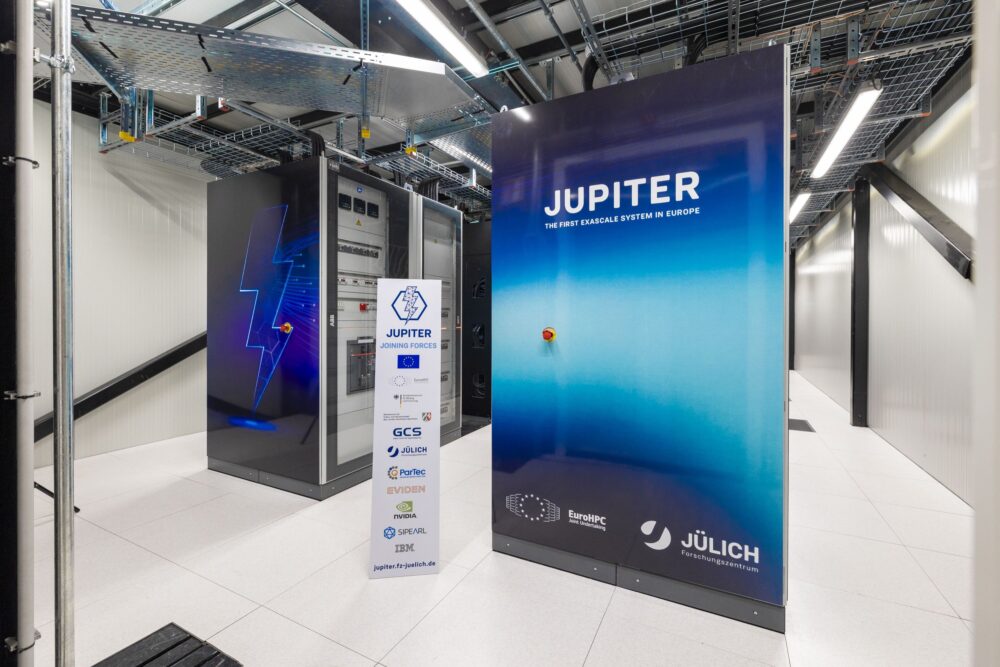
The EuroHPC (high-performance computing) Joint Undertaking, for example, aims at deploying quantum systems alongside traditional supercomputing infrastructure across member states. The EU’s concerted goal is to build a distributed hybrid ecosystem that integrates quantum processors and high-performance computing resources. As Prof. Calarco explains:
“EuroHPC QCS is at this moment anchored to the EuroHPC infrastructure for computing and simulation, where in several European supercomputing centers, including Cineca in Italy, we now have the first quantum machines, simulators and computers, which are being used as co-processors in a hybrid manner. In this way they open up the use of this type of equipment to users both in the academic and scientific field for further research, and also in the industrial field to begin making productive use of it.”
These efforts are leveraging the technologies developed by one of the EU’s most promising quantum computing startups, the Finnish IQM. Under the Euro-Q-Exa initiative, co-funded by EuroHPC and German national ministries, IQM deployed Germany’s first hybrid HPC-quantum system at the Leibniz Supercomputing Center in Munich in 2024, initially running a 20-qubit processor. By early 2026, a 54-qubit system was operational at the same site, with further expansions planned across Poland and Spain.
Beyond Computing
Quantum advancements are not limited to computing, though. While qubit-based computers are still far from widespread commercial applications, other quantum technologies in sensing and communication have already leaped forward. Europe is at the forefront of these too.
European start-ups are already deploying quantum cryptography-based secure networks across all EU member states through EuroQCI, the European quantum telecommunications infrastructure, building towards a continent-wide backbone designed to protect critical data from future threats, including those that might be coming from quantum computers themselves.
According to Prof. Calarco:
“Projects such as the EuroHPC QCS and the EuroQCI are the most promising initiatives because they bring together our great technological prowess with an emerging productive capacity, and also with actual use. They establish a virtuous circle between scientific discovery and the technological development of quantum devices. What we learn from this cycle feeds the next iteration, in research, in production, and again in use, to iteratively improve the capabilities of these technologies.”
The Investment Gap
Thanks to efforts like the Quantum Flagship, Europe has spurred a quite healthy quantum ecosystem. Around a third of all quantum companies worldwide are based in the EU. And the number of European quantum startups is roughly comparable to the US. The continent is home to serious hardware players, the aforementioned IQM in Finland, but also Alice & Bob and Pasqal in France, along with a growing number of emerging companies across member states. Nonetheless, the investment flowing into them is not matching the numbers seen in the United States.
According to official data from the Union, Europe captures only 5% of global private quantum investment, against roughly 50% going to the US. Public funding has been substantial, with over €11 billion mobilized since 2018. But public investments alone cannot scale companies from promising startups to global players. The EU also lacks large industrial early adopters, the kind of customers that in the US have helped companies like IonQ and D-Wave build credibility and revenue while the technology matures. Prof. Calarco puts it clearly:
“We do not so much have a problem with start-ups. 25% of the world’s start-ups in quantum technologies are in Europe, another 25% are in the United States, but the private investment imbalance is clear. The risk is a repeat of what happened with the web. The tech was invented in Europe, at CERN in Geneva, and yet almost all the proceeds of that revolution ended up in Silicon Valley. If we want to avoid missing the Quantum train too, we need to reverse this perspective and manage to foster significant investments in the growth of our EU companies.”
Europe’s Response
The EU is aware of the problem, though it is worth noting that most of the response, at least for now, remains publicly driven. The European Quantum Strategy, a policy brief published last year, explicitly sets out to “crowd in” private investment through blended funds and by positioning public bodies as anchor customers for European firms. The theory is that coordinated public investment can de-risk the sector enough to eventually attract the private capital that is currently going elsewhere.
There are encouraging signs that the ecosystem is moving in the right direction. IQM, for example, is preparing to go public on the New York Stock Exchange through a merger that values it at $1.8 billion. This would make it one of Europe’s first publicly listed quantum companies. With 21 systems sold to 13 customers and at least $35 million in revenue in 2025, it is one of the clearest examples of European quantum science turning into a commercial business, with private capital beginning to take notice.
More broadly, the EU Quantum Strategy defines five key areas of action: research and innovation, quantum infrastructure, ecosystem development, defense and dual-use applications, and workforce training through a dedicated Quantum Skills Academy. Under the EU Chips Act, six complementary quantum chip pilot lines are being established, each focused on a distinct hardware platform. They cover superconducting qubits, ion-trapped qubits, diamond-based chips, neutral atom systems, quantum photonics, and semiconductor-based systems, with up to €50 million in public funding each.
Preserving EU Sovereignty
On the general funding front, the European Innovation Council has already directed around €350 million into quantum startups between 2021 and 2024. Additional investments of up to €30 million per company are being prepared. The urgency behind these measures is motivated by preserving the EU’s sovereignty on its advancements. The goal is to avoid that European startups, starved of capital, could be acquired by non-European investors, taking IP, critical technologies, and talent abroad with them.
The results of these policy approaches and additional risk assessments will inform the Quantum Act, a new piece of legislation at the center of the EU’s policy response that will aim at translating the strategy into binding measures. The Commission is expected to table the legislative proposal soon. After that it will go through the full legislative process involving the Council and the European Parliament.
Prof. Calarco describes the current moment in clear terms:
“The Quantum Act is an extraordinary and truly unrepeatable opportunity. Now and for some years, around 4 to 5, we are still able to remain competitive at the global level. But if we did not sustain this competitiveness with appropriate funding and support for innovation, we would risk being left behind, with the risk of having to once again depend on other countries and other continents for the supply of these frontier technologies.”