
Improving the safety of immersion-cooled lithium-ion batteries under high load, TotalEnergies Lubrifiants’ Coolant Keep Plate reduces the risk of thermal runaway and fire during ultra-fast charging.
Lithium-ion batteries are a key component of industrial electrification efforts, due to their high energy density and ability to charge quickly. The challenge is protecting against the risk of thermal runaway and fire if a battery cell over-charges, over-heats or is damaged.
Direct Immersion Cooling
Direct immersion cooling works by submerging lithium-ion battery cells in a dielectric fluid, which efficiently conducts heat away from the cell while remaining electrically non-conductive.
The fluid makes contact with the entire surface of the battery cell, eliminating the need for several thermal interfaces between the cells and the cooling system. This offers improved heat transfer and temperature uniformity compared to traditional cooling methods like metal cold plates, thermal pads and air gaps.
Major lithium-ion battery manufacturers such as BYD, XING Mobility and Kreisel Electric have adopted the technology, while automotive makers like Volvo have deployed immersion-cooled battery systems in production vehicles.
Remaining Risk
While direct immersion cooling significantly reduces the chances of fire and thermal runaway propagation, a critical risk remains.
Lithium battery cells vent gas when their internal pressure becomes too high due to stress, failure or dangerous operating conditions. This violent gas jet can displace or expel some of the dielectric fluid, leaving part of the cell exposed. This compromises cooling and can allow thermal runaway to continue.
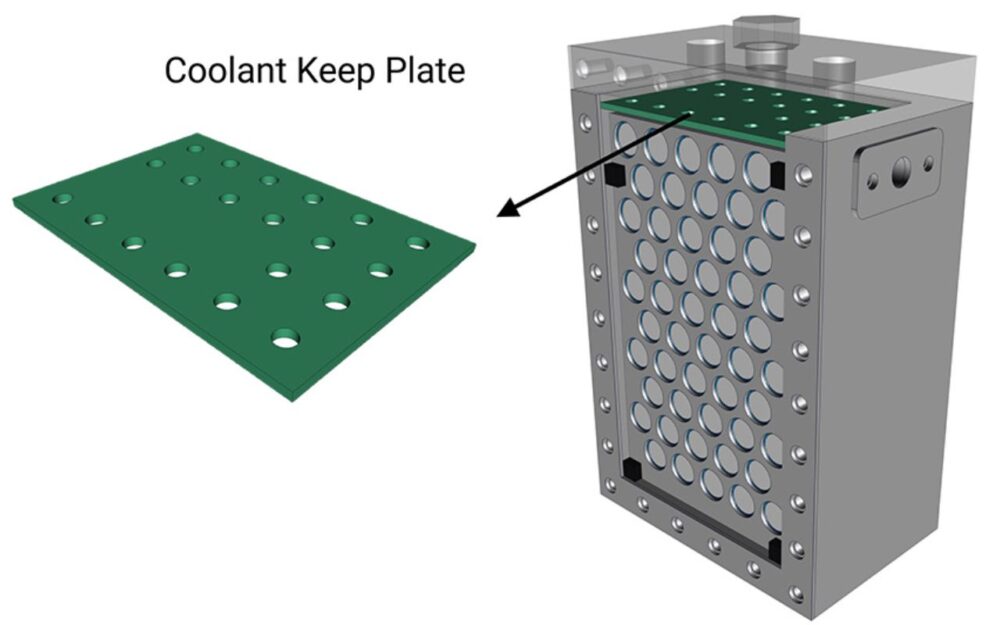
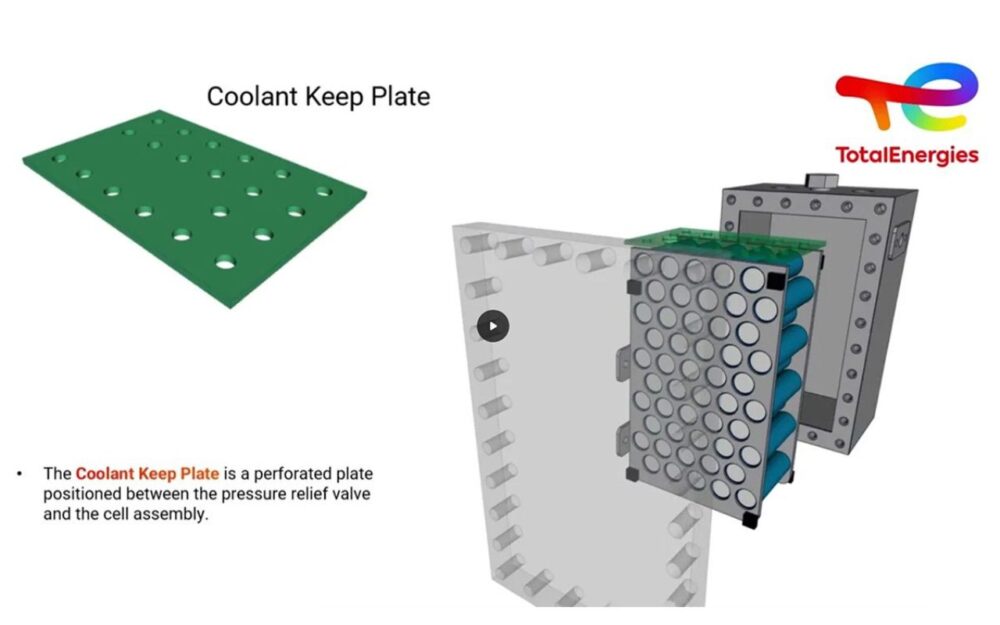
A Coolant Keep Plate sits between the battery cell group and dielectric fluid to address this risk. The plate separates gas from liquid, allowing the vented gas jet to safely escape while ensuring the battery cell remains fully immersed in dielectric fluid.
A Coolant Keep Plate
The passive technology relies on a compact design which does not require sensors, controls or a power supply. Enhancing battery safety without requiring a complex active system makes the technology cost-effective to industrialize, says Dr. Gérard Quoirin, battery specialist at TotalEnergies Lubrifiants in Paris. Combined with the advanced dielectric fluids developed by TotalEnergies Lubrifiants, Quoirin says the company’s Coolant Keep Plate delivers a new level of safety for immersion-cooled battery systems:
“Immersion alone is not sufficient. To preserve thermal protection after the first venting event, the fluid must remain around the initiating cell and the cells that have received the highest thermal load. The Coolant Keep Plate was developed to perform this function in a passive manner, while preserving gas evacuation.”
In tests conducted on several battery configurations, the company reported that no fire or thermal runaway propagation was observed when the Coolant Keep Plate was used, including scenarios that propagated without it in place:
“The Coolant Keep Plate acts like a filter to release the gas while ensuring the fluid remains trapped around the battery to keep it cool and protect against thermal runaway. The concept is already well-established in chemical engineering for separating and capturing gas for industrial use, but applying it to cooling lithium-ion batteries is something completely new.”
TotalEnergies Lubrifiants has been working on immersion cooling for more than a decade, with the Coolant Keep Plate in development for the last two years.
OEMs in Europe and in China
Several OEMs in Europe and China are currently evaluating the Coolant Keep Plate for applications including protecting immersion-cooled automotive, marine and truck batteries. The technology could be commercially available as early as next year.
While the Coolant Keep Plate is designed and optimized for TotalEnergies Lubrifiants’ own dielectric fluids, the principle can be adapted to other areas, cell formats and immersion-cooled battery architectures.
“TotalEnergies hasn’t patented the Coolant Keep Plate because we believe in immersion cooling. The question of safety is so important and we see great potential for this plate on any type of battery.”