


Railway control cabinets are becoming increasingly crowded and every millimeter counts. Lütze Transportation is responding with a new 6.2 mm-wide analog converter designed to combine signal flexibility, galvanic isolation and railway-grade robustness in a highly compact footprint.
Railway vehicles are becoming increasingly dependent on electronic systems. From propulsion and braking to monitoring, communication and passenger information, more functions require sensors, controllers and actuators to exchange reliable signals.
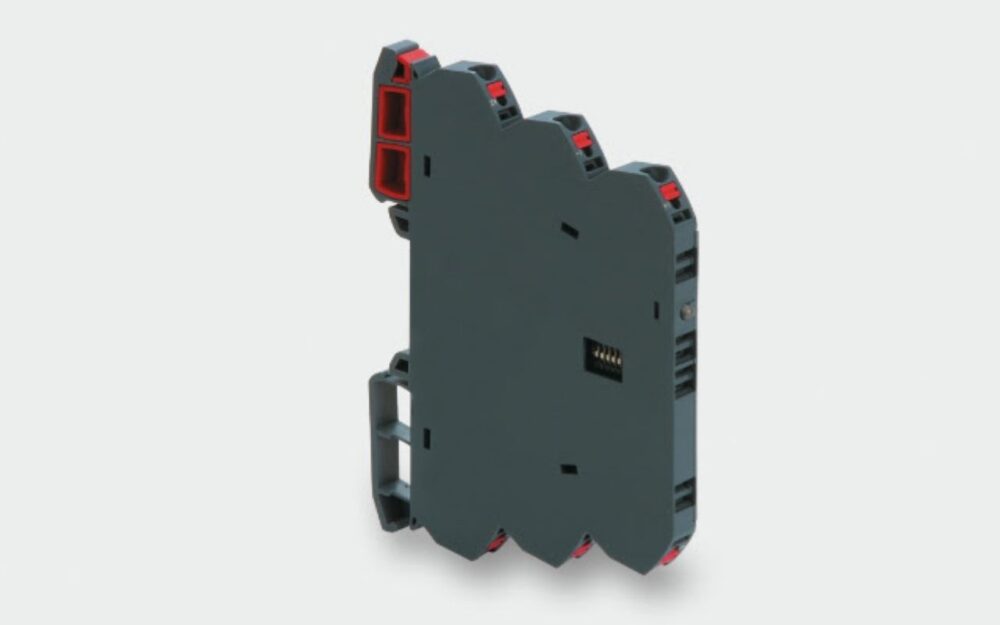
The challenge for engineers is that this growing electronic complexity does not necessarily come with more space. This is where German company Lütze Transportation sees an opportunity. They have introduced a new multi-range analog converter that is also the first product built around its new LCIS Rail housing platform. At just 6.2 mm wide and 68 mm deep, the module is designed to reduce the space required for interface technology inside railway control cabinets.
When Every Millimeter Matters
In a densely populated control cabinet, reducing the width of individual components can have a cumulative effect. A narrower interface module can leave more room for additional functions or help engineers maintain a compact cabinet architecture as systems become more complex.
The LCIS Rail housing has been developed specifically for railway applications. It is not an adaptation of conventional industrial housing to the sector.
Its first application is an analog signal converter capable of handling several of the signal ranges commonly used between sensors, controllers and actuators.
Using DIP switches, engineers can configure both input and output ranges for 0–10 V, 0–20 mA and 4–20 mA signals.
This means that one module can cover different signal-conversion tasks instead of requiring multiple variants. Beyond saving cabinet space, the approach can simplify product selection, reduce inventory requirements and limit installation effort.
More Than a Compact Footprint
For railway applications, however, miniaturization comes with another requirement: the component still has to withstand the electrical and environmental conditions encountered on rolling stock.
The converter operates from a 24 V DC supply and provides three-way galvanic isolation between its input, output and power supply. With an isolation rating of 1.5 kVrms, the architecture is intended to keep different parts of the signal path electrically separated.
The device is specified for temperatures ranging from -40°C to +70°C and incorporates several protection mechanisms, including surge protection, a PTC fuse on the current input and a short-circuit-proof output.
Lütze specifies an accuracy of 0.1% FSR, combining the compact form factor with the performance expected from a signal-conditioning component.
Designing for the Realities of Rail Maintenance
The physical design also addresses an often-overlooked part of railway engineering: installation and maintenance.
The LCIS Rail module uses push-in connections, enabling tool-free wiring. A 2 mm test opening gives technicians access for measurements and functional checks during commissioning or servicing.
The housing can also be equipped with insulated jumper combs for potential distribution, helping simplify wiring when several circuits need to be connected.
These features may appear relatively small compared with the headline 6.2 mm width, but they point to a broader design objective: reducing not only the physical footprint of interface technology, but also the time and complexity involved in installing and servicing it.
Railway Certification Built Into the Design
Regarding regulatory requirements, Lütze states that the product meets the relevant requirements of several railway standards, including EN 50155, EN 50121-3-2, EN 50124-1, EN 61373 and EN 45545-2, as well as EBA regulation EMC 06.
For manufacturers and system integrators, this is an important distinction. A component designed specifically for rolling stock has to address not only its electrical function, but also requirements relating to electromagnetic compatibility, insulation, environmental conditions, vibration and fire behavior.