

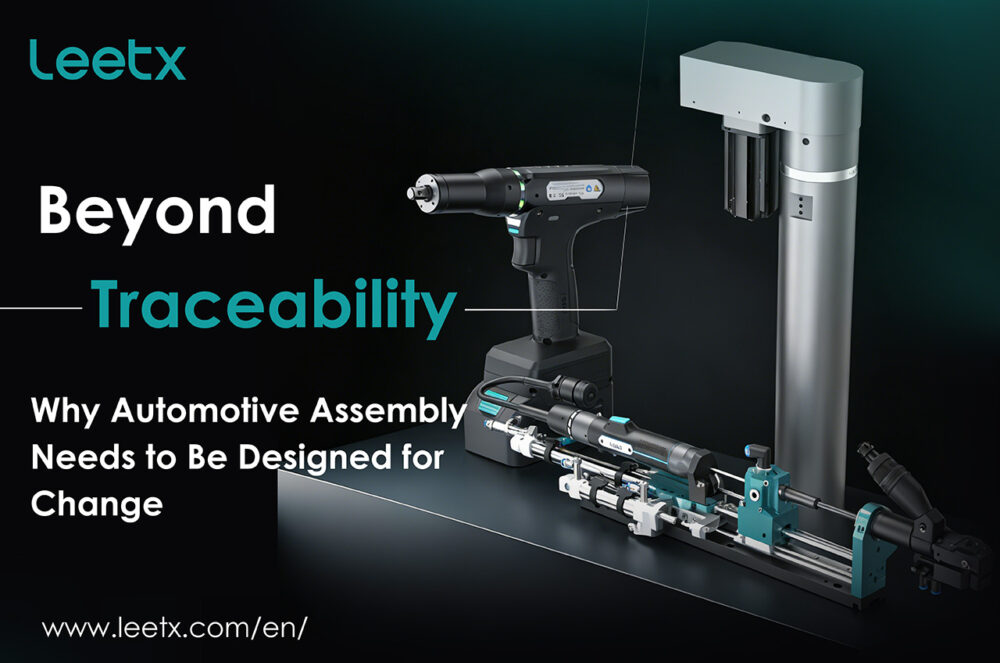

When model demand and project planning are no longer fully aligned, an assembly system‘s value lies not only in recording results, but in detecting deviations earlier and reducing the engineering burden that change brings.
By Olivia Zhang, Social Media Specialist at Leetx
What the automotive industry is going through is not a simple powertrain switch, but an extended transition in which multiple technology paths and product mixes coexist.
BCG’s 2026 global automotive supplier study notes that in the first half of 2025, sales of several battery-electric models in China, Europe and North America diverged noticeably from original forecasts, with some models running several times above or below plan. For suppliers, this can mean underutilized capacity on some projects and bottlenecks on others.
Product mix itself is also harder to predict. A JATO study of Europe’s five largest markets found that electrification has added new versions and configuration tiers, but some versions have not developed matching demand — raising operational pressure and inventory risk. Meanwhile, the room to absorb change is narrowing: a CLEPA survey released on 23 March 2026 reports that 24% of European automotive suppliers expect losses in 2026, and 76% expect margins below the 5% needed to sustain long-term innovation and capacity investment.
These trends reach the shop floor: models and configurations shift, project timing changes, component designs evolve, and fasteners, assembly sequences, feeding solutions and press-fit acceptance criteria may all change accordingly. Demand deviation is widening, product mix is growing more complex, and the margin buffer available to absorb these changes is thinning.
Assembly flexibility cannot compensate for poor capacity planning, nor can one piece of equipment absorb unlimited product variation. What it can do is reduce the cost and uncertainty of change once that change reaches the production floor.
Traceability Should Support Decisions, Not Just Records
Traceability is often treated as a retrospective function: when a quality issue occurs, engineers retrieve the tightening result or press-fit curve associated with the product serial number.
But process data has greater value when it influences what happens before the product leaves the station. In tightening, torque, angle and process curves can flag abnormal joints. In automated fastener feeding, the supply, transport and in-position status of the fastener feed into station control. And in press-fitting, the force–displacement curve indicates whether the part has reached position and whether the process shows over-pressing, incomplete pressing or other deviations. Where the project requires it, these results can drive station interlocks, so anomalies are flagged, blocked or confirmed before the product moves on.
In this sense, traceability becomes part of process control rather than simply a quality archive.
Can Processes Adjust More Easily When the Product Changes?
Once model change reaches the assembly floor, two scenarios need to be distinguished. One is variant switching: the product still falls within the station’s original design scope, and the change is handled through process programs, parameters, tightening sequence or tooling selection. The other is engineering change: the product goes beyond the original scope, requiring new process development, hardware adjustment, parameter validation and redefined acceptance windows. The boundaries — and the on-site workload — differ in each case.
For tightening, a variant change may involve torque and angle parameters, fastener count, sequence, control strategy and data linkage. When one line has to switch between multiple variants in the same product family, the controller itself can store up to 200 process programs simultaneously, with each program supporting up to 25 steps and 40 recipes — sufficient to cover most mixed-production scenarios. On a switch, the station calls the right process by product, and torque, angle, strategy and acceptance criteria are switched together, without repeated reconfiguration. Whether existing tooling and mechanical conditions still apply must be confirmed against the defined product scope. Upgrading a line from Product A to Product B — where the process itself needs to be renewed — falls into engineering change.
For automated fastener feeding, the room for adjustment depends more on fastener specification and feeding solution. Changes in screw length, diameter, head geometry or transport path may affect the bowl, tubing and end-effector configuration. Flexibility is not unlimited compatibility. It is a deliberately designed operating envelope — a compatibility range defined at project planning, so that fastener changes within that range can be handled by configuration and partial retooling, while anything beyond it is treated as an engineering change.