


Camera-based precision sorting is helping direct sellers and family-run farms improve quality control, reduce reliance on manual labor, and build more consistent processes.
In agriculture, quality requirements increase but labor becomes harder to find, so farms have to rethink how they sort their produce. Manual sorting is not always the right thing to do: it is indeed labor-intensive, difficult to reproduce, and can deliver inconsistent results.
Pneumatic sorting systems, meanwhile, can be noisy, maintenance-intensive, and energy-hungry. For many small and medium-sized farms, these factors make them difficult to justify economically or operationally.
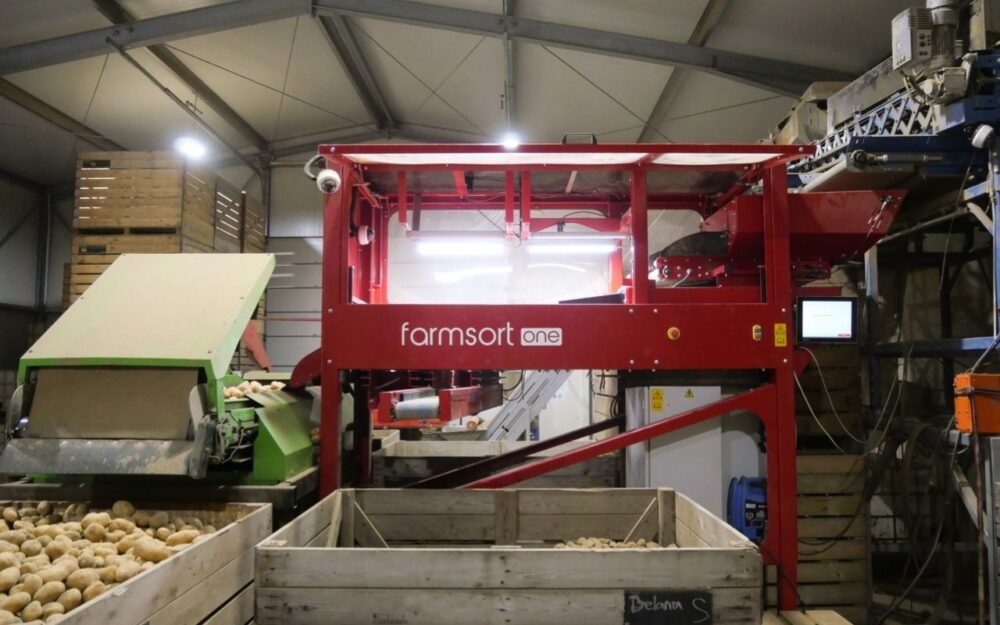
Düsseldorf-based company Schmiede.one has developed their Farmsort.one precision optical sorter, an industrial inspection technology that can be adapted to smaller agricultural operations. The system combines controlled product handling with repeated camera inspections and therefore can deliver consistent sorting results at high throughput while reducing dependence on manual labor.
Repeated Inspection Along a Defined Inspection Path
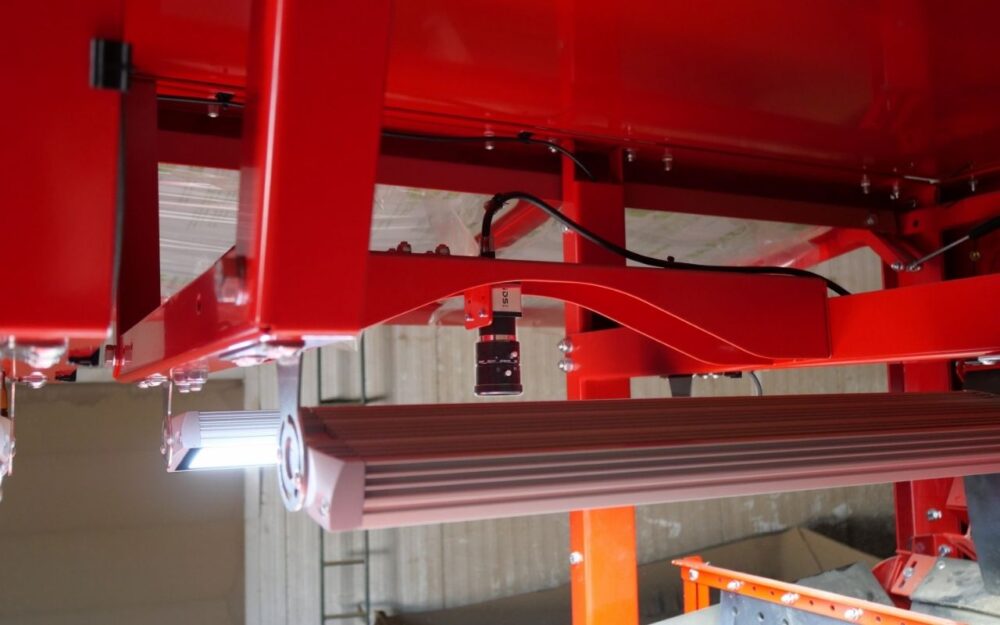
At the heart of the Farmsort.one concept is a 1.5-meter-long inspection line. Let’s take the example of a farm that cultivates potatoes. As each potato moves along the conveyor, it is visually inspected several times. Depending on the configuration, two or three industrial cameras from IDS Imaging Development Systems monitor the continuous product flow from different angles.
Rather than relying on a single image capture or panoramic view, the system uses repeated inspections along a controlled path. This provides a process-integrated approach to quality assessment based on repetition, redundancy, and controlled product positioning.
In a press release, Jan Kiwitt, Project Manager at Schmiede.one explained :
“We did not want a snapshot assessment, but controlled inspection along a defined path. The combination of a conveyor system and multiple inspections enables reliable detection of quality characteristics at a constant throughput.”
© 2026 IDS Imaging Development Systems GmbH
Electric Rail Sorting for Stable Processes
Farmsort.one can sort both washed and unwashed potatoes at throughput rates of up to two tonnes per hour, separating them into as many as five fractions. A fully electric conveyor system lies at the core of the installation. This technology is traditionally found primarily in larger industrial operations.
Compared with pneumatic sorting mechanisms, the electric system provides precise product guidance, reduces mechanical wear, and lowers energy consumption. Controlled product positioning is also essential for maintaining consistent sorting results and enabling continuous operation, regardless of staff availability.
This combination of controlled handling and automated inspection allows farms to move from labor-dependent sorting toward a more stable and repeatable process.
Industrial Cameras Turn Quality into an Objective Measurement
As mentioned before, Schmiede.one relies on industrial cameras from IDS Imaging Development Systems. The cameras used (two or three IDS U3-3270CP Rev. 2.2 USB3 Vision cameras) capture each tuber along the 1.5-meter inspection path and provide an objective assessment of product quality during the sorting process.
For example, one camera performs object classification, detecting foreign objects such as stones as well as small defects in the tubers, including holes caused by wireworms. Another one tracks each object as it moves along the conveyor.
Combined with a rotary encoder, the system can determine the precise position of each potato. Damaged products or potatoes that do not meet the specified quality criteria can then be systematically diverted.
Integration is carried out using the IDS peak SDK, which supports reproducible camera configuration, correct camera mounting, and precise focus adjustment. For Jürgen Hejna, Product Manager 2D Machine Vision at IDS,
“In integrated inline sorting systems, image quality is only one part of the equation. Reliability and secure integration are critical. Stable interfaces, long-term availability, and reproducible camera settings are essential for continuous, low-maintenance operation.”
Under real operating conditions, according to Schmiede.one, many users achieve throughput rates of 1.4 to 1.7 tonnes per hour without compromising sorting accuracy.
And the company adds that up to 73% of users can eliminate a second sorting stage altogether, significantly reducing the labor required for manual sorting.