



After humanoid robots threatened to replace humans in factories and logistics warehouses, now robotic dogs are starting to replace our canine companions, man’s loyal friends and trusted shepherds’ allies. The company Asylon Robotics has specialized in “drone dogs” tasked with guarding high value corn crops on farms.
For centuries dogs have played a vital role on farms across the world. They were working with livestock, guarding properties. And in many cases simply acting as companions for farmers often working in rural isolation. Today, high tech robotic dogs are taking over some of the roles traditionally performed by ‘man’s best friend.’
Although the canines will never be totally replaced, their high tech versions are starting to take over in some agriculture related duties. Including guarding high value crops.
The Bayer Use Case
For example, Bayer operates seven crop growing facilities in Hawaii totalling over 8,000 acres. They are the source of 90% of the company’s internationally sold feed corn seed. And those fields are often prone to attack by vandals, wildfires, boars, and other hazards.
At first Bayer relied solely on human security teams to protect employees, intellectual, and physical property on the islands. However, maintaining staffing patrols for 8,000 acres was very expensive. Plus, the company was finding it difficult to acquire enough staff particularly for overnight security patrols. Today those human patrols are being supplemented by Asylon’s DroneDog robotic security dogs.
Paw Patrol? No, Drone Patrol!
Due to the technology within, DroneDog is designed to handle dangerous all-terrain environments. Security personnel can thus focus on the most immediate tasks instead of patrolling perimeters or sitting in an idling vehicle all night.
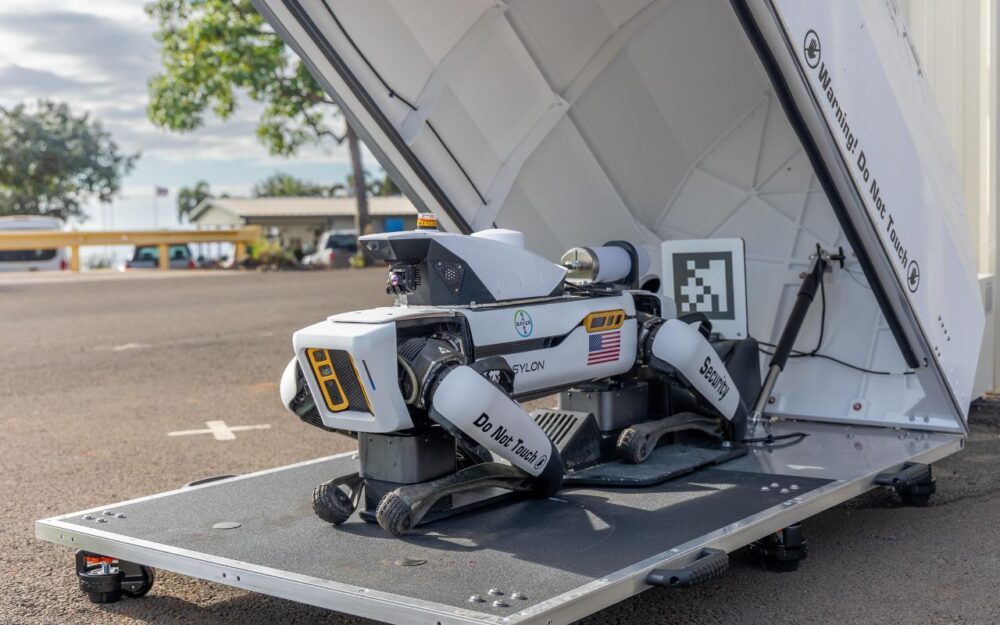
Equipped with thermal and electro-optical cameras with 20X optical zoom, AI/ML classifiers, cloud connectivity, an expandable payload port, and anti-theft technology, DroneDog is proving to be a highly effective security tool.
The ‘dog’ connects to the cloud for remote operation and live streaming. It can be monitored by on-site security teams at the Bayer Hawaii Security Operations Centre (HSOC), and in Asylon’s 24/7/365 Robotic SOC.
Operational staff can instantly be alerted to potential threats on the ground and view them in real-time. Depending on the nature of the incident, Bayer’s security team can respond to mitigate the threat.
When DroneDog is not on a security mission, it returns to its DogHouse, installed outside on Bayer’s grounds. These kennels give the DroneDogs protection from the elements and allow the units to rapidly recharge its batteries for next mission.
More Deployment
The success of Bayer’s first deployment of DroneDog in Hawaii prompted the company to expand deployments to other facilities on the islands and in California.
Bayer says that by supplementing human security teams with security robots, it has been able to enhance the monitoring of its facilities with more patrols.
The dogs have also helped reduce staffing issues while improving employee safety. It’s also worth noticing the environmental impact of their use. This eliminated the number of vehicle patrols required per day, and reduced overall security operational costs.
Additionally, by using DroneDog, the company also now has historic video footage of security incidents for post-event analysis and any necessary court action or security audits in the future.