


As geopolitical battles intensify over rare earth elements—materials essential for products such as EV motors—industrial players are increasingly designing rare-earth-free alternatives. Pivoting toward ‘Magnet-Free’ or ‘Alternative Magnet’ topologies will not only help mitigate supply chain volatility but also reduce the carbon footprint associated with the extraction of Neodymium (Nd) and Dysprosium (Dy).
Here is an overview of the rare-earth free motors technologies and the key players driving this shift. Notably, most are Tier 1 suppliers working in close collaboration with major EV manufacturers.
Rare-Earth-Free Topologies
1/ Externally Excited Synchronous Motors (EESM / SESM)
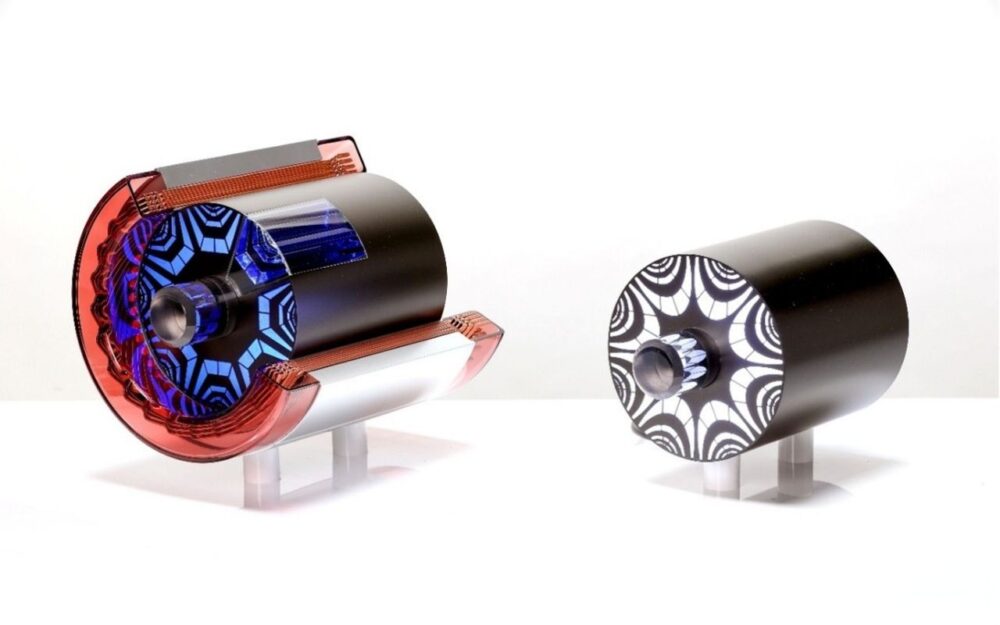
Instead of using permanent magnets to create a magnetic field in the rotor, these motors use copper wire windings. When current flows through these windings, the rotor becomes an electromagnet.
Traditional EESMs (like those in the BMW i4 or Renault Zoe) use “brushes” or “slip rings” to transfer electricity to the spinning rotor, which can wear out. ZF’s In-Rotor Inductive-Excited Synchronous Motor (I²SM) uses a wireless inductive transmitter.
What are the advantages?
It matches the torque of a permanent magnet motor but reduces the production CO2 footprint by 50%. Because the magnetic field can be “turned off” when not needed, it eliminates “drag losses,” making it significantly more efficient for highway cruising.
2/ Switched Reluctance Motors (SRM)
SRMs are the “simplest” motors: the rotor is essentially a solid piece of toothed iron. It spins because the stator’s electromagnets pull on the rotor’s teeth (reluctance).
What is behind this breakthrough?
Historically, SRMs were criticized for being noisy and “jerky” (torque ripple). But manufacturers have been able to solve this using two things:
- Model Predictive Control (MPC): this software predicts the rotor’s position and adjusts the current in microseconds
- Silicon Carbide (SiC) inverters: they allow for much smoother power delivery.
What Are the Applications?
It is ideal for harsh environments or heavy-duty cycles (like industrial mining or e-buses) because there are no magnets to demagnetize and no rotor windings to overheat.
3/ The “Hybrid” Approach: Hitachi Astemo’s Dual-Motor Strategy
Revealed at the Japan Mobility Show 2025, the Astemo’s strategy optimizes the vehicle by using different technologies for different wheels:
Main Drive (Rear): Magnet-Assisted SynRM
This motor uses cheap, abundant Ferrite magnets (iron oxide) arranged in a “multi-layer flux” structure. To prevent the coils from melting under the high current needed to boost ferrite’s performance, Astemo uses oil-immersion cooling. It delivers 180 kW, but is only 30% larger than a rare-earth unit.
Auxiliary Drive (Front): 100% Magnet-Free SynRM
Since this motor is only used for bursts of acceleration, it uses no magnets at all. This is critical because when the motor is “off” during coasting, it creates zero magnetic drag, saving battery life.
4/ Advanced Materials: Iron Nitride (Fe16N2)
While Ferrite magnets are weak (0.4T), Iron Nitride is the “holy grail” of magnet science, with a theoretical saturation of 2.5 Tesla—surpassing even the best Neodymium magnets (1.6T).
Use case
Niron Magnetics has successfully scaled this technology. At CES 2026, they debuted a Variable Flux Motor (VFM) in collaboration with MATTER (an Indian EV company). These magnets are made from iron and nitrogen—two of the most abundant elements on Earth—eliminating the “rare-earth tax” and geopolitical supply risks entirely.
Major Players and Partnerships
Hitachi Astemo & Honda (2025-2026)
Honda became the majority shareholder (61%) of Astemo in late 2025. This move accelerates the integration of Astemo’s rare-earth-free e-Axles into Honda’s “0 Series” EVs. Astemo’s newest powertrain combines a synchronous reluctance motor (SynRM) with high-efficiency Silicon Carbide (SiC) inverters.
Stellantis & Niron Magnetics
Building on a 2023 investment via Stellantis Ventures, Stellantis and Niron Magnetics are working on a joint project titled “Variable Flux Field Intensifying Motors Using Iron Nitride Permanent Magnets.” Supported by a $2.7M grant from the U.S. Department of Energy, the focus is on scaling Niron’s “Clean Earth Magnets” (Iron Nitride) to displace mid-grade Neodymium (NdFeB) in mass-market EV platforms, without the environmental cost.
MATTER & Niron Magnetics
As mentioned before,Niron Magnetics and Indian EV firm MATTER revealed the first high-performance Variable Flux Motor (VFM) prototype for light mobility during last month’s CES. The design uses iron nitride magnets and a specialized controller to dynamically adjust flux, optimizing efficiency across both high-torque launches and high-speed cruising, without using rare-earth materials.
Ola Electric
Last October, Ola Electric became the first Indian OEM to receive AIS 041 certification from the Global Automotive Research Center (GARC) for its in-house ferrite-based traction motor. By using advanced geometry to overcome the lower magnetic remanence of ferrite (compared to Neodymium), Ola has achieved a significant reduction in the Bill of Materials (BOM) for its Gen-3 platform vehicles.
Honda & Enedym
Honda’s investment in Canada-based Enedym has accelerated the refinement of Switched Reluctance Motors (SRM), which contain no magnets at all. Recent focus has been on “Acoustic Noise, Vibration, and Harshness” (NVH) mitigation through advanced pole-shaping and high-frequency power electronics.