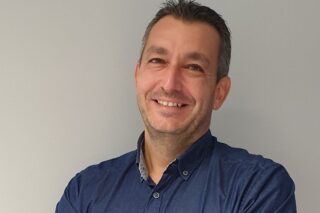



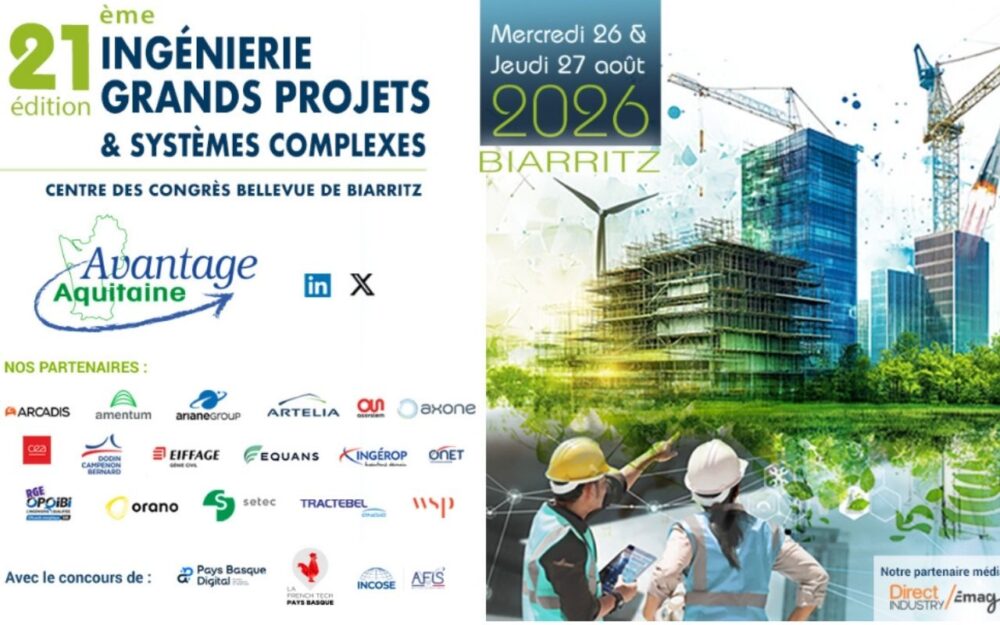
Industrial projects today have to contend with AI, geopolitical tensions, sovereignty issues and cybersecurity. Faced with these new challenges, how can engineers continue to successfully deliver projects that are already immensely complex? On the occasion of the opening of the 21st edition of the IGPSC Congress in Biarritz, France, DirectIndustry, a partner of the event, spoke with Thierry Massard, President of the Scientific and Technical Committee, and Brice Pingaud, Director of Operations and Developmentat Avantage Aquitaine, to examine the key issues that will shape this new edition.
The IGPSC Congress opens its doors today in Biarritz for its 21st edition. Since its creation, the event has brought together engineers, industrial companies, experts, researchers and decision-makers around a common topic: managing complex major projects and the challenges they face.
This year, discussions are taking place in a particularly dense context. AI, defense, sovereignty, critical infrastructure, energy and nuclear power, digital transformation and the acceptability of major projects are among the topics that will be addressed over the two days. And beyond technology, what is also at stake is the industry’s ability to maintain control over increasingly complex projects.
Why have these issues become unavoidable? Was IGPSC ahead of the curve on some of these transformations? What trends and concerns will dominate discussions this year? And why does the congress continue to choose a late-August date? Thierry Massard and Brice Pingaud answer all our questions.
IGPSC returns this year for its 21st edition. Over the past twenty years, the industrial world has changed profoundly. What has changed the most, in your view, in the way complex major projects are designed and managed?
Thierry Massard: “Over the past two decades, we have clearly moved away from sequential engineering, with its fixed specifications, its division into watertight work packages and its purely linear milestones, in favor of highly systemic and iterative management. The major turning point is interface management. Today, a major project is no longer simply the sum of independent subsystems: it is a vast network of technical, contractual and geopolitical dependencies that must be understood from the outset. In practice, teams now spend less time seeking the absolute performance of an isolated component than mapping interface risks and the criticality of supply chains. It is a profound change that transforms both the profession and the methodology.”
The Congress brings together very diverse profiles (engineers, researchers, industrial companies, decision-makers). Beyond the diversity of the topics discussed, what is the common thread running through these major programs? We hear a lot about AI: is it the common thread?
Brice Pingaud: “AI naturally occupies an important place this year, but it does not sum up IGPSC. One of the characteristics of the congress is precisely the wide variety of topics and sectors represented: energy and nuclear power, defense, space, infrastructure, civil engineering, mobility, industry, materials, cybersecurity, team management and the management of major projects. The common thread is complex, often strategic projects that bring together many stakeholders, very different areas of expertise and sometimes very long cycles. This diversity also makes it possible to carry out a genuine benchmark between sectors. A method, an organization or feedback presented in one field can provide answers to professionals working in another sector. AI is therefore one of the major topics of this edition, but it is part of a much broader program built around the transformations currently affecting engineering and major projects.”
Thierry Massard: “What connects all these projects, whether it is a data center, a nuclear reactor, a weapons system or a major transport infrastructure, is a requirement for interdependence from the design stage. They are all now assessed according to the same framework: performance, resilience, sovereignty and societal acceptability. Artificial intelligence is not the cement holding these projects together, it is the accelerator that makes it possible to orchestrate them. It multiplies our simulation capabilities and facilitates documentation work to inform decision-making, but it does not replace systems architecture or human governance.”
Precisely, what role does AI play in this 21st edition? Are we seeing a genuine transformation of practices in complex systems engineering?
Thierry Massard: “AI has moved from the status of a simple proof of concept to that of an operational tool, even if its adoption varies across sectors. Three applications are proving particularly transformative:
– Predictive simulation coupled with digital twins, which makes it possible to explore vastly larger design spaces than before.
– The analysis of massive amounts of data to identify early signs of deviation in long-term programs.
– The cross-optimization of architectures under multiple constraints (costs, mass, safety and cybersecurity requirements).
Does this change the design process? Absolutely, since thousands of variants can be tested before even drawing up a detailed plan. However, AI remains a decision-support tool: for critical systems, responsibility for the final decision must remain firmly in human hands.”
Are projects more complex today? Or is it mainly their environment that has become more complex: regulations, geopolitics, supply chains, acceptability, skills, cybersecurity?
Thierry Massard: “The two dimensions are progressing together, but the real catalyst comes from the environment. Of course, systems incorporate more software and connectivity. But the real upheaval lies in the fact that a technically perfect solution can become obsolete overnight if it relies on a non-sovereign component, a single supplier or expertise that is gradually disappearing. Environmental constraints and cybersecurity requirements are now becoming inherent design parameters, just like material strength. In short, we are no longer sizing just a system, we are sizing its entire ecosystem.”
Defense, sovereignty and critical infrastructure have been important parts of the IGPSC program for several years, while these topics have more recently taken center stage in the political and economic debate. Do you feel that IGPSC was in some way ahead of the curve on these issues? These subjects seem to have become unavoidable for engineers and industrial companies. What answers can the congress provide?
Thierry Massard: “Without misplaced triumphalism, these topics have been part of the congress’s DNA since its foundation in 2006 by Thierry Leveugle, who himself led major programs for France, such as the ARD demonstrator, human spaceflight and the M51 missile. Defense and critical infrastructure raise very pragmatic engineering questions: Who controls the technology? Who can ensure maintenance in times of crisis? Which functions absolutely need to operate in degraded mode? These are all topics that IGPSC has been addressing for a long time through real-world feedback. The only real novelty is that these questions are now entering the public debate. Our role remains the same: to confront strategic vision with the hard operational reality, far from posturing.”
Does the multiplication of threats (cyberattacks, geopolitical tensions, supply disruptions, technological dependencies, etc.) mean that we need to rethink the very notion of resilience for complex systems?
Thierry Massard: “Absolutely. Resilience can no longer be considered simply as a safety margin added at the end of the process. It is a fundamental architectural requirement that must guide the very first stages of design. We are moving from a culture of failure prevention to a logic of ‘operational survival capability’: a system must be able to maintain its vital functions in degraded mode and reconfigure itself on the fly. Such a capability must be tested and measured throughout the entire life cycle, well beyond the initial acceptance phase.”
Should cybersecurity now be considered a design dimension of an industrial system, on the same level as safety, performance or maintenance?
Thierry Massard: “It is obvious. The security-by-design principle requires mapping attack surfaces, adjusting levels of trust and integrating defense barriers (segmentation, monitoring, identity management) from the earliest stages of the architecture, rather than trying to add a layer of security once the system has been delivered. In the highly critical programs we follow at IGPSC, cybersecurity is no longer simply about protecting an existing asset: it contributes to defining the asset itself, just like mechanical strength or nuclear safety.”
Energy and nuclear power are making the headlines at this year’s edition. Is this simply a cyclical shift or a lasting strategic reaffirmation?
Thierry Massard: “I would describe it more as a strategic reaffirmation. These projects have never disappeared, but they are returning to the forefront because they are central to decarbonization, our competitiveness and our energy independence. The 2026 program addresses both new reactors (EPR2, SMRs) and energy geostructures and the scaling up of green technologies. The underlying challenges remain formidable: skills shortages, long industrial supply chains and zero tolerance when it comes to safety. It is this level of rigor that the congress highlights, far removed from passing trends.”
Brice Pingaud: “Energy, in the broadest sense, has always played an important role in the IGPSC program. A session is devoted to it almost every year, because these issues are strategic, structuring for industry and directly linked to current events. Depending on the edition, we address nuclear power, new production solutions, decarbonization, energy infrastructure, energy efficiency and the scaling up of emerging technologies. It is therefore not a topic we have added recently because it has become fashionable. It has long been part of the congress’s DNA and its importance is only becoming clearer.”
This year, nearly 30 speakers will present projects to which they have directly contributed. Which examples of real-world experience are you personally most looking forward to?
Thierry Massard: “Those that document the transition from conceptual theory to operational reality, because that is precisely where the real difficulties of integration, qualification and skills development arise. Good feedback avoids the pitfall of a polished success story: it takes the time to explain the trade-offs made, the mistakes corrected and the differences observed between modeling and physical reality. It is this technical honesty that makes IGPSC so distinctive compared with a conventional trade show.”
Brice Pingaud: “That is exactly what we ask of speakers when we prepare their presentations. They must present a project in which they were sufficiently involved to be able to explain its context, technical choices, organization, results, but also the difficulties encountered. We ask them to avoid overly general presentations and not to devote too much of their presentation to introducing their company. After a few elements of context, they must get to the heart of the subject, explaining its technical aspects, challenges and complexity. We also encourage them to remain factual about their performance, to present concrete application cases and not to shy away from limitations, mistakes, negative results or points requiring attention when these are genuinely part of the feedback. This transparency is what interests an informed audience and allows participants to leave with lessons they can apply to their own projects.”
If you had to identify three major trends that will run through the discussions in Biarritz this year, what would they be? And, conversely, what are the three main concerns or areas of vigilance that engineers and industrial companies should have in mind today when approaching complex major projects?
Thierry Massard: “On the trend side, I would highlight the arrival of AI in systems engineering, the rebuilding of our industrial and technological sovereignty, and the emergence of resilience-by-design in response to hybrid threats. Not forgetting a highly transversal challenge: the transmission of knowledge over life cycles that extend over twenty or thirty years. In parallel, our three main areas of concern are: the loss of control over architectures that have become so tangled that they can no longer be fully audited; unforeseen technological dependencies that come to light in times of crisis; and the persistent compartmentalization of data and responsibilities between the different partners in the same program. A project can rely on remarkable innovations and still fail simply because of a lack of governance at its interfaces.”
Thierry, as an engineer and President of the Scientific and Technical Committee, what key message would you like participants to take away with them when they leave Biarritz?
Thierry Massard: “A deep conviction: complexity cannot be mastered by working in silos and isolating ourselves in ivory towers. The success of a major project depends on the ability to bring engineers, industrial companies, operators, researchers and decision-makers together around a shared set of constraints. I would also like everyone to leave with the idea that sovereignty and resilience are not cosmetic options that can be added to industrial performance after the fact: they are determined from the outset through key choices regarding architecture, technologies and skills, with methods that can be directly applied to their own challenges.”
Brice, IGPSC now brings together more than 270 participants. How do you explain its growth and longevity since 2006?
Brice Pingaud: “The longevity of IGPSC is first and foremost based on a positioning that has never really changed. IGPSC is neither a trade show nor a purely academic conference. It is a place for peer-to-peer exchange, focused on topics, projects and real-world experience. We ask speakers not to overexpose their company and to refocus their presentation on the project: the choices made, the methods used, but also the limitations, challenges and difficulties encountered. Participants come looking for precise content and experiences from which they can draw something for their own activities. The role of the Scientific and Technical Committee is also essential. Its members identify the topics, contribute to building the program and support speakers in preparing their presentations. This allows us to maintain a consistent level of rigor and offer a balanced program.
We are also fortunate to bring together a high-level audience: program directors, project managers, engineers, experts, researchers, decision-makers and representatives of both major groups and SMEs. The quality of the audience directly contributes to the quality of the questions and discussions. Finally, the format remains deliberately convivial. The destination, breaks, lunches and evening event allow discussions to continue in a more informal setting. This combination of quality topics, the level of participants and conviviality certainly explains the trust that has developed over the years and the steady growth in attendance.”
IGPSC has the particularity of taking place every year at the end of August, a period traditionally less busy for professional events. Why have you chosen to keep this date, and what does this period bring to the congress and its participants?
Brice Pingaud: “For eighteen years, IGPSC was held in June. The pandemic forced us to move the congress to the end of August. We then asked our audience whether they wanted to return to the original schedule or keep this new period. The end of August was ultimately chosen.
This date corresponds well to a transition between the summer period and the start of the new season. Participants are generally more available and can take a little time to step back before returning to the busier pace of September.
IGPSC is obviously about the topics, speakers and quality of the program, but it is also about the atmosphere. Participants come to learn and meet experts, but also to take the time to exchange ideas. The end of August, after twenty editions in the Arcachon Bay area and now in Biarritz, contributes to this availability and this particular atmosphere. The setting remains important, but it is always there to serve the content and the encounters.”
Which audience are you primarily targeting, and what sets IGPSC apart from other events in the sector?
Brice Pingaud: “IGPSC is primarily aimed at those who design, manage, finance or deliver complex major projects: project owners, project managers, program directors, project managers, engineers, technical experts, researchers, academics, decision-makers and industrial managers. The congress remains specialized, but is deliberately open to different sectors and profiles.
The format may seem conventional, with presentations in plenary sessions, but we make sure to keep it dynamic: topics follow one another, sectors vary and each presentation is limited to 20 minutes, followed by 5 minutes of questions and answers.
We ask speakers not to spend too much time promoting their company. The topic and the feedback must remain at the center of the presentation. Members of the Scientific and Technical Committee review the presentations and support speakers, when necessary, to adapt the message as effectively as possible to IGPSC and its audience, without questioning their expertise or the content of their experience.
The quality of the audience is also an important differentiator. Speakers address informed participants who are able to ask precise questions and extend discussions beyond their own sector.
Finally, the welcome, quality of the catering, convivial moments and choice of venue are fully part of the experience. They obviously do not replace the content, but they create the conditions that allow participants and speakers to continue discussions, develop their networks and build lasting relationships.”