


As artificial intelligence reshapes industries and demand for computing resources continues to surge, Europe is determined to maintain a strategic position in the global supercomputing race. At the heart of this ambition is Germany’s Jülich Supercomputing Centre (JSC), one of Europe’s leading hubs for high-performance computing (HPC).
Artificial intelligence, climate modeling, advanced manufacturing, drug discovery, quantum computing research: behind many of today’s most complex scientific and industrial breakthroughs lies an increasingly critical technology: supercomputing.
Giant Machines Serving Science and Industry
As nations compete for technological leadership, access to high-performance computing (HPC) has become a strategic asset. While the United States and China dominate headlines in the race for computing power, Europe is quietly building some of the world’s most advanced supercomputing capabilities.
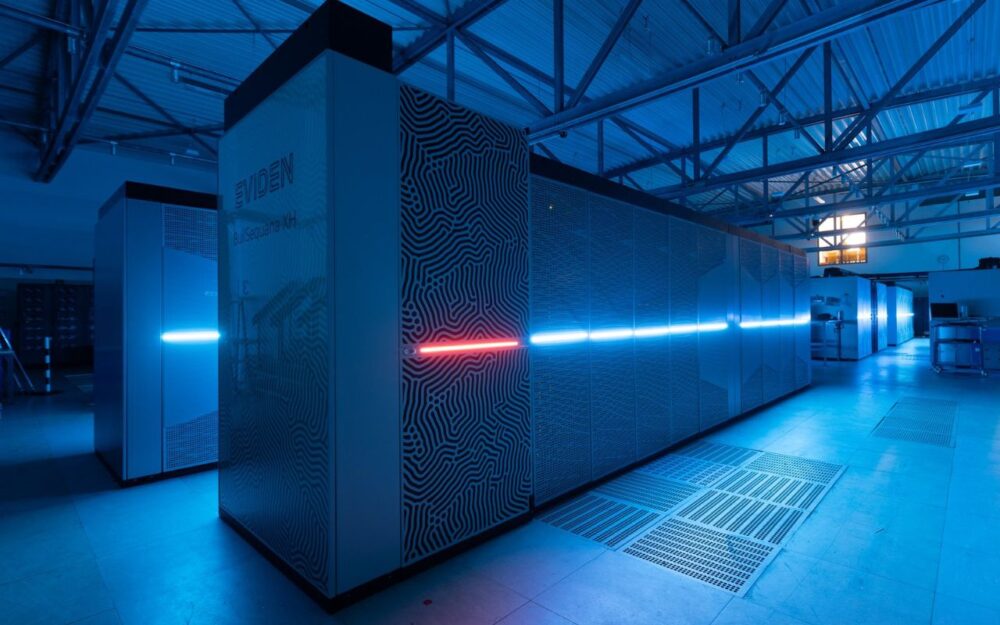
At the center of this effort stands the Jülich Supercomputing Centre (JSC) in Germany, home to JUPITER, Europe’s first exascale supercomputer.
Sohel Sebastian Herff leads the Industrial User Office at JSC. For him,
“We have different supercomputers and have been hosting them for multiple decades now. One new machine, JUPITER, is an exascale machine and the first one in Europe. It’s one of the most powerful systems in the world.”
What Exactly Is a Supercomputer?
Unlike conventional computers designed for everyday tasks, supercomputers consist of thousands, or even hundreds of thousands, of processors working simultaneously on complex calculations.
These machines can simulate weather systems, model aircraft aerodynamics, analyze genomic data, train large artificial intelligence models, and explore quantum phenomena. Problems that would take years to solve on a desktop computer can often be completed in hours or days.
At Jülich, HPC resources are available not only to scientists but also to industrial users, Herff explains:
“We enable companies to use our HPC systems or connect them to our experts to conduct research on the machines.”
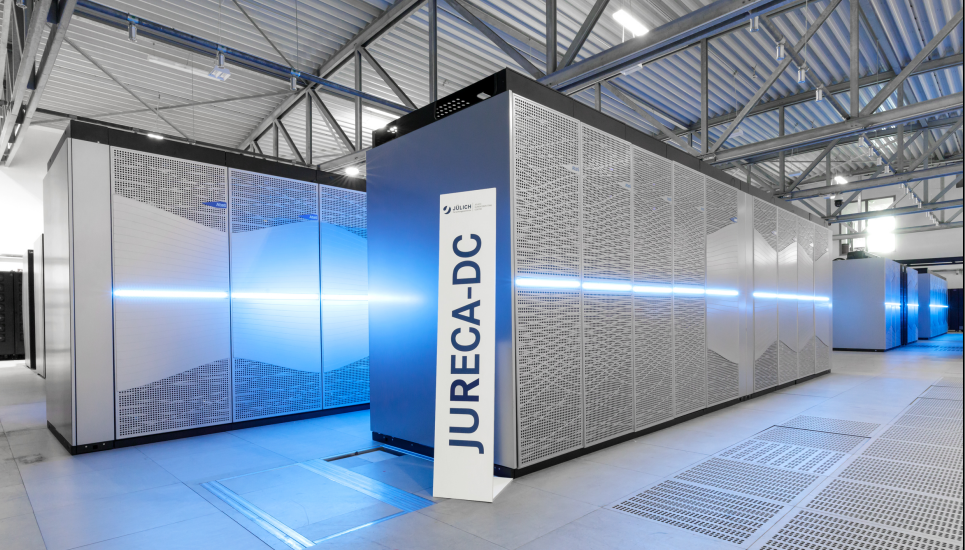
One example is JUREKA, JSC’s commercial HPC platform.
“This is our smallest machine, which is however still quite large. For industrial purposes, it’s usually sufficient. But in rare cases, especially now with AI consuming a lot of computational resources, companies need much more computing power.”
Indeed, training large language models, foundation models and generative AI systems demands enormous processing capabilities, particularly access to advanced graphics processing units (GPUs). This is to address these growing needs, that Europe has entered the exascale era with JUPITER, the continent’s first exascale supercomputer.
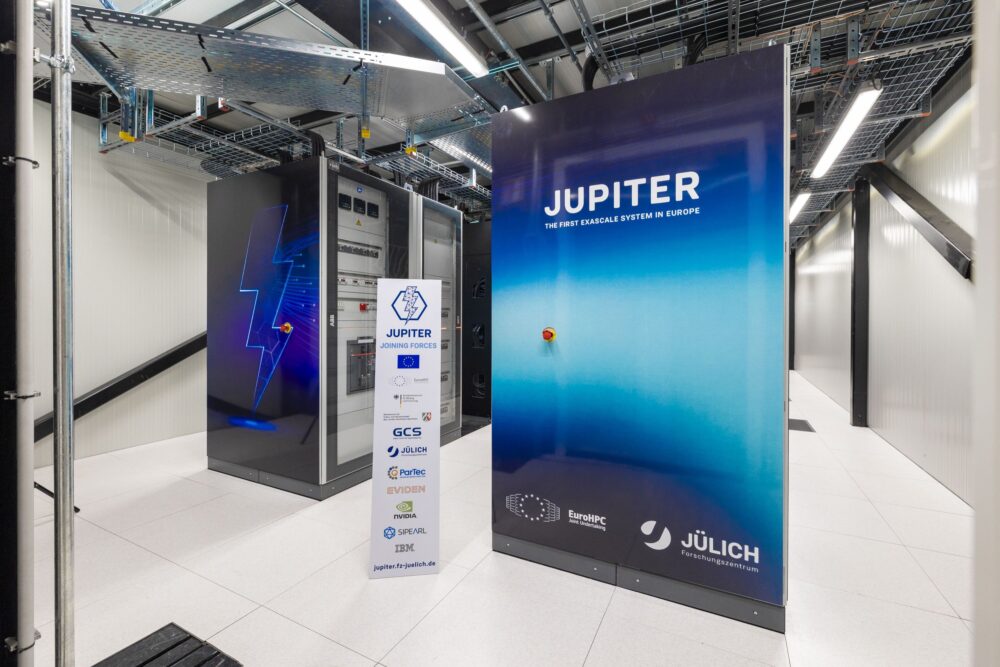
JUPITER: Europe’s Exascale Bet
An exascale machine is capable of performing more than one quintillion calculations per second (a billion operations every second). This unprecedented level of performance that only a handful of countries can currently achieve, places JUPITER among the most powerful computing systems ever built.
For Europe, the achievement is about more than scientific prestige. It is a strategic investment in European scientific independence and industrial competitiveness. It means that European researchers, industries, and governments have access to world-class computing resources without relying entirely on foreign infrastructure.
According to Herff, the machine ranks among the world’s most powerful supercomputers and is listed in the internationally recognized TOP500 ranking, which is updated twice a year.
The system is primarily dedicated to scientific research, supporting projects in climate modelling, fluid dynamics, neuroscience, human brain simulation, artificial intelligence training and quantum computing research. Researchers can simulate climate evolution, test advanced materials virtually, model biological systems, and solve problems that would be impossible to reproduce experimentally.
Why Europe Remains Competitive
The United States and China are often viewed as the dominant players in the global computing race.
The United States benefits from a powerful ecosystem that combines federal funding, leading universities, national laboratories, semiconductor companies, and major cloud providers. China, meanwhile, has invested heavily in HPC as part of its broader technological development strategy.
Yet Europe’s strength lies in its scientific collaboration and specialized research networks. Through initiatives such as EuroHPC, European nations have pooled resources to build world-class computing infrastructure that can compete globally. The launch of JUPITER further demonstrates that Europe is not only participating in the supercomputing race but intends to be among the leaders, believes Herff:
“In Germany, we have good research institutes and many research groups that have been using supercomputers for a couple of decades. We do groundbreaking research on those machines.”
This accumulated expertise gives Europe a major competitive advantage. Beyond hardware, the continent has also built a sophisticated scientific ecosystem capable of producing world-class research across numerous disciplines. For policymakers, supercomputers are increasingly viewed as strategic assets comparable to energy networks, transportation infrastructure or telecommunications systems.
The GPU Revolution
But one of the biggest challenges facing supercomputing today is not hardware alone but software. The biggest transformation in high-performance computing is the shift from traditional CPUs to GPU-based architectures. Herff explains:
“For many years, this was not the case. It was CPUs, Now most of the computing capacity is coming from GPUs.”
Indeed, for decades, scientific codes were developed primarily for CPUs (central processing units). Today, much of the performance growth comes from GPUs (graphics processing units), the same technology that powers modern AI systems. This shift creates a major challenge for scientists and engineers.
“Many research codes were written for CPUs. To use GPUs, researchers need to put a lot of effort into restructuring the software, or sometimes even rewriting it entirely from scratch.”
The challenge extends far beyond adapting software to a single graphics processor. Modern supercomputers require applications capable of running efficiently across thousands of GPUs simultaneously.
“They need to be able to make use of more than just one graphics card. Using many such graphics cards at the same time is a major challenge.”
Avoiding Technological Dependence
Although Nvidia currently dominates the AI hardware market, European supercomputing centers are deliberately maintaining technological diversity.
Jülich primarily relies on Nvidia GPUs, while other German centers have adopted Intel- and AMD-based architectures. This approach helps researchers avoid becoming dependent on a single vendor and ensures greater flexibility as technologies evolve.
“Nobody really knows what will happen in the future. Researchers want codes that can be used independently of the vendor.”
As concerns about technological sovereignty grow across Europe, this hardware-neutral strategy is becoming increasingly important.
Bridging Classical and Quantum Computing
Beyond artificial intelligence, supercomputers are also playing a critical role in the development of quantum technologies. One of the recent achievements highlighted by Herff involved a record-breaking quantum simulation performed on JUPITER.
“There was a new world record made on the JUPITER machine. A quantum computer simulation with 50 qubits. The former record was 48 qubits.”
Although practical quantum computers remain an emerging technology, classical supercomputers are already helping scientists design, test and understand quantum systems. For Herff,
“This may be one of the key technologies in the future. Quantum computing and classical computing are interacting very closely right now.”
The Real Competition: Ecosystems, Software and Talent
For Europe, the future of supercomputing will not be determined solely by who builds the fastest machine. The real challenge lies in developing efficient software, training highly specialized engineers and researchers, and creating a sustainable innovation ecosystem capable of translating computing power into scientific and industrial breakthroughs.
From fluid mechanics and energy systems to medicine, advanced manufacturing and fundamental physics, supercomputers have become indispensable tools across nearly every field of modern research. With systems such as JUPITER, Europe has demonstrated that it can compete at the highest level. The next question is whether it can translate this computing power into scientific discoveries, industrial innovation, and economic leadership.
You could also be interested in this story