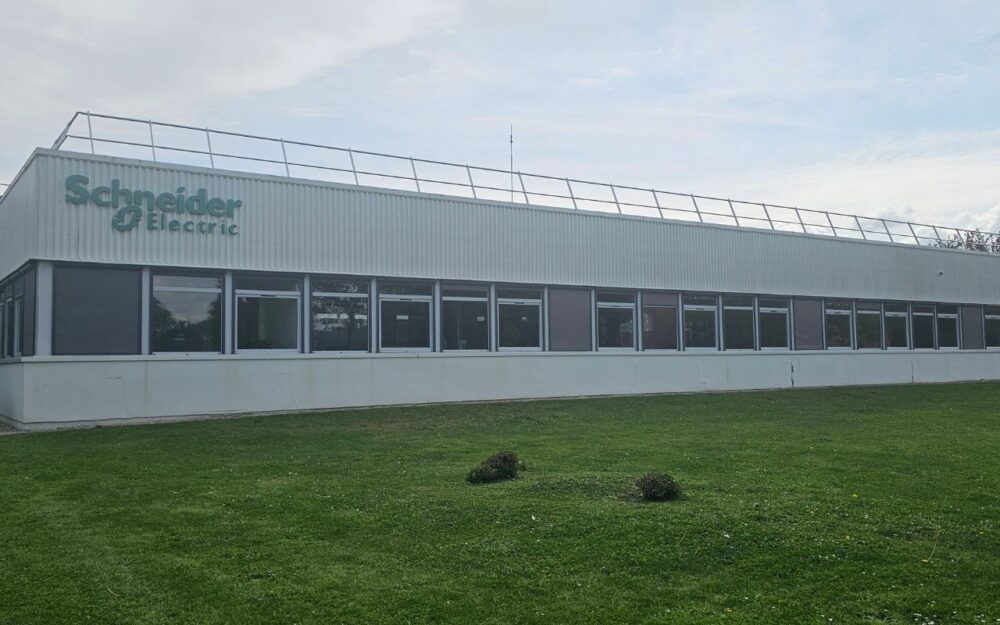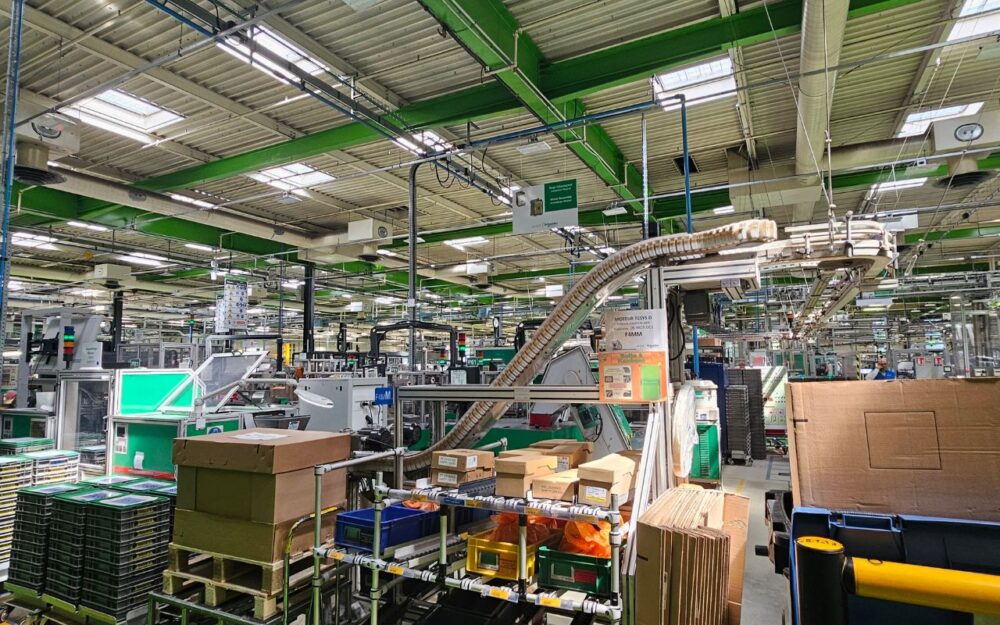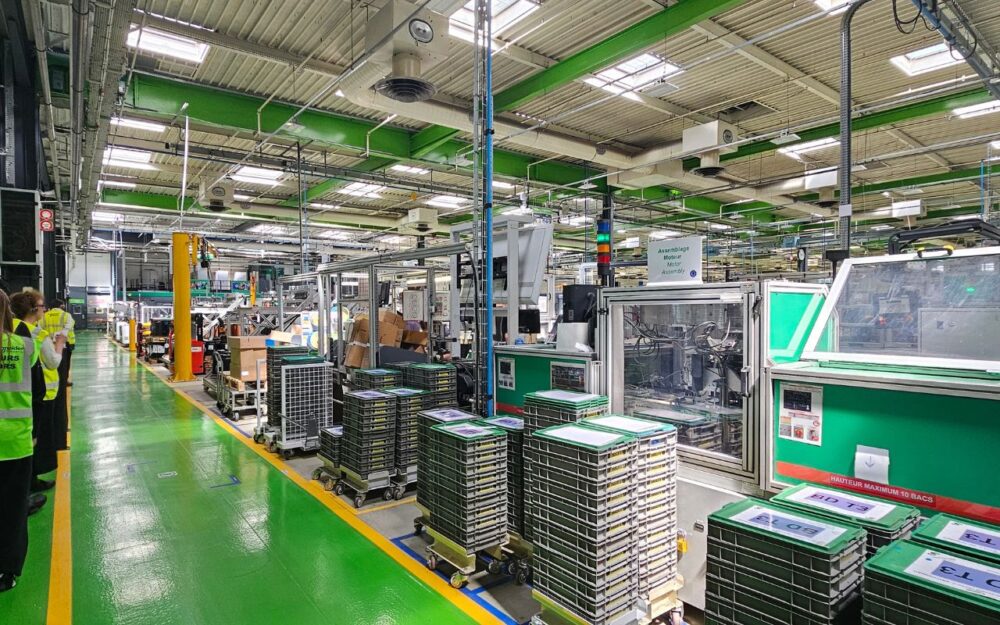


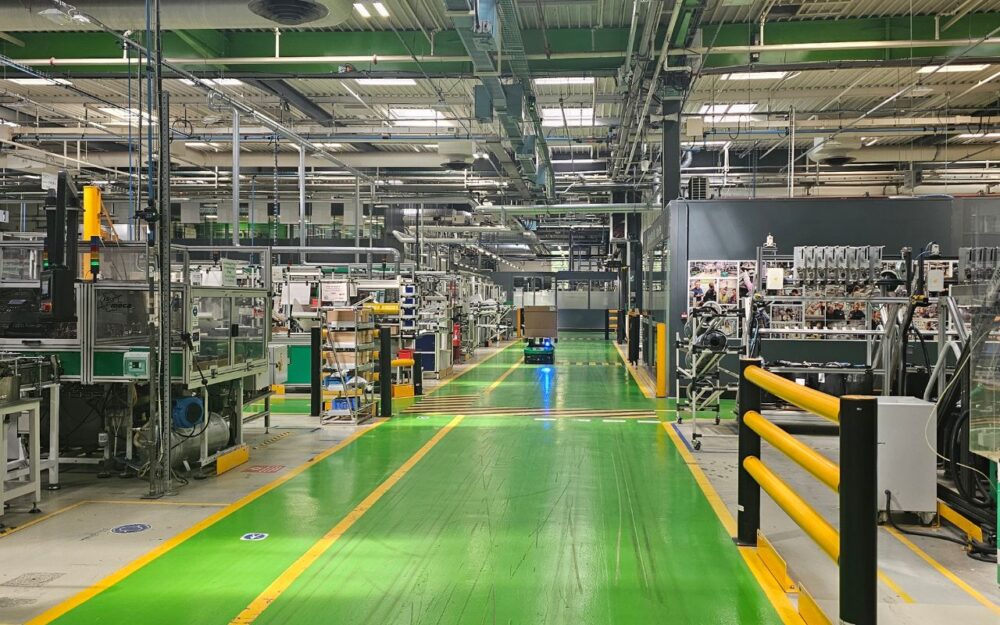

We were invited around ten days ago to visit Schneider Electric’s Le Vaudreuil plant in Normandy, France, alongside other journalists, including reporters from the renowned New York Times. Between AGVs, AI-powered cameras and decades-old machines, the French automation leader is showcasing how Europe can transform its industrial legacy into a strategic advantage for the future.
In Le Vaudreuil, Normandy, AGVs named “Paul” and “Emile” move silently through the factory aisles. Intelligent cameras inspect electrical contactors at industrial speed without slowing down production lines. Operators monitor workflows through digital interfaces connected to Aveva and EcoStruxure platforms. Artificial intelligence manages complex industrial cycles, optimizes energy consumption and reduces waste.
But behind this technological showcase lies another reality: part of the equipment inside this Schneider Electric factory is several decades old. This is precisely where the French group’s strategic message comes into play.
Legacy is an Asset
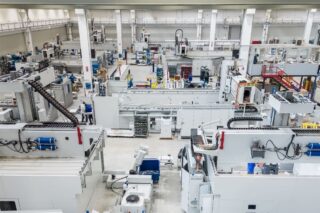
Le Vaudreuil is not a “greenfield” factory designed from scratch around the latest technologies. It is a fifty-year-old industrial site gradually transformed through digitalization, automation and data exploitation. And for Schneider Electric, this is a crucial demonstration: Europe does not need to completely rebuild its industry in order to regain competitiveness. According to Sandra Ferraguti, who has managed the site for a little over a year,
“We have a brownfield site with machines that are sometimes thirty, forty or fifty years old and that we are still able to operate with high performance. And alongside them, we also have brand-new machines filled with new technologies. And we succeed in supporting European competitiveness.”
At a time shaped by rising energy costs, trade tensions and competition from the United States and China, Schneider Electric is defending a simple idea: Europe’s industrial legacy is not a handicap, but an asset that can be modernized.
Let’s see in details a couple of illustrations from the shopfloor.
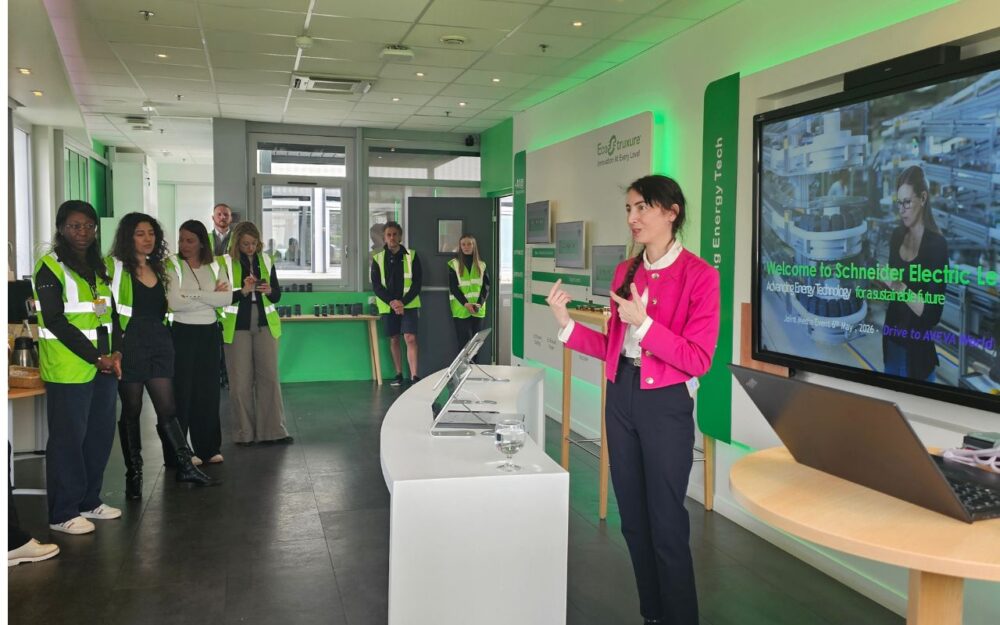
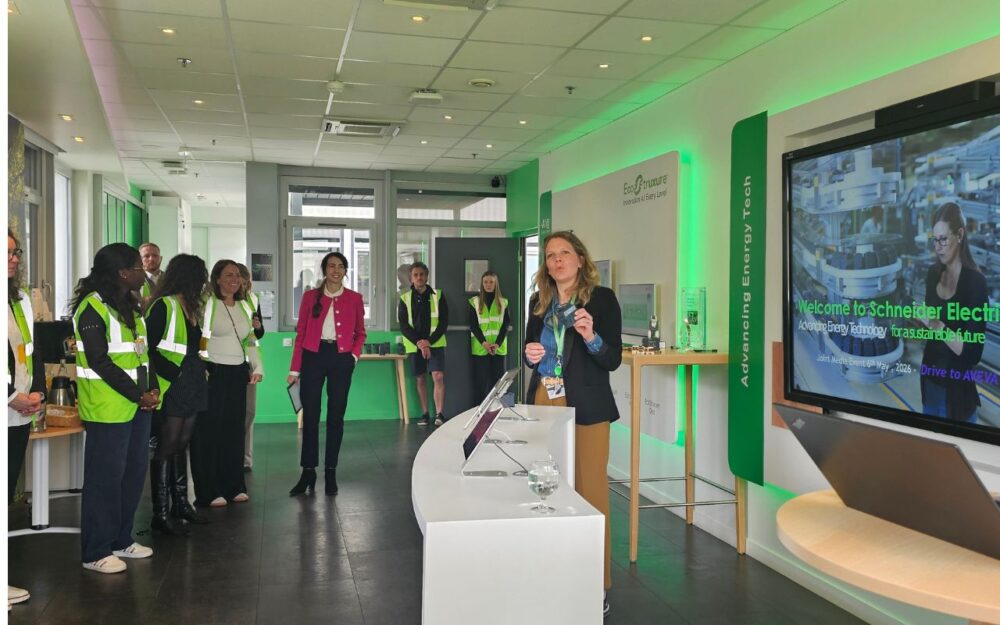
Brownfield as a Playground for Industrial AI
The Le Vaudreuil site mainly produces TeSys electrical contactors, the components used to control industrial motors found everywhere: elevators, machine tools, production lines and automated systems.
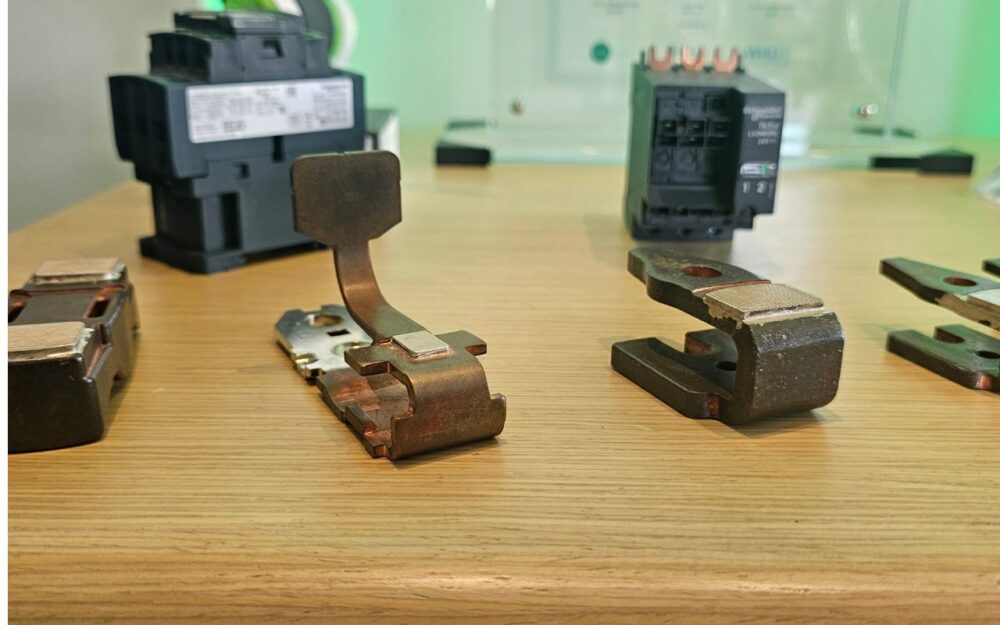
The factory also manufactures “contacts,” small but critical assemblies made of a silver tip attached to a copper support. Every year, 74 million of these parts are produced on-site. The activity is strategic for Schneider Electric, which also processes nearly 45 tons of silver for several factories across the group.
And the group is using artificial intelligence not as an experimental tool, but as a very concrete operational lever.
We entered the chemical workshop where reactors produce silver powder using different chemical compounds. The process requires several washing cycles to achieve a sodium level below 200 ppm before drying.
For years, the process was entirely manual. Operators systematically performed six washing cycles before sending samples to a laboratory for analysis. Results could take between 24 and 48 hours.
Now, the entire process is supervised through Aveva and EcoStruxure solutions. Data from industrial equipment is analyzed in real time. AI models predict sodium levels and automatically recommend when the washing process can stop.
In many cases, four cycles are now sufficient instead of six, explains one operator on-site:
“Before, we had to wait for lab results before continuing. Now the system tells us when to stop washing and we immediately know whether the powder meets quality standards.”
The gains are significant: reduced production times, lower water and gas consumption, less waste and major savings on laboratory analysis costs.
Schneider Electric says the project achieved return on investment within a year, including €700,000 saved on laboratory transport and analysis costs, a 22% reduction in gas consumption and a 73% decrease in waste related to the process.
For Gwenaelle Huet, Executive Vice President, Industrial Automation at Schneider Electric,
“Everything we do through digitalization helps reduce energy costs, but also energy consumption. So we reduce costs, reduce CO2 emissions and improve operational efficiency.”
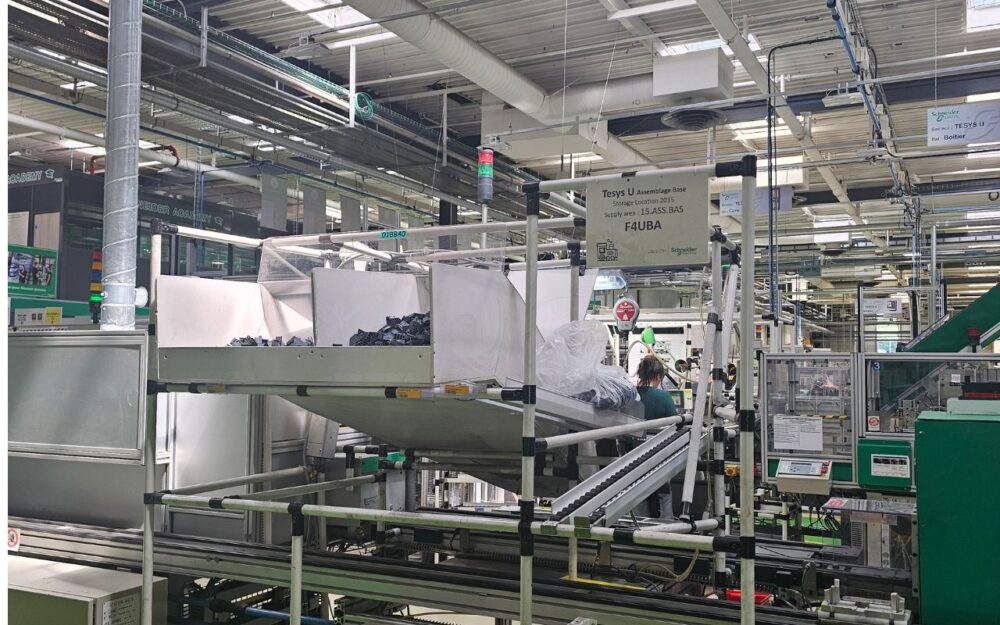
When AI Cameras Replace Manual Inspection
Another illustration of this gradual modernization lies in industrial vision systems.
On a finishing line, nearly completed contactors arrive on pallets. Two intelligent cameras take pictures of both sides of the product and automatically verify 17 criteria in less than three seconds, explains Christophe Ernis, who leads digital transformation deployment at the site:
“We do not want quality checks to slow down machine cadence. This is possible thanks to cameras with embedded artificial intelligence.”
If a defect is detected, the system automatically identifies the product and redirects it to a repair station. Operators then decide whether the product can be repaired or must be scrapped.
The site has been using vision systems for two decades, but Schneider Electric is now accelerating the replacement of older systems with AI-enabled equipment.
“Today, we have around 25 AI camera stations. And we are investing to progressively replace our older vision systems in order to improve quality robustness.”
The Hidden Challenge: Connecting Legacy Systems
Beyond the technology demonstrations, the real challenge is integration. For Gwenaelle Huet,
“Many of our customers have existing data systems that are completely disconnected. And sometimes industrial companies hesitate to move toward digitalization because they do not know how to handle that complexity.”
At Le Vaudreuil, Schneider Electric demonstrates how to connect these different industrial layers.
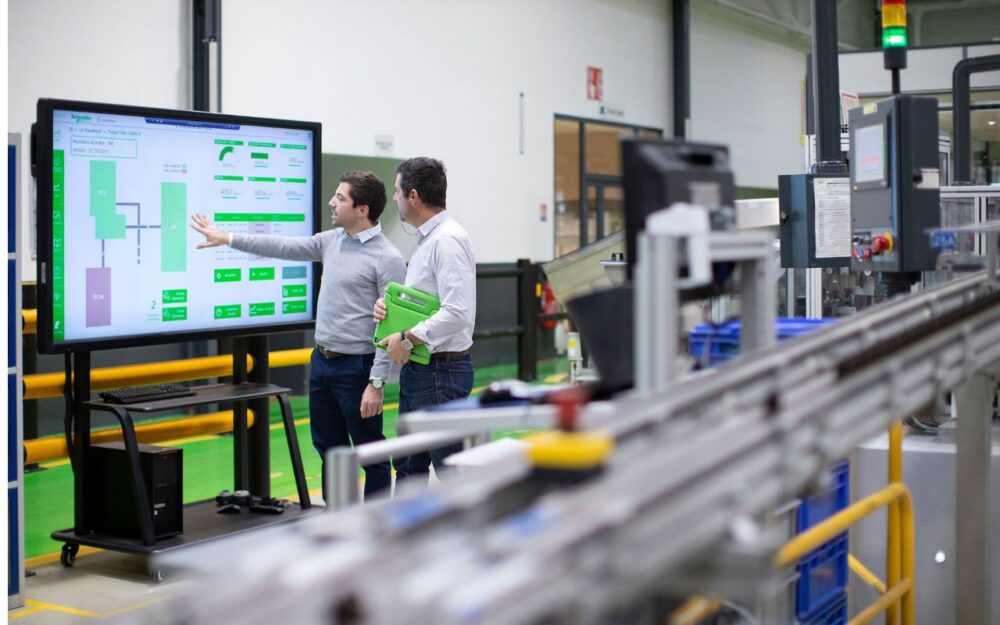
Data is first captured on the shop floor through sensors, PLCs and machine vision systems. It then flows into Schneider Electric PLCs and Aveva and EcoStruxure supervision platforms. Above that come MES layers and finally SAP ERP systems.
Christophe Ernis, who also oversees the site’s IT/OT architecture explains:
“The most important thing is to capture data from the shop floor. Then you need to make all the levels work together.”
The ultimate objective is to build an industrial “control tower” capable of optimizing processes in real time.
Competitiveness Also Depends on Energy
Energy remains a constant theme throughout the visit. In today’s European context, Schneider Electric believes energy has become a central factor in industrial competitiveness.
The group is working on systems capable of combining industrial and energy data in order to dynamically adjust a factory’s electricity consumption depending on power prices. Non-critical areas of a plant can automatically slow down during electricity price spikes, orchestrated by AI systems, adds Gwenaelle Huet:
“All of this is driven by the power of data. And it helps rebalance competitiveness distortions with other parts of the world.”
A More Local and Circular Industry
Le Vaudreuil also serves as a showcase for a more regionalized industrial model. The site’s main supplier is another Schneider Electric plant located in Beaumont-le-Roger, roughly thirty minutes away. The group’s European distribution center is also nearby, in Évreux. For Sandra Ferraguti, the plant’s manager,
“This is the power of localization and regionalization. We have our suppliers and customers within the same region, so we can be extremely fast.”
Schneider Electric is also pushing circularity further. The silver used in industrial processes used to be sent to external refiners. Since 2023, the company has worked with a local partner to reintegrate refined silver directly back into production at Le Vaudreuil. The group estimates this new model avoids around 440 tons of CO2 emissions.
A Transformation That Remains Fundamentally Human
Despite the omnipresence of automation and AI, Gwenaelle Huet insists on one key point: industrial transformation remains primarily a human challenge.
“The technology already exists. The real question is transformation.”
The group therefore highlights the importance of training, upskilling and making industrial jobs more attractive. Inside the site’s warehouses, new digital tools guide operators in their daily tasks. AGVs automate part of the logistics workflow while digital solutions replace old paper-based Kanban systems.
Tools such as “e-train” are also used to accelerate onboarding by guiding new operators through component retrieval and delivery tasks across the factory. For Virginie Rigaudeau, Sustainability leader at Schneider Electric:
“We are not doing digital for the sake of digital. We are a brownfield factory. We need to accelerate execution and performance. Digital is a lever to accelerate performance, but also resilience and sustainability.”
Ultimately, Schneider Electric is not trying to showcase a futuristic factory built entirely from scratch in Le Vaudreuil. Instead, the group is trying to demonstrate that in Europe, industrial transformation will first happen through the intelligent modernization of existing assets.