


They stole the show at Chinese New Year. China’s humanoid robots have become impossible to ignore. Our Shanghai correspondent takes stock of the country’s leading manufacturers and their competitive edge.
A humanoid robot is a robotic system that features a head, torso, two arms and two legs and is capable of mimicking human movement and behaviour. With the integration of advanced AI, these machines are no longer limited to controlled factory environments. Logistics and manufacturing are the first key areas of deployment.
Indeed, unlike conventional industrial robots bolted to a single task, humanoids can navigate unstructured environments and adapt on the fly. They are therefore well-suited for operations such as mixed-case palletizing or unstructured item picking. They can also take on workflows that historically resisted automation precisely because it required human judgment and physical versatility.
So humanoid robots have a lot of potential. This explains why the global humanoid robot market is on a meteoric rise.
The Global Humanoid Robot Market
According to data from IDC (International Data Corporation), around 18,000 humanoid robots were sold worldwide in 2025. This generated approximately $440 million in hardware revenue. This represents a year-over-year (YoY) increase of roughly 508%.
For MarketsandMarkets, the broader market, including hardware but also software and services, is already valued at nearly $3 billion. Projections could reach $15 billion by 2030. Other analysts are even more bullish. SkyQuestt projects the market could reach $35.4 billion by 2033 at a CAGR of 48.9%.
The Chinese Humanoid Robot Market
This segment was long dominated by American players. But China has entered the race at full speed and is already pulling ahead. Nearly 90% of all humanoid robots sold globally in 2025 were Chinese, states Lily Li. She is the research manager at IDC China Robotics and Embodied Intelligence:
“In 2025, the global humanoid robot market expanded rapidly, with China vendors taking a leading position supported by a comprehensive industrial supply chain. Advances in dexterous upper-limb manipulation and integrated cognitive-motor embodied models are enhancing autonomous operation and human-robot collaboration. At the same time, hardware-centric sales models are shifting toward RaaS, operational services, and platform ecosystems.”
International Banker reports that China Center for Information Industry Development (CCID) (a division of China’s Ministry of Industry) forecasts the domestic humanoid robotics industry will surpass 20 billion yuan ($2.8 billion) by 2026.
The 2026 Spring Festival Gala
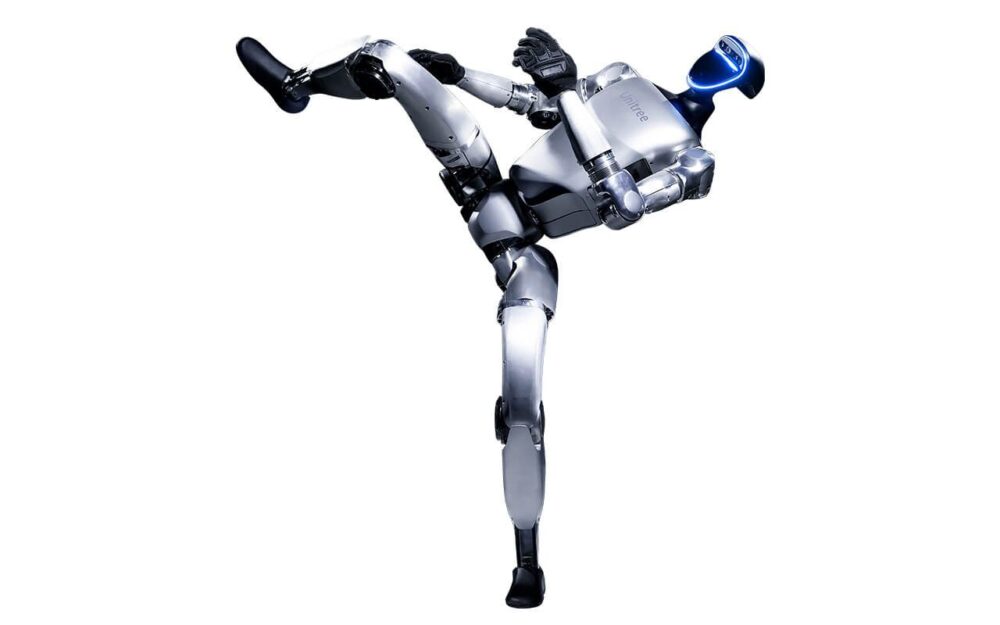
China’s humanoid robotics industry had its Sputnik moment during the 2026 Spring Festival Gala, with robots performing perfectly choreographed kung fu. People often cite it as the world’s most-watched television program. Broadcasters air it on Chinese New Year’s Eve and, in recent years, use it to showcase China’s advances. Humanoid robots are no strangers to the show; they also appeared on the 2025 broadcast, but whereas the models a year ago could barely stand, the latest cohort stunned with their dexterity.
However, for every video on social media wowing viewers, there seems to be another of the robots falling flat on their faces or going berserk. In a world now filled with AI fakes, more telling are the production figures; market leader AgiBot only produced 5,100 robots in 2025 and Unitree made 4,200. Professor Mohd Rizal Arshad, Dean of the School of Robotics at XJTLU in Suzhou, cautions:
“Many of the examples people see in the media are essentially demonstrations of what these systems might be able to do in the future. They show impressive progress in robotics and artificial intelligence, but they should not necessarily be interpreted as robots that are already ready for large-scale industrial deployment … these platforms are best understood as technology demonstrators.”
Diana Derval, PhD, Chief Investigator at DervalResearch, sees the current three main usage scenarios for such robots as: service, combat and industry. For those with dreams of using such a robot in the home, Derval says:
“A lot of data will need to be collected and annotated before the robots can be released in unstructured environments like households.”
The Top Manufacturers
The industry is very much in its infancy, with China Daily claiming that worldwide shipments of such robots reached around 13,000 last year. With Chinese companies already dominating the fledgling industry, who are the companies to watch?
1/ AgiBot
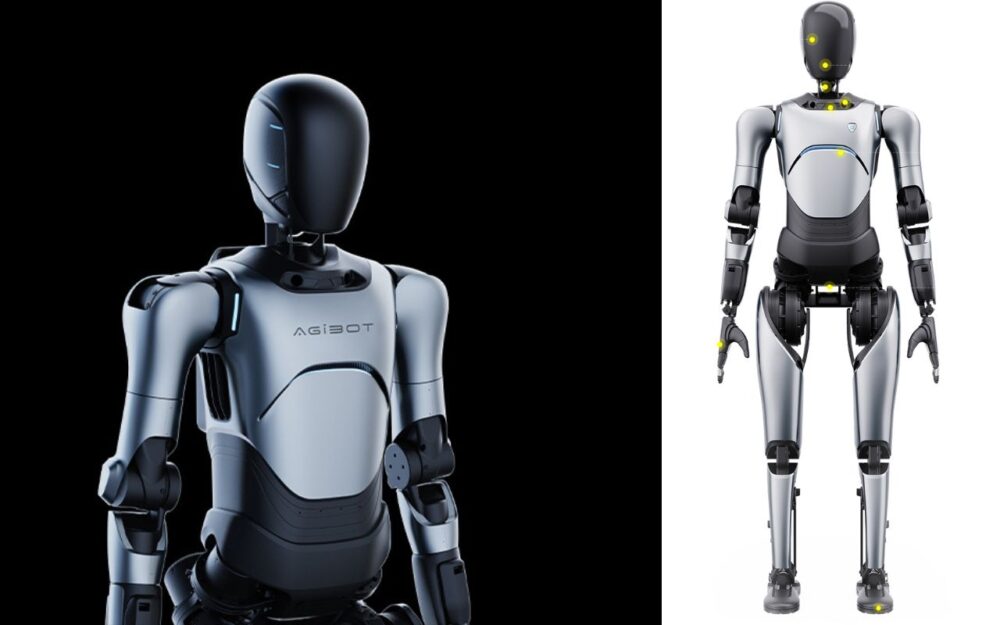
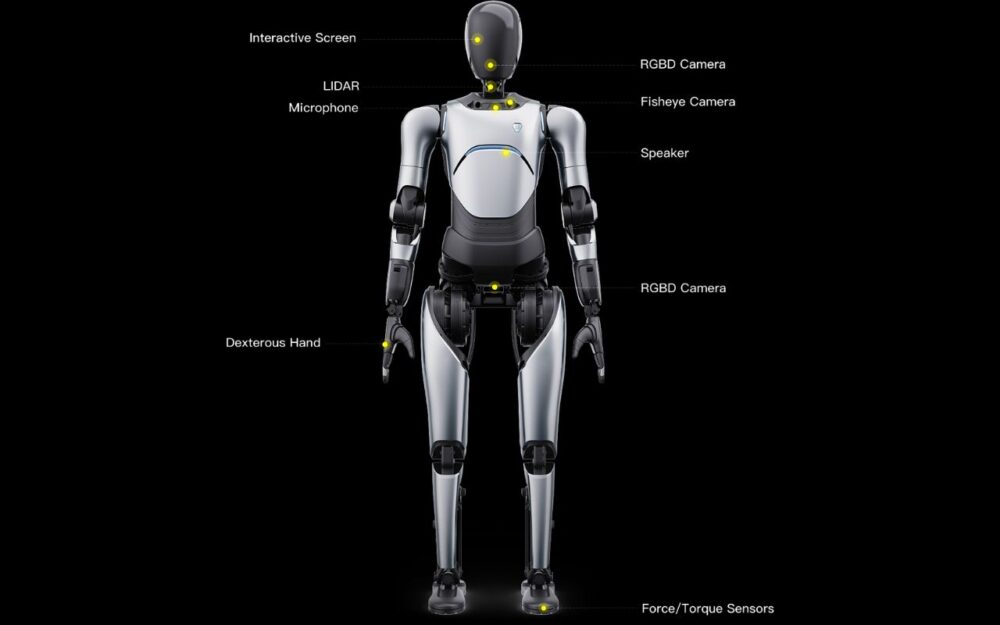
The company was founded in 2023 by former Huawei engineers and has both its factory and headquarters in Shanghai. Omdia’s report General-Purpose Embodied Intelligent Robot 2026, published in January 2026, ranked AgiBot first globally in both humanoid robot shipment volume and market share in 2025. The Shanghai-based company shipped more than 5,100 units over the year, capturing 39% of global market share — placing it first worldwide across both key commercial indicators.
Fulin Precision, a car-parts producer, has deployed nearly 100 AgiBot robots to perform repetitive manual tasks, including loading and unloading materials and moving boxes and parts. China Mobile deployed some others in around 50 pop-up stores and 30 service centers across 22 cities, acting as receptionists and ticket distributors. The ticket distribution task was often previously undertaken by a touch-screen kiosk rather than a worker. Where the robot holds a distinct advantage is in its ability to talk to the customer, and guide them through the store.
Many of AgiBot’s robots end up in the firm’s training facility, where they operate up to 17 hours a day, learning household tasks such as folding clothes and preparing food. Such usage in the real world is still probably years away. Derval, however, points out that perception in Asia makes the acceptance of such robots more likely:
“The perception of humanoid robots varies tremendously between geographical regions, with people in Western countries tending to see robots as threats likely to turn against humans (think of the Terminator), while Asian countries see robots as useful machines serving humans.”
2/ Unitree Robotics
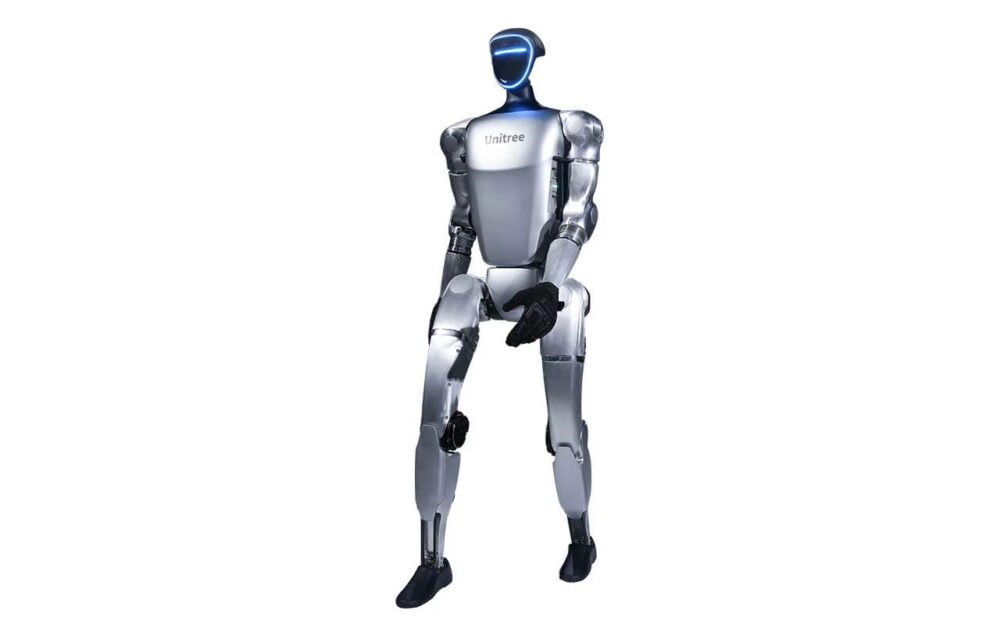
Unitree is arguably China’s most recognizable humanoid robot brand. Founded by Wang Xingxing in 2016 and headquartered in Hangzhou, the company today employs roughly 1,000 people and ships robots to over 30 countries.
Despite ranking second in production according to independent analysts like Omdia’s report, Unitree’s CEO Wang Xingxing has pushed back on that assessment, claiming the company shipped approximately 5,500 humanoid robots in 2025. This figure, he argues, puts Unitree ahead of Agibot. The dispute remains unresolved, but what is beyond question is Unitree’s dominance in brand recognition. Through a string of high-profile PR coups — most notably its G1 robots’ now-iconic performances at the CCTV Spring Festival Gala, watched by hundreds of millions of people — Unitree has become the global public face of China’s humanoid revolution. This means it is likely better known than AgiBot.
The G1 is priced from $13,500, weighs in around 35 kg and is 130 cm high. However, the specification also claims a battery life of only two hours and a maximum arm load of just 2 kg for the standard model.
In another PR stunt this year, a G1 clad in a red down jacket formed an 186-meter-long, 100-meter-wide pattern in the snow, celebrating the Winter Olympics. Derval explains:
“Unitree is preparing for an IPO, riding on the fact that their robot just achieved a new tour de force and made the headlines by autonomously walking 130,000 steps at -47°C in China’s Xinjiang province.”
Founded in 2016 and headquartered in Hangzhou, the company first developed robotic dogs before expanding to humanoids. The CEO, Wang Xingxing, has forecast deliveries of between 10,000 and 20,000 units in 2026.
3/ UBTech
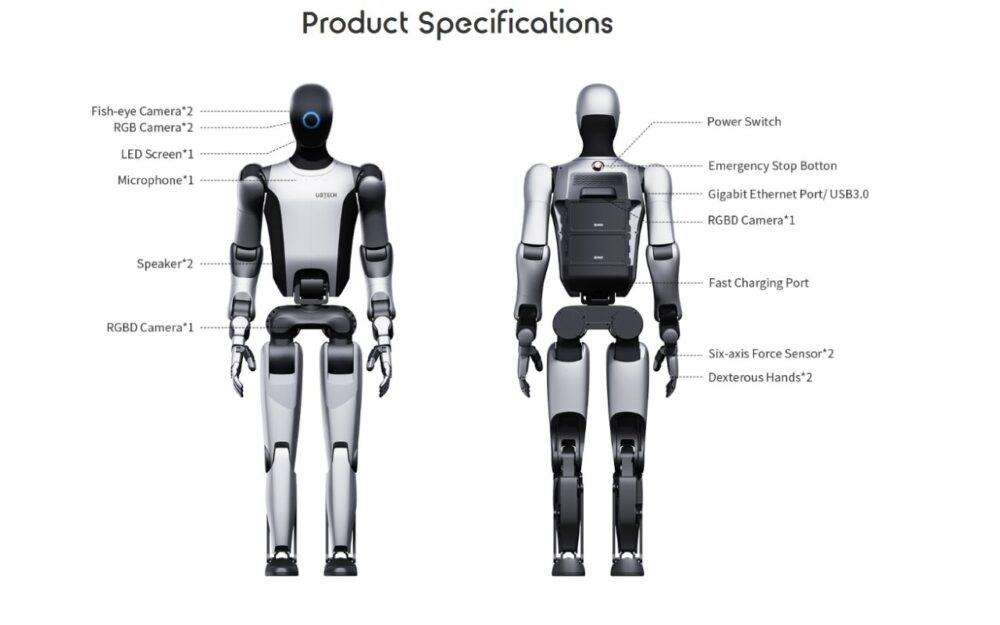
UBTech is one of China’s oldest robotics companies. Founded in 2012, it produced around 1,000 humanoid robots in 2025. Concentrating on industrial humanoids for use in logistics and manufacturing automation, the company sells robots in the Walker series. According to Derval:
“UBTech’s humanoid robots can already be seen walking around on automotive production lines from BYD to Geely, busy with handling. Their straight-thighed Walker S2 is equipped with a legacy AI agent allowing it to autonomously execute tasks, including swapping its own battery for a fully charged one from the battery rack. Intelligent, autonomous, available 24/7, and able to move in a semi-structured environment, UBTech’s Walker S2 has the potential to replace some of the human workforce left in OEM factories.”
The Shenzhen-based company, which has a listing on the Hong Kong Stock Exchange, claims to have 2,790 robotic and AI-related patents. It is generally considered one of the most mature companies in the humanoid field, and last year achieved the first swarm intelligence exercise by such robots. Carried out at a Zeekr (Geely) car plant, the robots were controlled by UBTech’s BrainNet AI network rather than individually, enabling them to perform complex tasks that require coordination between units.
4/ Leju Robotics
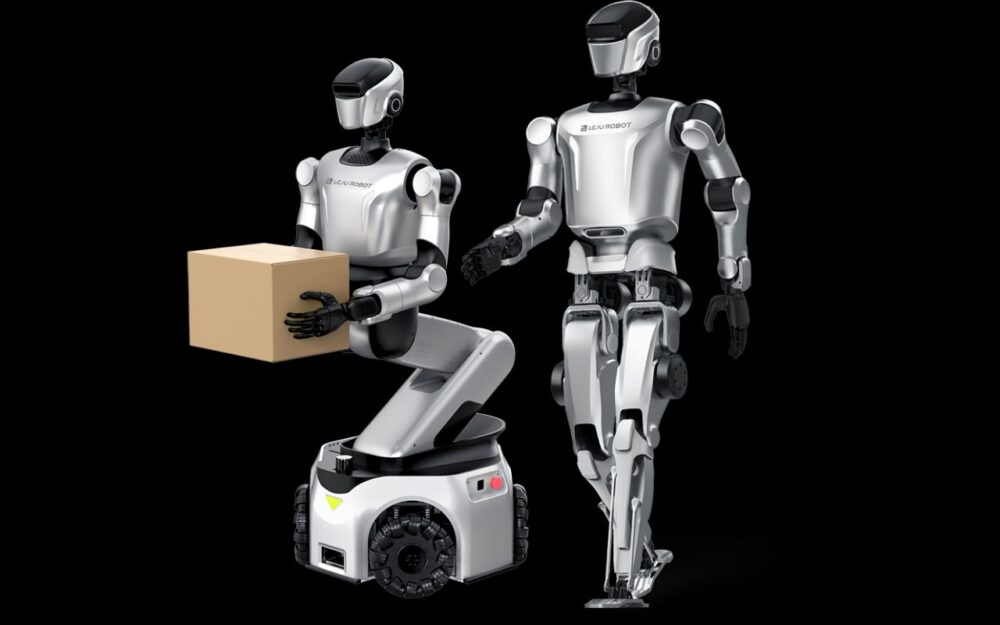
Although it is a private company founded in Shenzhen in 2016, Leju Robotics’s founding team has links with Harbin Institute of Technology, one of China’s top educational institutions in robotics. The company has received financial support from tech giant Tencent in its funding rounds.
Leju’s humanoid robots are largely focused on the education and research sectors. The AELOS series is between 30 cm and 40 cm high and programmable in Scratch, Python, and C++. The company also produces other series, including KUAVO, a full-height humanoid (around 1.7 meters) noted for its proprietary torque servos and algorithms that allow walking at up to 4.6 km/h.
5/ XPeng
Although not currently the fifth-largest player in the industry, XPeng is certainly a company to watch. They have announced plans to begin mass-producing its IRON humanoid robot this year.
In November 2025, XPeng stunned the world when its Next-Gen IRON robot took the stage at the company’s AI Day in Guangzhou. The movements were so fluid, and the robot looked so lifelike, there was speculation that it was actually an actor in a suit. To quash this, CEO He Xiaopeng cut away the material covering to reveal the wires and servos.
It is one of the largest humanoid robots with a height of 178 cm and a weight of 70 kg. IRON boasts 82 degrees of freedom throughout the body, along with what XPeng claims is the industry’s smallest “harmonic joint,” allowing 1:1 hand size, giving the hand 22 degrees of freedom.
XPeng is often called the Chinese Tesla. And the IRON robot, along with the firm’s electric cars and advanced self-driving technology, helps cement the analogy. With the Chinese car industry’s profitability under severe pressure, XPeng is not the only manufacturer looking to diversify into robots. Fellow US-listed Chinese company Li Auto has also branched into the area. But it is concentrating on two-wheeled rather than two-legged models.
Upcoming Challenges
Clearly, the industry still requires much development. Many of the videos of the humanoids, such as those from last year’s Beijing half-marathon, show a trailing human operating the robot via a remote-control unit. This doesn’t necessarily mean they are nothing more than a remote-controlled toy, but rather that they use shared autonomy, where some functions are autonomous while others require a human operator to complete. This is particularly the case in the training environment, which is currently being used as the industry ramps up. Professor Mohd Rizal Arshad explains:
“From a systems engineering perspective, the biggest challenge is moving from a research prototype to a reliable operational system. In robotics development, we often describe this journey using Technology Readiness Levels, from TRL1 at the research stage to TRL9 for fully operational systems. Many humanoid robots today are somewhere in the middle of that scale. Demonstrations show that the core technology works, but significant effort is still required to make the systems reliable, safe and maintainable in real environments.”
Rizal also points out that robots, particularly in factories, rarely work alone. They will need to work with other machines, systems, robots and humans. Furthermore, there are question marks over the usefulness of humanoid robots and their costs. As Rizal notes:
“A general-purpose robot may be flexible, but it may not perform specific tasks as efficiently as a robot designed for that particular task. In many cases, application-specific robots may still be the more practical solution.”
According to a Mitsubishi Research Institute survey, people in China were much more open to robot involvement in consumer services than in Japan, the UK, or the US. Derval suggests:
“What might also help the adoption is that Asian humanoid robots are often shorter, slightly cuter, or at least less creepy looking, with more effort put into the actual features.”