


At Global Industrie in Villepinte, a clear trend is emerging: Chinese industrial robot manufacturers are accelerating their expansion into the European market. Among them, Dobot embodies this new generation of players challenging a landscape historically dominated by German and Japanese giants.
A Growing Chinese Presence
Walking through the exhibition halls, the rise of Chinese exhibitors is impossible to miss. Dobot is not alone. Other players such as Estun, Elite Robots, and Taiwan-based Techman Robot are also multiplying demonstrations and business meetings at France’s largest industrial event.
This momentum is no coincidence. France still lags behind in automation, leaving significant room for growth in robotics adoption. Combined with an aging workforce and a shortage of industrial skills, the need for automation is expected to increase sharply in the coming years, something Chinese manufacturers have clearly understood.
Yet, contrary to common assumptions, their main challenge is not necessarily competing with well-established European players like ABB or Japanese leaders such as Fanuc and Yaskawa, but rather differentiating themselves… from other Chinese competitors.
“There are many other Chinese brands here at the show. But that doesn’t mean they can easily penetrate the European market,” says Jean De Gantes, technical sales engineer at Dobot.
In this highly competitive environment, the battle goes far beyond price.
Dobot’s Positioning: Accessibility and Simplicity
Historically specialized in 6-axis collaborative industrial robots, the Shenzhen-based company, founded 11 years ago, is built around a clear promise: making automation accessible.
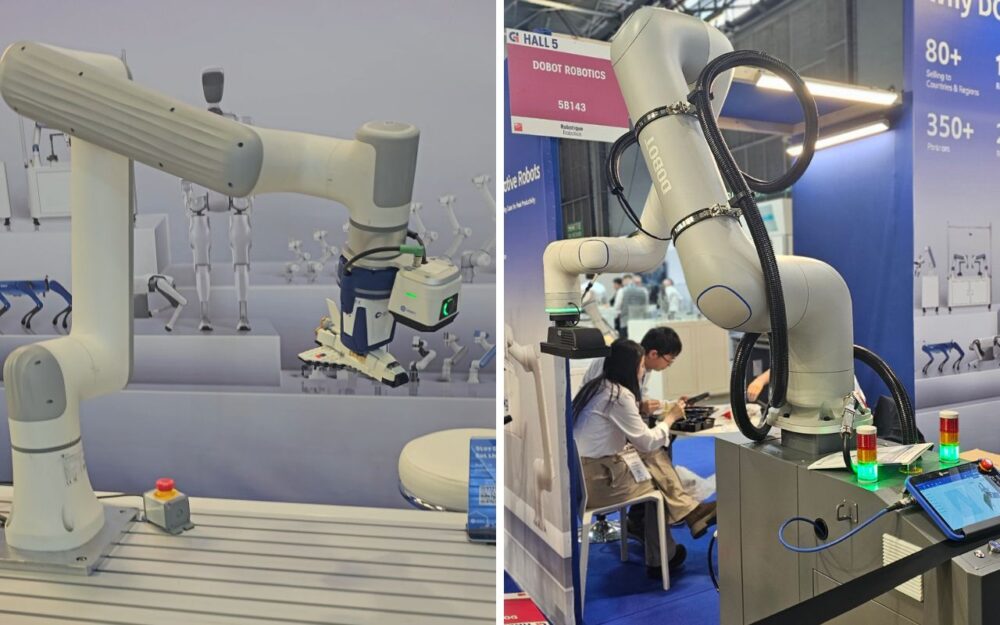
At the show, Dobot highlights a turnkey palletizing solution capable of handling loads of up to 30 kg. Its key feature is an open-source, no-code interface designed for non-specialists.
“If you know how to use a tablet or a smartphone, you can use our robots.”
This approach directly targets a high-demand segment in Europe: small and mid-sized industrial companies looking to automate without hiring robotics experts.
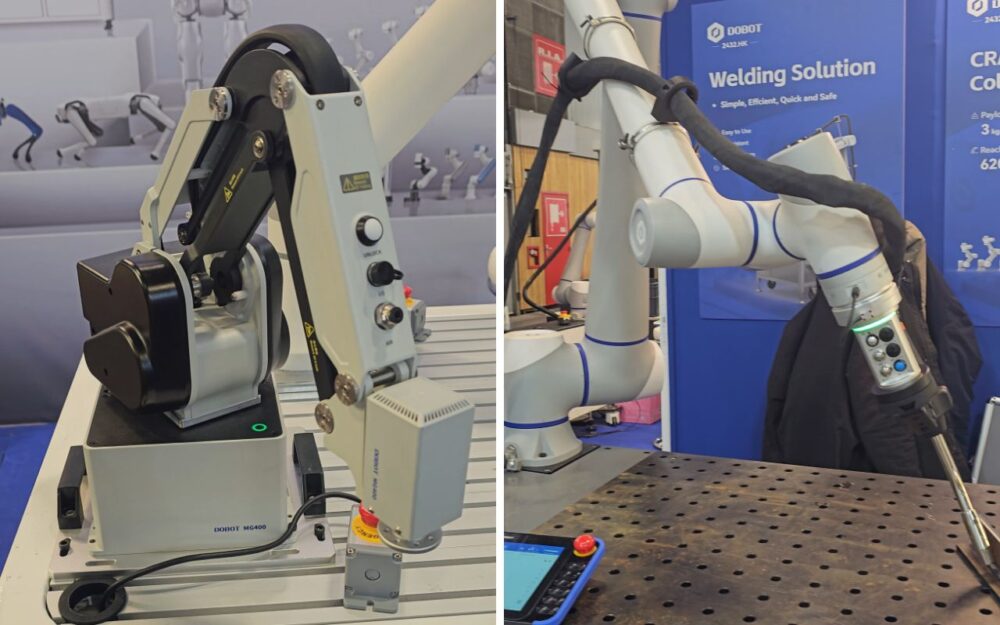
Dobot’s product range is broad. It starts with small 4-axis cobots like the MG400 (around 500 grams payload), priced just above €2,000 and suited for electronics or light pick-and-place tasks. At the other end, robotic arms capable of handling 30 kg are priced below €40,000, a positioning that clearly undercuts traditional market standards.
The Key Battleground: Price… and Service
While price remains a strong argument, it is no longer enough. Dobot emphasizes a strategic differentiator: local presence.
With headquarters and R&D in Shenzhen, the company operates a European office in Germany with around 35 employees, supported by mobile technical teams across Europe, including France.
Unlike some competitors, Dobot claims a direct-to-customer model without distributors.
“Price is an argument, of course. But if there is no support behind it, customers are not interested. What really makes the difference is service and support.”
The company provides training, pre- and after-sales support, connections with integrators, and full project assistance. They believe these are key elements for convincing European manufacturers accustomed to high service standards.
Helping European Industry Stay Competitive
Dobot’s message aligns with a well-known reality: the competitiveness gap with Asia.
“More and more European manufacturers are looking to automate with controlled costs. That’s where we come in. They complain about Asian competition… but Asia is also the largest robotics market in the world.”
The company aims to provide European industries with cost-effective tools to accelerate automation and reduce production costs. This is particularly relevant in countries like France, which remain less automated than Germany.
Dobot targets sectors such as food processing, pharmaceuticals, cosmetics, and machining.
“We have IP68 robots, meaning they are water-resistant and fully sealed. They can operate in harsh environments, such as food production lines with heavy cleaning or machining environments with oil projections.”
To succeed in Europe, regulatory compliance is critical. Dobot has made this a key differentiator, with CE certification, ISO 9001 and 14001 compliance, and alignment with upcoming European machinery directives. These standards, the company says, are then applied globally across its product range.
While Dobot declines to disclose European sales figures, “It’s a fierce market, competitors are constantly watching us”, it reports around 12,000 six-axis robots produced annually and more than 100,000 robots sold worldwide since its founding.
“We are not the largest Chinese robot manufacturer, but we have been the leading exporter of Chinese collaborative robots for six consecutive years.”
Beyond Industrial Robots: Humanoids and Quadrupeds
Dobot is not limiting itself to traditional industrial robotics. While it does not target AMRs like some other exhibitors, the company is investing heavily in humanoid and quadruped robots. This technologies, still emerging in Europe, are already widespread and mature in China.
Humanoid Robots
In China, humanoid robots are booming, attracting heavy investment. These robots tackle tasks that traditional industrial robots struggle to perform, while interacting in environments designed for humans (read our in-depth article).
“Our environments, factories, hospitals, kitchens, warehouses, are designed for bodies with two arms and two legs, capable of flexible manipulation and movement,” explains Jean.
Humanoids can outperform AMRs in complex or irregular environments.
“On uneven floors or in complex spaces, AMRs can be difficult to deploy. In contrast, a biped robot with hands and multiple degrees of freedom can replicate human gestures and handle more sophisticated tasks.”
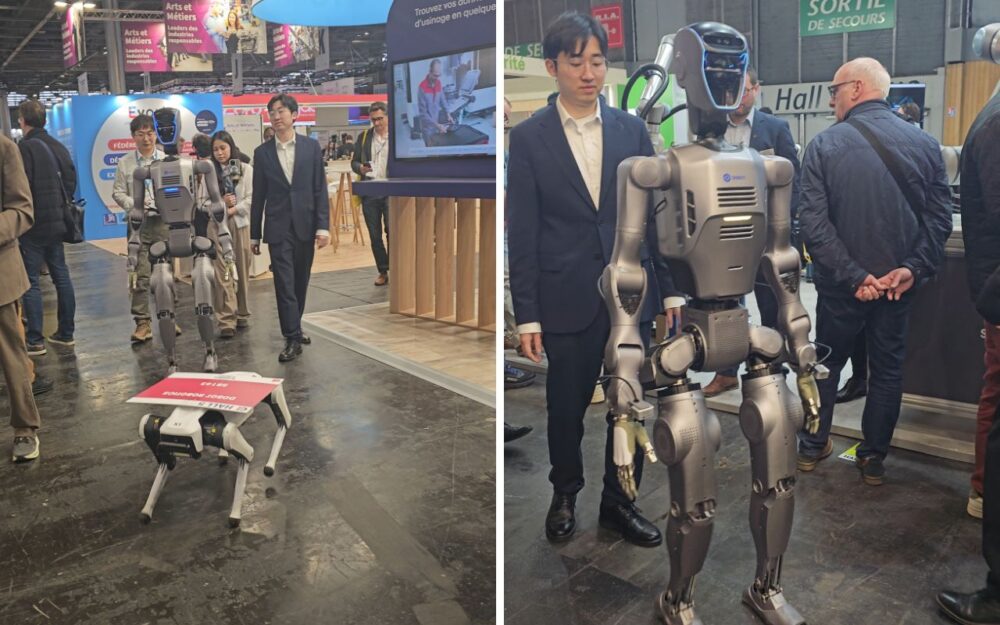
They have therefore developed a humanoid, which they paraded through the aisles of the show. And, let’s be honest, it was enough to startle the visitors.
That said, he acknowledges that in Europe, use cases remain largely limited to research and experimentation. Concrete industrial applications are still rare, unlike in China where humanoids can already serve in cinemas, restaurants, and more.
The main challenge is software. While the hardware is impressive, programming humanoids to perform specific tasks is complex.
“A robot remains fundamentally dependent on what it’s taught. The value lies in the software: vision, environment understanding, natural interaction. The goal is simple control, even via natural language, for example, asking the robot to pick a red piece based on criteria. We believe this will extend to industrial robots as well.”
Dobot humanoids already embed PCs capable of running AI models locally, with rapid improvement expected as components miniaturize. Hardware upgrades continue, smoother movement, improved stability, hidden cabling, modular designs, and customized grippers for industrial applications. Prices range from €30,000 to €70,000, with fewer than 500 units sold annually.
Quadruped Robots
Quadrupeds are also limited in Europe but seem to find practical industrial use faster than humanoids, says Jean:
“They are much more adaptable to industrial applications. We have requests for tasks that AMRs struggle with, like moving parts across uneven floors or stairs. Payloads can reach 12 kg,” says Jean.
Equipped with Lidar, cameras, and open-source software, quadrupeds provide an alternative where traditional solutions hit limits, particularly for light parts in pharma or similar industries.
Interest at the Show and European Outlook
Dobot’s presence at Global Industrie demonstrates the speed and ambition of Chinese manufacturers. Even if Europe is still catching up, interest is real. Visitors often arrive with projects, parts, and concrete problems.
“Many come with projects, pieces, and real challenges. From SMEs to large groups, they want to see how these new machines could integrate into their operations,” Jean notes.
Dobot’s expansion into Europe signals a broader shift: Chinese robotics manufacturers are not just competing on price, but reshaping industrial automation through accessibility, service, and innovative humanoid and quadruped technologies.
The question remains whether they will be able to build lasting trust with European manufacturers.