



AI will drastically change the way we work. By now, in early 2026, we have read or heard this sentence hundreds of times. This is probably why in the public discourse it has already surged to the rank of self-evident truth. We can all agree that our approach to intellectual work has already changed since the inception of ChatGPT and the other LLMs. And it probably will change even more. But there are disagreeing takes on how exactly it will affect work in the future at a larger scale.
Many self-proclaimed AI-experts have already produced detailed and confident reports predicting how the workplace will soon become unrecognizable. They explain how white-collar work will inevitably be affected by AI agents. And how anyone who is not familiar with AI-based tools will be left behind.
The Citrini Research Speculative Essay
A forward-looking — and contested — analysis by Citrini Research, The 2028 Global Intelligence Crisis, has been making waves since its publication on February 23rd. According to James V. van Geelen and Alap Shah, the authors of this speculative essay modelled on the American case, by 2028, AI will be so capable that it will undermine the very foundations of the consumer economy. US unemployment will be above 10%, the S&P 500 down 40%. All this will not happen because of a classic recession, but because of excessive efficiency.
Their hypothesis — and it is only a hypothesis — is as follows:
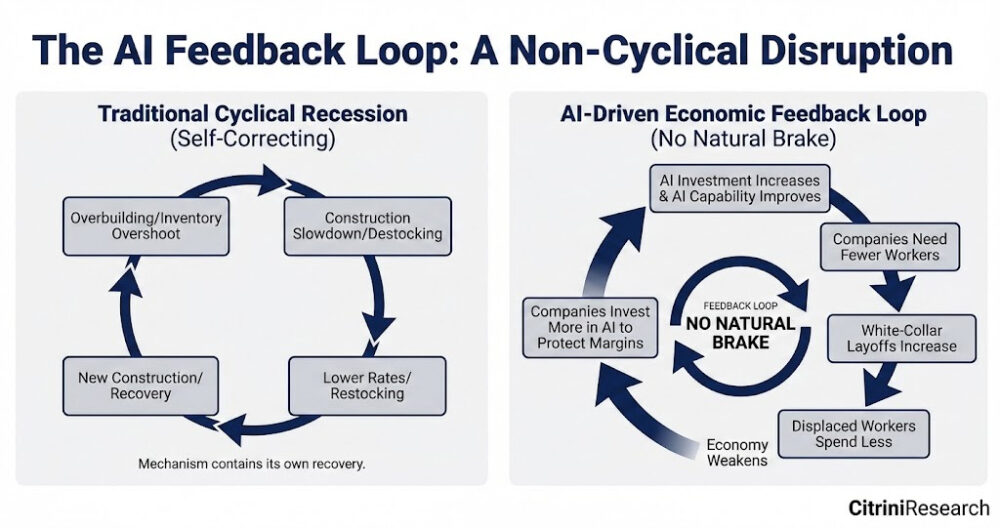
“AI got better and cheaper. Companies laid off workers, then used the savings to buy more AI capability, which let them lay off more workers. Displaced workers spent less. Companies that sell things to consumers sold fewer of them, weakened, and invested more in AI to protect margins. AI got better and cheaper. A feedback loop with no natural brake.”
If AI replaces high-value tasks at minimal cost, the income model of the top 10% begins to erode. And for good reason. They account for more than half of US consumer spending. A spiral takes hold: layoffs, falling demand, margin pressure, further AI investment. A potential systemic risk to capitalism itself. A striking irony for a technology that embodies unchecked capitalism at its most extreme.
Compounding this is a credit crisis. White-collar workers, having lost their jobs and forced into lower-paying roles, can no longer service their debts. And layered on top is a fiscal challenge. Even in the United States, public finances rest heavily on taxing labour. If the wage share shrinks in favour of capital, tax revenues contract while social transfers rise.
“The first negative feedback loop was in the real economy: AI capability improves, payroll shrinks, spending softens, margins tighten, companies buy more capability, capability improves. Then it turned financial: income impairment hit mortgages, bank losses tightened credit, the wealth effect cracked, and the feedback loop sped up.”
At the end of it all, what remains is social chaos.
The US National Bureau of Economic Research (NBER) Study
Yet, skeptics abound. And so do reports from respectable research institutes suggesting that the trend is not as clear as suggested. Many CEOs and executives say they fail to see the practical application of the shiny promises peddled by AI-companies.
The blurry picture of the impact of AI on jobs and employment is well framed by a new study released in February 2026 by the US National Bureau of Economic Research (NBER). According to the report, which surveyed around 6000 CEOs, CFOs, and other executives from the USA, Great Britain, Germany, and Australia, the impact of AI on productivity in companies that widely adopted the new technology for the day-to-day processes has been way lower than expected. In many cases it hasn’t matched the financial forecasts in terms of savings or revenue increases.
You could also be interested in this article
The interesting aspect is that, despite these results, AI seems to benefit from a widely optimistic stance regarding the possibility that such productivity and revenue gains will eventually materialize. According to the NBER, respondents still believe that AI use can bring a 1.4% increase in productivity within the next three years. Revenue-per-employee being the widely adopted benchmark for these figures.
There is more to the picture. CEOs and executives expect the figure to go up as soon as AI will reliably let them fire as many people as possible. Most of the respondents expect indeed to be able to reduce their personnel by 0.7%. That would result in about 1.75 million fewer job positions just in the companies surveyed.
In other words, the purported benefits of AI right now might just as well amount to wishful thinking by high level executives who see the tool as a great opportunity to optimize profitability in the most simple way known to corporate: headcount reduction.
Quantity vs Quality
Reports like the one from NBER are quite useful to assess the pulse of the industry, at least in Western markets. But they consistently suggest quantitative answers to a fundamentally qualitative problem. While it might even be true that AI will help industry captains to get rid of pesky, expensive, and soon useless human employees, what will the remaining people do at these companies? How will they use AI to become more productive? How will the internal processes change and adapt to the new rules of AI work? In short, how will their work actually change thanks (or because of) AI?
Answering with 100% reliability is close to impossible. Generalizing an answer about work in the future is a futile effort. Industries will adapt to AI adoption in widely different ways, based on their expected output, set of competences, different regulations in different jurisdictions, and varying needs for compliance and quality assurance.
The way AI will change the creative work in a creative agency will not be comparable to how it will affect engineers or consultants. Accountants or financial advisors will not use AI the same way a marketing specialist would, and so on.
Automation vs AI
Moreover, when talking about AI disruptions to the workforce, there seems to be widespread confusion around the difference between AI-driven disruptions and automation-driven changes. Automation is a settled concept that has already produced sweeping changes in the nature of work way before the current wave of generative AI.
The distinction here is key to understand how the nature of our work will be affected. Automation usually refers to a rule-based set of systems that can replace a human worker in the execution of a broadly task-based job. This has been true and tested throughout the computer and internet revolution. Machines were displacing previously safe but “boring” low-skilled jobs. Robots were taking the place of human workers in factories and other high-risk and strenuous lines of work.
AI Agents
The new wave of AI systems and tools goes beyond replacing fixed routines. They can learn from experience, analyze data, and – above all – take agency and execute decisions. Thanks to these advanced abilities, AI systems rewrite completely the chain of work where humans are demanded to take control of decision-making processes. Until now that was a task that only an experienced human could perform.
Admittedly the confusion arises from the fact that newer AI systems, LLMs, and agentic frameworks are, in a way, a higher level layer of automation. Instead of replacing menial, programmable tasks, the machine can now potentially do the previously unthinkable, and automate more complex systems that until recently required human adaptability and advanced thinking (managerial and organizational tasks, for example).
Given these premises, we can assess that the jobs that will remain available to humans will have to rise to a higher conceptual and orchestration level. The humans still needed in the process will be those who can adapt their thinking to delegate processes or “subroutines” to the automated thinking machines and agents, while remaining the final gateway to ensure the quality and compliance of the output. While the parameters and the involvement of the human in the process might vary widely based on factors such as risk, criticality, and compliance, this conceptual framework might be applied to many different roles and fields.
More or Fewer Jobs?
This shift to a higher conceptual level of work creates a new set of yet unsolved problems. The workforce might have to readapt to a widely shifting set of paradigms around the nature of intellectual work as we have always known it.
On the other hand, through proper reskilling, many workers could adapt in time to the new nature of work. And after a first phase of profit maximization through headcount reduction, companies might discover that hiring more people to command agents and AI systems might indeed lead to higher productivity and revenues. So, according to many economists, an initial disruption might be followed by normalization, as we’ve already seen for previous shifts.
As Josh Tyrangiel has recently explained in an article titled “America isn’t ready for what the AI will do to jobs”. It was published earlier in February by The Atlantic:
“Many economists insist that this will all be fine. Capitalism is resilient. The arrival of the ATM famously led to the employment of more bank tellers, just as the introduction of Excel swelled the ranks of accountants and Photoshop spiked demand for graphic designers. In each case, new tech automated old tasks, increased productivity, and created jobs with higher wages than anyone could have conceived of before. The US Bureau of Labor Statistics projects that employment will grow 3.1 percent over the next 10 years. That’s down from 13 percent in the previous decade, but 5 million new jobs in a country with a stable population is hardly catastrophic.”
What the numbers we see fail to account for, once again, is the qualitative nature of work. And its meaning for the workers themselves. If AI will turn everyone into an orchestrator of AI agents, work might intensify in a way that won’t lead necessarily to higher job satisfaction. And to an increase in the average wages for white collar workers.
“Reverse Centaurs”
Cory Doctorow is a science-fiction and Internet activist. In a recent essay, he wrote we might be facing a future in which most of the workers that have to deal with AI will be asked to become “reverse centaurs”:
“There’s a bit of automation theory jargon that I absolutely adore: ‘centaurs’ and “reverse-centaurs.” A centaur is a human being who is assisted by a machine that does some onerous task (like transcribing hours of podcasts, editing large parts of an essay, helping to script a tedious task). A reverse-centaur is a machine that is assisted by a human being, who is expected to work at the machine’s pace.”
While being a centaur is empowering and desirable, continues Doctorow, becoming a reverse-centaur is a gruesome prospect. Yet, these tools seem to be created and funded for the express purpose of creating reverse-centaurs. And not of empowering workers towards a future where work is different, more productive, still meaningful and primarily “human”.
The Example of Coding
Coding is one of the environments where AI tools have shown the most impressive evolution in the last year. Solutions like Claude Code, Codex, Cursor, and many others have already started to significantly alter the software engineering industry.
And yet, despite the widespread adoption and the lower rate of hallucinations than seen in other fields, professionals report a mix of awe at the technology and skepticism at the applicability at scale. In many cases, while speeding up the actual “action” of writing code, AI coding assistants seem to shift the burden towards more time-intensive parts of a coder’s work, like code review and quality control. The quality of code produced by these instruments in large corporate environments is in many cases not up to par with that of human coders.
As reported by The Register:
“As things stand, generative AI in software development has failed to live up to the hype, the wide-ranging Technology Report 2025 from management consultants Bain & Company says. Two-thirds of software firms have rolled out GenAI tools, but developer adoption is low among those, and teams using AI assistants report a productivity boost of perhaps 10 to 15 percent.”
Meanwhile, another recent study from nonprofit research group Model Evaluation & Threat Research (METR) found that,
“AI coding tools actually made software developers slower, despite expectations to the contrary, because they had to spend time checking for and correcting errors made by the AI.”
You could also be interested in this article
Unemployment Is Good (For Investors)
This last consideration leads to a final element that is sorely missing from most analyses about how AI will impact the future of work: hype.
In its current stage, what we call AI is mostly a set of instruments and systems devised, developed and wholly owned by a very small set of technology companies. OpenAI, Anthropic, Nvidia, Microsoft, Mistral and a few others are constantly controlling and steering the discourse around the impact of AI on the future of work. Their boastful predictions about the displacement of white collar jobs are often amplified by the media in a way that doesn’t challenge their enormous conflict of interests adequately.
A Discourse Controlled by the Big Tech
Sam Altman famously claimed that OpenAI knew how to get to General Artificial Intelligence by 2025. Or that human radiologists would already be obsolete by now, completely supplanted by AI. He was utterly wrong.
Dario Amodei, CEO of Anthropic, claimed in early 2025 that within 3 months at least 90% of code would be written by AI. He was wrong. That’s only true for (according to the most optimistic estimates) 30% to 40% of code.
The most recent scare-inducing prediction comes from Mustafa Suleyman. Microsoft’s AI chief stated as a fact that within the next 18 months, AI will reach “human-like performance level on most, if not all professional tasks“. Basically, he believes all white collar workers might be out of a job within the next year and a half. Why should we believe he somehow will be right?
2008 Global Crisis, Covid-19 Pandemic and AI
One doesn’t need to be an AI or work expert to understand how Suleyman’s claims are utterly out of scale. A simple comparison could be with the two most impactful events of our recent economic history, the Covid-19 pandemic and the 2008 global crisis. In the first case, the peak unemployment reached 14.8% in the USA, before declining. Between 2008 and 2010, the US unemployment rate peaked at 10%. So, highly invested AI personalities claim that the impact of an impressive, yet widely recognized as imperfect, tool will create levels of unemployment that are worse than two black swan events combined.
The people making the most alarmist claims about AI’s impact on jobs are the same ones who need to convince investors they haven’t burned hundreds of billions on a technology that won’t deliver. Their easiest pitch: repeat ad libitum that workers, the quintessential capitalistic burden, will soon be obsolete. It’s a narrative completely detached from ethics, moral considerations, or any serious attempt at accountability. So why should anyone who isn’t a multi-billionaire VC investor believe a word of it? Or assume it has any role in envisioning the future of work?
You could also be interested in this article