


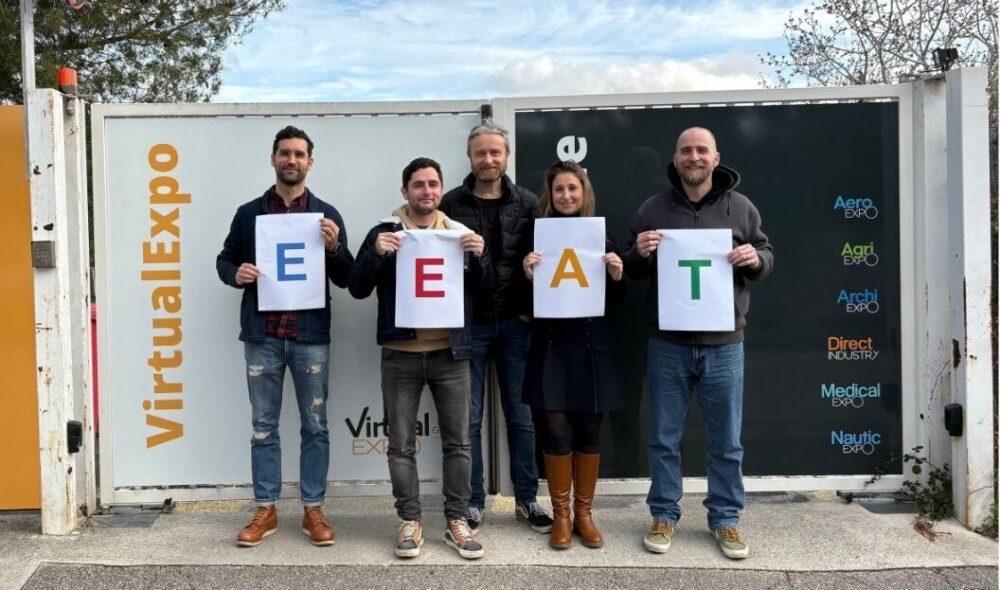

Artificial intelligence is flooding the web with technical data sheets and generic articles. This raises a crucial question for industrial B2B players: how do you prove to an algorithm—and to a buyer—that your expertise is real, tested, and certified? Google has already made its call with E-E-A-T. In this article, Dante Swift (see profile), marketing specialist at Marseille-based VirtualExpo (our publishing company), explains how E-E-A-T has become the new industry bulwark against rampant AI content generation. The good news is that you don’t need to play yet another algorithm: with E-E-A-T, your know-how IS your best algorithm.
In a hurry ? Here are the key notes to know:
- E-E-A-T isn’t just another buzzword — it’s central to Google’s indexing approach in 2026. The acronym stands for Experience, Expertise, Authority, and Trust, and its importance has grown with recent Google algorithm updates, especially as AI content floods the web and Google shifts toward more human-centric quality signals.
- Experience now matters more than ever — and can outweigh formal credentials. Google’s systems increasingly detect first-hand, original experience (e.g., unique insights, firsthand observations, real case details), which can outperform generic expert claims without evidence.
- It’s about who says it, not just what is said. E-E-A-T emphasizes entity-based credibility: Google’s Knowledge Graph connects content to real authors, entities, and reputations — meaning signatures, verifiable profiles, and linked credentials help ground your content.
- Genuine authority is built through recognition, not manipulation. Mentions, citations, and links from respected sites (even unlinked mentions) contribute to authority. This reflects real world reputation rather than outdated SEO tricks like keyword stuffing.
- Trust is the ultimate goal— transparency and verifiability are critical. Google increasingly looks for clear author attribution, accessible contact information and policies, real user feedback, and empirically validated content — all of which signal trust and protect against misinformation.
Since the rise of AI, you’ve likely been bombarded with articles hailing the latest acronyms—GEO, AIO, AEO, LLMO—each hysterically announcing the death knell of the grandaddy of them all, SEO. These buzzwords abound, feeding an entire industry of frantic advice.
But there is really only one acronym you need to know. It’s not the prettiest, it doesn’t roll off the tongue, but it broadly encompasses and even guides the others. It’s E-E-A-T.
It’s also the one acronym that Google doesn’t want you to know too well. Indeed, E-E-A-T is only mentioned twice in their 37-page overview of their search quality rater guidelines (yet a whopping 120 times in the full 182-page document). While keeping us transfixed on their new AI features, Google appears to have surreptitiously shifted E-E-A-T from ‘best practice’ to an algorithmic necessity in its December 2025 Core Update (source 1; source 2; source 3; source 4). To many in the industry, that’s interpreted as “vital” for survival.
Believe me, you don’t need to know about the latest update to Gemini’s image creation software, but you DO need to know about E-E-A-T.
So What Is E-E-A-T?
E-E-A-T stands for Experience, Expertise, Authority, and Trust.
EXPERIENCE
Which projects, achievements, or innovations have you carried out?
EXPERTISE
Have you been able to turn these experiences into validated knowledge?
AUTHORITY
What do respected individuals or recognized organizations say about you?
TRUST
What do customers who have actually purchased your products or services say?
E-E-A-T is no ephemeral buzzword. It began in 2014 as a simple set of guidelines for Google’s Search Quality Raters called E-A-T (without the Experience). It became the fully fledged E-E-A-T in December 2022—just two weeks after the launch of ChatGPT. According to most commentators, the timing was no coincidence—rushed out to face off the explosion in AI-assisted content churn. (An important nuance: Google isn’t anti-AI—it’s anti-misinformation, which AI can churn out in seconds.)
The logic is impeccable and intuitive:
➡️ Experience to Expertise: you can’t be an expert without proven experience.
➡️ Expertise to Authority: you can’t have authority without recognition of your expertise.
➡️ Authority to Trust: you can’t be trusted without authority.
Experience – The Price of Entry
In its December 2025 Core Update, Google significantly raised the quality threshold, placing experience above even expertise and second only to trust. Highly sophisticated algorithms now detect subtle visual and semantic signals of genuine human experience. It’s now better for a non-accredited rookie to demonstrate first-hand experience on their homemade blog than it is for an accredited expert to make unsubstantiated claims (though both are best of course).
So it all begins with good old fashioned, first hand experience. That’s why the most successful site of 2025 in terms of organic traffic growth was an experience-filled recipe blog called au-fil-du-thym.fr. In their own words: “an amateur, volunteer-run website that aims to be a nature journal and seasonal recipe book… maintained as a hobby in the little free time I have outside my (real) job and family.” (Source: it’s in French, but hey—it’s the age of AI; a translation is only two seconds away.) Sure, it contains a mass of SEO-friendly keywords, but they appear naturally; these articles couldn’t exist without them. This is not keyword stuffing—it’s experience stuffing.
Au-fil-du-thym illustrates perfectly how E-E-A-T now applies to all sectors and not only to the “Your-Money-Your-Life” domains of finance and health. B2B, B2C, marketplaces, manufacturer sites, blogs, forums, product review sites… everyone’s concerned. E-E-A-T also concerns as much AI generative search as it does traditional search. Afterall, if Cloudflare’s 2025 Review is anything to by, the primary target for AI SERP APIs (the bots working for ChatGPT, Claude, and the like) is Google’s search. (Source).
So whether the LLMs “sign up” to E-E-A-T or not is largely moot. That’s why GEO and LLMO are now largely covered by SEO, which itself is increasingly guided by E-E-A-T. So don’t be a dinner-party bore—you really do only need one acronym.
Why Is E-E-A-T So Important?
With E-E-A-T, Google has made a definitive shift away from the “manipulated web”—which rewarded keyword stuffing and artificial backlinks—toward a natural web that reflects the same dynamics that have built brands since time immemorial: word of mouth, earned trust, and genuine reputation. To be fair, this was always their intention, but, somewhat ironically, they had to wait for AI to make it possible. Long time in the making, E-E-A-T has become the cornerstone of Google’s indexing strategy,
Google’s not shouting about it because it doesn’t want E-E-A-T to be hacked. (though I dont think they need to worry about that). They want to maintain the illusion that these are still just “fuzzy humanistic guidelines”. They aren’t. It’s code hard-wired into the algorithm. But that doesn’t mean E-E-A-T is a simple score or ranking system that will magically boost your visibility.
To use an analogy: if the algorithm is the car and the user is the driver, E-E-A-T is the GPS. Google’s quality raters continuously recalibrate it to favor the safest and most reliable routes and avoid shortcuts through untrustworthy roads—but, crucially, the GPS is autonomous. It makes each and every judgment call. The driver is free to change course, but if you want more cars to stop at your diner, you need to get on the good route. Get onboard with E-E-A-T. That isn’t a hack; it’s cooperation.
So How Does E-E-A-T Actually Work?
With E-E-A-T, “Who” says it is more important than “What” they say.
“Aliens found on Mars!”. What matters most – the claim itself or the person who made it? A shock jock working for the National Enquirer or a signed, dated and addressed press release from NASA‘s director, posted on their website?
How does Google construct and recognize the “Who” ?
Google uses what it calls the “Knowledge Graph“. It’s less a graph than a map—composed of interconnected entities (“nodes,” in Google jargon), each linked by numerous relationships (“edges”), like shipping routes fanning out across the ocean. By mapping these myriad correlations, Google builds a large-scale model of real-world shared knowledge ; if E-E-A-T is the CV, the Knowledge Graph is the background check. It can’t prove information is true, but it takes it beyond reasonable doubt.
Now picture that map in 3D – Google charts entities over time from past to present – so we’re talking more planets and galaxies than islands in the sea. An entity can be a historical fact, a living or dead person, a scientific concept, a technical protocol, a city, a company, an organization, or institution… basically anything that is a recognised nugget of human knowledge. The thicker and more numerous the connections between entities, the greater their authority and the more powerful the halo effect they cast over the rest of the cluster. Think NASA, The Beatles, Albert Einstein, General Motors, Jesus or, hey, now that we’re getting theistic, the God of the web itself, Google!
E-E-A-T therefore represents a sea change from content-centric indexing (what is said) to entity-centric indexation (who says it). This is crucial because if you make bold claims in an article that is undated and signed by a locationless and nameless “Marketing Team,” you are effectively telling Google “No one is willing to put their reputation on the line for these words.” In a world of AI-driven misinformation, that is an immediate “Trust” failure.
E-E-A-T isn’t hacked. It’s revealed.
Time then for me to stick my neck out: by putting the onus on massive cross-verification via the Knowledge Graph, E‑E‑A‑T is essentially unhackable at scale. Try to scale ‘Expertise’ with fake personas, and the Knowledge Graph will see 1,000 entities with no real-world connections: no LinkedIn history, no tax filings, no industry citations. The sheer effort required to fake reality to that degree means you might as well just build the company for real.
With E-E-A-T, there is no formula to crack — the “formula” is reality. This isn’t a game changer, it’s a game ender: you no longer “optimize” content — you substantiate it.
There’s a reason why E-E-A-T ends with a T, not an O:
You can’t SEO-optimise experiences you never lived.
You can’t GEO-optimise expertise you were never accredited for.
You can’t LLMO-optimise authority that no one ever bestowed upon you.
You can’t AIO-optimise trust that no one ever placed in you.
Those things exist before the webpage is written. And increasingly, Google is able to tell the difference. Here’s how…
1. Experience – Do You Really Have First-Hand Experience?
Google’s Goal: To distinguish between an AI-generated summary and someone who has actually touched, used, or visited the subject.
- Visual Fingerprinting: Google’s Vision AI analyzes original photos/videos. It looks for EXIF data (metadata proving the camera type, GPS location, and timestamp). It also checks if the image exists elsewhere; if it’s a stock photo, the “Experience” score drops significantly.
- Information Gain Signals: the algorithm measures how much “new” information your page adds compared to the top 10 results. If you mention a specific, unique “failure point” in a product or a “hidden entrance” in a travel guide that isn’t in other articles, you gain an Experience boost.
- Semantic “I” Patterns: the Natural Language Processing (NLP) specifically looks for first-person narratives and “sentiment-rich” descriptions (e.g., “When I tightened the bolt, I noticed a slight resistance…”) which are harder for basic AI models to hallucinate authentically.
2. Expertise – Do You Really Have These Credentials?
Google’s Goal: To verify that the author has the formal “right” to speak on the topic, especially in YMYL (Your Money, Your Life) categories.
Google uses the Knowledge Graph to connect an author’s name to a specific “Entity.” This is often called Entity Triangulation. It checks:
- LinkedIn/Social Verification: are the “SameAs” schema tags pointing to a profile with a long history in this industry?
- External Registries: for health or law, Google cross-references names against official databases (NPI numbers for doctors, Bar Associations for lawyers).
- Topical Authority Mapping: the algorithm tracks an author’s “publishing history” across the web. If you’ve written 50 verified articles on “Organic Chemistry” over five years, Google assigns you an Expertise Vector for that specific topic.
- Structured Data (JSON-LD): Google checks for Person schema that includes knowsAbout, award, and alumniOf properties.
3. Authoritativeness – What Do Others Say About You?
Google’s Goal: To see if the rest of the world considers you a leader. This is the external version of expertise.
- The “Seed Site” Proximity: Google has a list of “Seed Sites” (trusted benchmarks like The New York Times, Wikipedia, or Nature.com). It measures how many “hops” you are away from a link or a mention on these sites.
- Unlinked Brand Mentions: this is widely considered a strong authority signal. If your name appears in a Wall Street Journal article but doesn’t have a link, Google still counts it as a “Citation.” They treat citations as more authentic than links because they are harder to buy.
- Search Volume as a Proxy: if people start searching for “[Your Name] + [Topic],” Google’s “Navboost” system recognizes that the market views you as a go-to authority.
4. Trustworthiness – How Can I Trust You?
Google’s Goal: To ensure the site is safe, honest, and technically sound. This is the ultimate result of the other three.
- Transparency Markers: the algorithm programmatically scans for an “About Us” page, a “Contact” page with a real physical address (verified via Google Maps), and a clear “Editorial Policy.”
- Fact-Checking via Consensus: Google compares your claims against “consensus” data (like Wikipedia or PubMed). If you claim “drinking bleach cures a cold,” your Trust score is instantly nuked because it contradicts the verified Knowledge Vault.
- User Engagement: if users click your result and immediately “bounce” back to search, it signals a lack of trust. If they stay, click “Contact,” or navigate to your “About” page, it signals that the user has verified your identity for themselves.
How Does This Translate Into Brass-Tacks Content Creation?
Put simply, if you engrave this on your marketing brain, you won’t go wrong : Don’t just say it, prove it!
With that in mind, here are some generic green and red flags ( or rather, to comply with our graphic charter, orange and gray flags 😉 ) for making E-E-A-T compliant content :
EXPERIENCE
| DO | DON’T |
|---|---|
| Use original, unedited imagery. Upload photos with intact EXIF data (location/timestamp) to prove you were physically present. | Use stock photography. Google’s Vision AI identifies these instantly and discounts the “Experience” score. |
| Include “I” and “We” narratives. Describe specific sensations, unique failures, or personal observations that an AI cannot “feel.” | Write in a neutral, AI-style voice. Avoid third-person summaries that read like a product manual or Wikipedia entry. |
| Focus on information gain. Add one unique tip or proprietary data point not present in the current top 10 search results. | Regurgitate existing content. Compiling a “best of” list based solely on other results provides zero experience value. |
| Compile user application notes covering real-world pain points, limitations, and unrecommended uses of your products. | Only focus on when things went well. True experience comes unfiltered. |
EXPERTISE
| DO | DON’T |
|---|---|
| Link bylines to a professional LinkedIn. Connect every author to their LinkedIn profile to provide a verifiable biography and career history. | Use “Admin” or “Staff” bylines. Anonymous content is a major red flag for low-quality/AI-generated “slop.” |
| Implement JSON-LD Schema. Use Person or Organization schema with the sameAs property to link to verified social footprints like LinkedIn and professional bodies. | Assume your “About” page is enough. The algorithm needs technical “hooks” (JSON-LD) to connect your dots across the web. |
| Maintain a consistent “Topical Beat.” Publish frequently on a specific niche to help the Knowledge Graph categorize you as an entity. | Pivot wildly between topics. Writing about cryptocurrency one day and organic gardening the next confuses your “Expertise Vector.” |
| Show your credentials. Explicitly link to certifications, awards, or professional registries (e.g., medical boards or bar associations). Better still, let visitors download the PDF certificates. | Use “dead-end” names. If a name is mentioned but has no external link to a professional profile, Google cannot verify expertise. |
AUTHORITY
| DO | DON’T |
|---|---|
| Pursue unlinked mentions. Get your name or brand mentioned on high-tier industry sites, even if they don’t provide a clickable link. | Buy low-quality backlinks. Mass-produced “guest posts” on irrelevant sites are now an algorithmic red flag for manipulation. |
| Build “Entity Search” volume. Create a brand that people search for by name (e.g., “Jane Doe marketing strategy”) rather than just keywords. | Ignore your digital footprint. If the only place your name or brand exists is on your own website, you have no authority. |
| Get cited as a primary source. Provide original data, quotes, or research to journalists to build a “semantic cluster” of authority. | Optimize for bots over humans. Content that doesn’t get shared or cited by humans eventually loses its algorithmic authority. |
| Allow for user-generated content on your website – such as a community of users who share the same pain points and discuss tips and advice relating to your niche and the use of your product. | Rely solely on a static FAQ with generic answers to prosaic questions and zero accountability or transparency. |
TRUST
| DO | DON’T |
|---|---|
| Use individual, named bylines. Attribute every piece of content to a specific person with a verifiable digital history and a LinkedIn presence. | Use “Marketing Team” or “Editorial Dept.” These are viewed as masks for AI content and destroy accountability. |
| Include an “Expert Reviewer.” If a marketer writes the copy, have a certified expert review it and list both (e.g., “Reviewed by Dr. X”). | Use “Ghost” personas. Creating fake experts with AI-generated headshots is detectable and can result in severe trust degradation or manual action. |
| Verify your physical existence. Use a real address and phone number (NAP) that matches your Google Business Profile and official registries. | Hide your disclosures. Burying affiliate or sponsored content disclosures triggers “Trust” penalties in the algorithm. |
| Allow for product evaluation by verified users. Open a Trustpilot account and actively reply to ratings left behind. | Delete critical ratings instead of replying to them facing the music. |
If you are a subscriber to one of the VirtualExpo Marketplaces, check out our guide on how to optimize the E-E-A-T signals on your company stand.
The Real Challenge Isn’t Technical – It’s Cultural
None of the above is fundamentally beyond the capabilities of an SME. In fact, smaller structures stand to benefit more because they are less constrained by rigid corporate culture. With the relentless cat-and-mouse game between AI sophistication and Google, it’s unlikely the rules will get any easier.
That absolutely does not mean Siemens.com should mimmick a non-profit homeopathy blog. No hacking! But the people there have genuine professional experience—which underpins their recognised expertise, right? So just reveal it. Don’t hide behind stiff marketing copy. Relax, get real, be bold: let corporate policy allow it, not stifle it.
So, are you ready to change behavior and…
➡️ stop signing communiqués with “Marketing team” in favour of full name, job title, biography, photo and a link to their LinkedIn?
➡️ stop paying thousands for overproduced promotional videos in favour of real product demos filmed on a smartphone?
➡️ stop changing dates on publications to make them look new, or deleting old articles because the employee who wrote them has left the company?
➡️ stop making bold claims without backing them up by independently validated research or downloadable certifications?
In the Natural Web of 2026, the answer must be Yes.