
The outage window doesn’t get any longer when a relay room approaches 50°C (122°F). Protection engineers still have to complete demanding test sequences, often with limited ventilation, restricted working space and equipment generating heat of its own. Under these conditions, how a relay test system manages that heat becomes just as important as the performance it delivers.
Content provided by Doble-Megger
Working where conditions are less than ideal
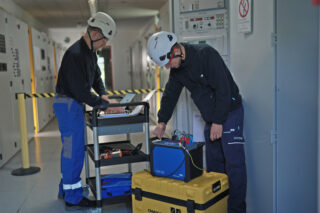
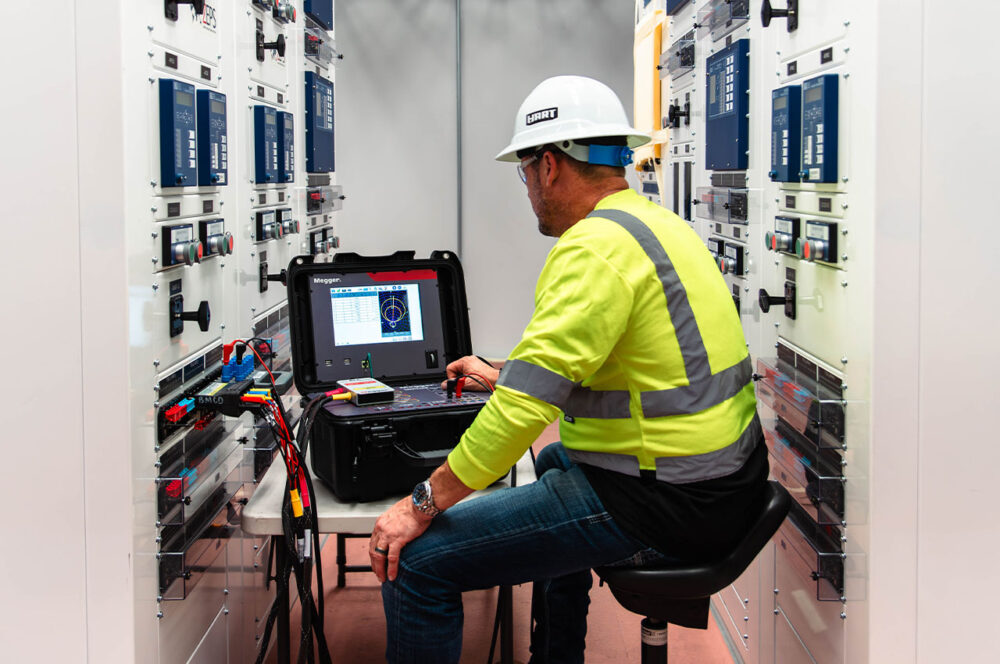
Substation relay rooms rarely offer the space or ventilation of a workshop. Panels are often surrounded by other equipment, cable lengths restrict where test sets can be positioned, and maintenance teams must work within established outage windows. In hotter climates, temperatures approaching 50°C (122°F) can make these conditions particularly demanding.
The equipment generates heat of its own. Current and voltage amplifiers, power supplies and other electronics produce heat throughout operation, adding to the thermal demands already imposed by the surrounding environment.
As temperatures rise, the difference between the internal components and surrounding air decreases, making that heat more difficult to dissipate. Sustained outputs and repeated test operations can add further pressure, particularly when airflow around the enclosure is restricted.
High-output testing brings different thermal demands
Protection relay testing can involve sustained current injection, repeated switching operations and brief periods of higher output. Each places different demands on the power electronics, with both output level and duration influencing the heat generated.
A short high-current injection places different demands on the equipment from a lower output maintained over an extended period. The SMRT46R’s 60 A output at 319 VA per phase, for instance, has a 1.5-second duty cycle. Understanding these distinctions becomes especially important when planning extended test sequences in hot environments.
The challenge for equipment design is to accommodate demanding electrical outputs while managing the heat generated inside the unit.
Managing heat begins with power efficiency
Cooling alone cannot compensate for every source of internal heat. Electrical energy lost during power conversion becomes heat that the equipment must dissipate, making power-supply efficiency an important part of thermal management.
Improved distributed power supplies are central to the design of Doble-Megger’s SMRT46R and FREJA546R relay test systems. By reducing unnecessary power losses, the architecture helps limit heat generation before the cooling system becomes involved.
The arrangement of the internal electronics is equally important. Keeping heat-sensitive components away from the main power section reduces their proximity to significant sources of heat, while additional space within the enclosure provides greater flexibility for cooling and component placement.
In both systems, the touchscreen sits in the lid, separated from the main power electronics. Combined with revised cooling arrangements, the design brings power efficiency, heat dissipation and component placement together rather than treating them as separate considerations.
Flexibility where working space is limited
The separation of the touchscreen also serves a practical purpose beyond thermal management.
Where access to a protection panel is restricted, the touchscreen can be removed from the lid and connected through Ethernet. Engineers can keep the main unit close to the relay connections while positioning the controls somewhere more accessible.
This flexibility is particularly valuable in crowded relay rooms, where moving the entire test system may be impractical and working conditions offer little freedom to rearrange equipment.
Built for demanding field conditions
With an operating temperature range of -10°C to 50°C (14°F to 122°F), the SMRT46R and FREJA546R are designed for use across a wide range of environmental conditions. Their improved power architecture, revised cooling and flexible display arrangement reflect the demands placed on relay test equipment outside controlled environments.
When temperatures rise and working space is restricted, these engineering decisions become more than design details. They help determine how effectively a relay test system can accommodate the practical demands of maintenance and commissioning work.