


Dead-end tracks used to end with a simple steel beam. Today, with longer and heavier trains, the buffer stop has become a safety-critical energy absorber at the end of the line. COMPENSER® gas-hydraulic buffers and deformation tubes from LEBEN-Dämpfungstechnik turn collisions into controlled forces at railway end stops and in couplings. Overview of the Industrial Shock Absorber product portfolio).
Written by Klaus Leben, Founder, LEBEN-Dämpfungstechnik GmbH
Why Modern Railway End Stops Are Critical Safety Devices
A buffer stop – or bumping post – does much more than mark the end of a siding. It is the last mechanical safeguard between several hundred, or even several thousand, tonnes of moving mass and station buildings, platforms and passengers. In busy terminals, metro depots and stabling yards, design scenarios must consider higher approach speeds, mixed traffic and frequent low-speed impacts during shunting. (See Hydraulic Absorbers for Railway Technology).
Operators therefore treat railway buffer stops as strategic assets. They must provide predictable stopping distances, limit peak forces into the vehicle and track structure. They also need to be as compact and maintenance-friendly as possible. Typical solutions for fixed and friction buffer stops are illustrated in LEBEN’s railway end-of-track application: End-of-track Buffers Stop
Fixed vs Friction Buffer Stops – And the Role of Hydraulics
On today’s railways, two end-of-track philosophies dominate:
Fixed buffer stops are rigidly attached to the track or embedded in concrete. All energy is absorbed inside the stop, typically by gas-hydraulic buffers such as the S-Type COMPENSER® or by deformation tubes like the CE-Type.
Sliding friction buffer stops (including hydraulic friction types): They are clamped to the rails and are designed to move along them in a major impact. Friction shoes scrape on the rail profile to absorb energy. In many modern systems, this sliding friction is combined with long-stroke gas-hydraulic buffers. Everyday low-energy bumps are handled hydraulically and recoverable, while only severe overruns require the full sliding distance.
COMPENSER® hydraulic industrial shock absorbers sit at the core of both concepts. They are either inside fixed buffer stop structures or in sliding frames. An overview of the product portfolio is available here: Hydraulic Bumper Stop
S-Type: Gas-Hydraulic Buffers for Mainline and Depot End-of-Track Stops
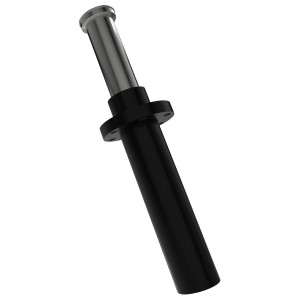
For heavy mainline, depot and freight applications, LEBEN uses the S-Type COMPENSER® gas-hydraulic buffer
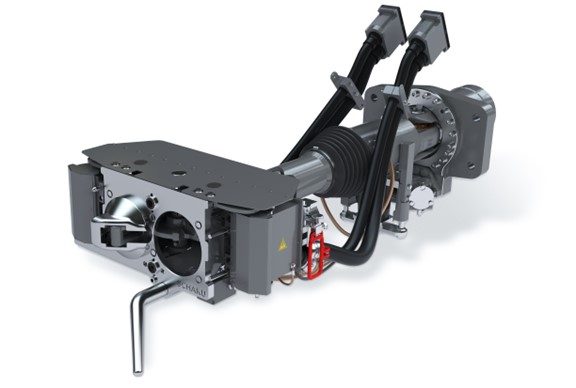
An inner tube with impact cap moves into an outer cylinder. Hydraulic oil is forced through orifices while a separating piston compresses a nitrogen gas volume. The gas acts as a spring and provides reset energy for the return stroke. S-Type buffers cover high energy capacities. They can be arranged in parallel for terminal tracks with long passenger trains or heavy freight sidings.
Robust materials, double hard-chrome or nickel-plated piston rods and corrosion protection coatings allow use in ports and outdoor terminals. Flexible mounting options (front and rear flanges, foot blocks or tube-in-tube designs) make integration into steel buffer stop frames or directly into concrete foundations straightforward.
C-Type and Ce-Type for Lighter Tracks and Crash Scenarios
Where moving masses are lower and installation space is tight – for example at metro terminals, tram stops, industrial sidings or workshop tracks – LEBEN applies the: C-Type hydraulic industrial shock absorber
The C-Type is a compact hydraulic buffer with a displacement principle and short overall length. It suits depot tracks, maintenance pits and industrial rail systems in steelworks, ports or factories, where speeds are limited but accidents must still be contained.
For once-in-a-lifetime emergency scenarios, LEBEN provides the: Crash-Element CE-Type deformation tube
These irreversible crash elements absorb energy by plastically deforming a steel tube with a mandrel, creating a predictable force–stroke curve. CE-Type elements are attractive where a purely mechanical, non-leaking, temperature-robust solution is required and where simple replacement after a major impact is preferred to overhauling hydraulic units.
From Ready to Use Railway Buffers to Completely Customized Solutions With Engineering Support
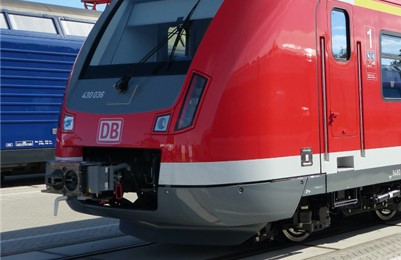
Energy absorption is also needed between vehicles. Gas-hydraulic COMPENSER® units are integrated into railway coupling buffers for metro, streetcar, suburban and intercity trains, protecting vehicle structures in longitudinal impacts. Selected references are shown in the railway technology section
Designing a hydraulic industrial buffer or coupling buffer is based on defined collision scenarios, standards and verified calculations. LEBEN applies the same engineering approach used in its Energy Absorbing for Industrial Applications – from defining worst-case combinations of masses and speeds, through energy and force calculations, to selecting an appropriate design of C-, S- and CE-Type elements.
Dynamic tests on in-house rigs, static and cyclic tests and FEM simulations ensure that real behaviour matches the design. As a third-generation family company, LEBEN-Dämpfungstechnik develops and manufactures all COMPENSER® elements in Bavaria, Germany.