

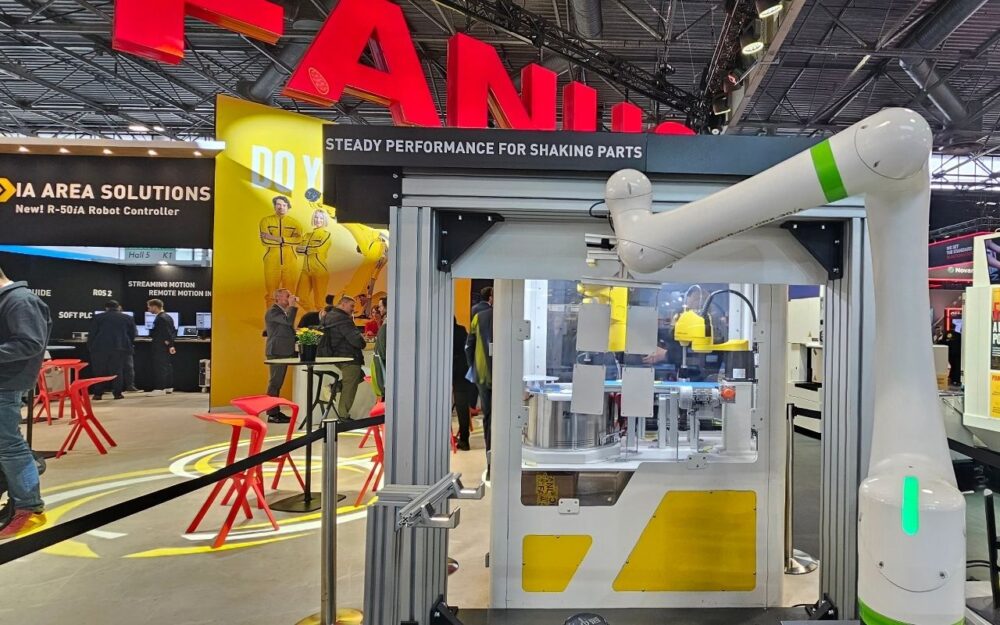

At Global Industrie, it takes only a glance to see robots in motion. But behind these precise metallic arms lies an increasingly sophisticated artificial intelligence, capable of adapting its movements to a changing environment. To understand the stakes, we spoke with Nicolas Couche, product manager at FANUC with 30 years of experience in industrial robotics.
“I’ve been with FANUC France for 30 years, so I’ve seen technological evolution across decades and the acceleration in recent years,” Couche explains.
For him, AI is no longer a distant promise, it’s a tangible reality.
Integrated Vision: The Robot’s Eyes
A major strength of FANUC lies in its robots equipped with integrated vision systems. 2D and 3D cameras, force sensors, and powerful industrial computers allow machines to analyze and interact with their surroundings.
“FANUC may be one of the only industrial robot makers with a fully integrated vision system… For at least 10 years, we’ve used algorithms to simplify setup and optimize detection, for example in bin picking operations,” Couche says.
The results surpass human capability: using deep learning, robots anticipate part positions and adapt instantly to unforeseen variations. Couche adds,
“Now it’s even more interesting: computers are cheaper, algorithms are public, and everything accelerates at an incredible speed. We’re showing solutions of physical AI, not just traditional LLMs, to pilot robots intelligently.”
Computing Power in Action: The Nvidia Partnership
A key pillar of FANUC’s AI strategy is its partnership with Nvidia. FANUC robots leverage Nvidia GPUs to process camera and sensor data in real time.
“FANUC is extremely discreet in its development, but for bin picking or dynamic screwing, you need a computational power that only GPUs can provide,” Couche explains.
This partnership also enables digital twins for factory automation, notably in Nvidia’s own server production lines.
“Nvidia’s Soft Isaac SIM has been integrated into our virtual programming solutions to simulate robot interactions in a factory before they even act,” he adds.
Flexibility in Motion
One of the most striking demonstrations is dynamic industrial motion. On a miniature automotive line, FANUC robots track moving parts as a human operator would.
“We put a 3D camera on the robot, it sees what it needs to do, follows dynamically, and performs the operation, even if the part shifts slightly or the model changes from day to day,” Couche explains.
This adaptability relies on streaming motion, which allows real-time robot control with environmental updates every millisecond. Combined with FANUC’s force sensors and Nvidia’s computational power, robots become both autonomous and precisely controllable.
Cable Harness Assembly: Tackling Industrial Challenges
Another standout example is cable harness assembly, a notoriously tricky task in automotive, aerospace, and rail industries. Flexible, irregular cables must be precisely positioned, a challenge for traditional automation.
FANUC combines two standard robotic arms, cameras, specialized grippers, and force sensors to manage cable tension and pathing.
“Cables are awful, they’re like chewing gum, they don’t hold their shape,” Couche laughs. “Yet we can maintain them and position them perfectly. It’s the combination of technology, teleoperation, and computation that makes it possible.”
Three Revealing Use Cases
Watch our video
1/ Visual Line Tracking: Following the Unpredictable
In food processing, products often move along unstable lines or slightly offset positions. Visual Line Tracking allows robots to track moving items in real time using vision systems and IPC computers.
“The robot identifies a small white square on the moving hanging piece. Once it locks onto it, the robot picks up the product and follows the square as it moves along the line, precisely placing the item in the unloading area—even if the piece shifts or wobbles slightly,” Couche explains.
Beyond food processing, this technology is applied to paint lines, where supports deform in ovens, and to automatic depalletization of irregularly stacked boxes, ensuring items are picked safely without damage.
2/ Dynamic Screwing with In Bolt
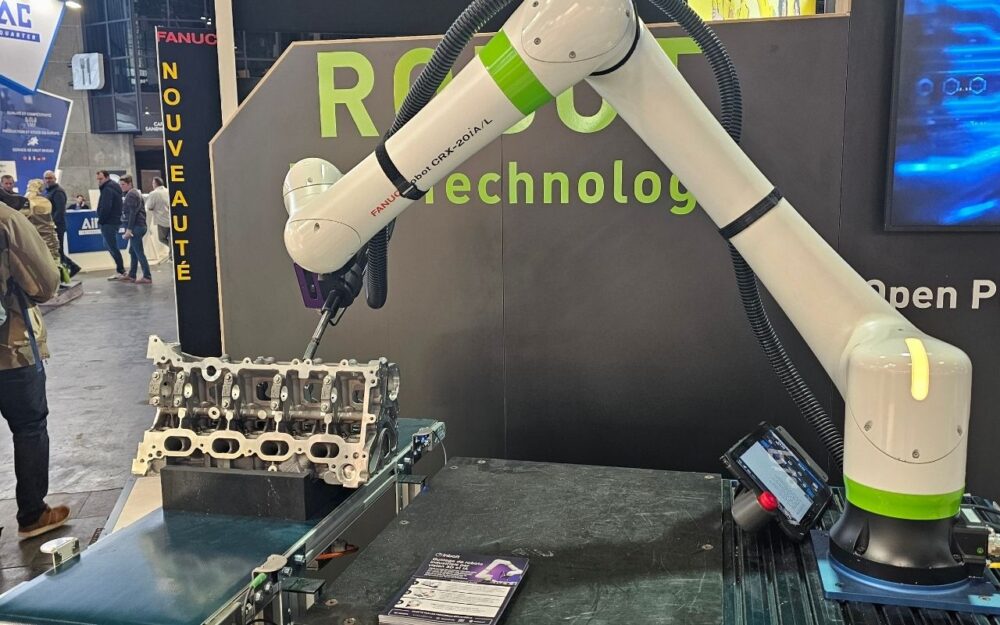
In partnership with the French startup In Bolt, FANUC demonstrates a robot that screws or unscrews motor components in motion. Cameras detect the exact location of screws, while Nvidia GPUs calculate optimal trajectories.
“If you move the part again, it adapts,” Couche notes.
This showcases how AI transforms traditionally manual operations into precise automated gestures, even in dynamic, complex environments.
3/ Bin Picking: Handling Randomness with Precision
Bin picking remains a universal challenge: extracting parts from a bin without damage, with maximum efficiency. FANUC robots use 3D vision, detection algorithms, and IPC computing to identify, anticipate, and pick parts accurately.
“The robot takes a snapshot, analyzes it, and thanks to our IPC computer, it picks each piece one by one at optimal efficiency,” Couche explains.
Applying similar principles, cable harness routing uses dual robots, cameras, grippers, and force sensors to guide cables into precise paths.
“We control tension and guide the cable exactly where it should go. The combination of sensing, teleoperation, and computing allows the robot to manage complexity humans would struggle with,” Couche says.
Beyond Automation: Intelligent Robotics
FANUC robots no longer simply repeat programmed motions. They interact with their environment, generate their own paths, and in some cases can be deployed with low-code or no-code interfaces.
“We’re approaching low code for palletization. You define where boxes arrive, where to place them, and hit a button. But for complex tasks like cable harness assembly, the robot must adapt dynamically to every piece,” Couche emphasizes.
Humanoids, AGVs, and Economic Considerations
Despite the advances in AI, certain technologies like humanoid robots and AGVs are more delicate choices.
“To carry 50 kg packages, a humanoid isn’t necessarily the right solution. You need a more robust and cost-effective system,” Couche explains. “A humanoid with many articulations might cost €200,000, it doesn’t make sense. But a two-arm system can reduce costs almost tenfold while achieving the same functionality.”
FANUC does not develop AGVs or AMRs like competitors KUKA or Staubli. While the technology is increasingly proven, real-world deployment presents challenges: geolocation errors, Wi-Fi instability, and frequent service interventions can affect reliability and quality perception.
“Even in a simple warehouse with two aisles, it’s never simple. Old facilities, space constraints, and system limits make it challenging to deliver consistent quality,” Couche notes.
They felt it couldn’t provide a quality product that would meet expectations.
The Factory of the Future, Today
At FANUC factories in Japan, robots have been assembling robots since 1995. Today, with AI, integrated vision, and Nvidia-powered computing, they are flexible, adaptive, and capable of managing the complexity of modern industry.
“The advancements are here, they’re available. Now it’s about application, robots interacting with many sensors, adapting dynamically. Not just picking a product, but adjusting to everything to complete the task,” concludes Couche.