


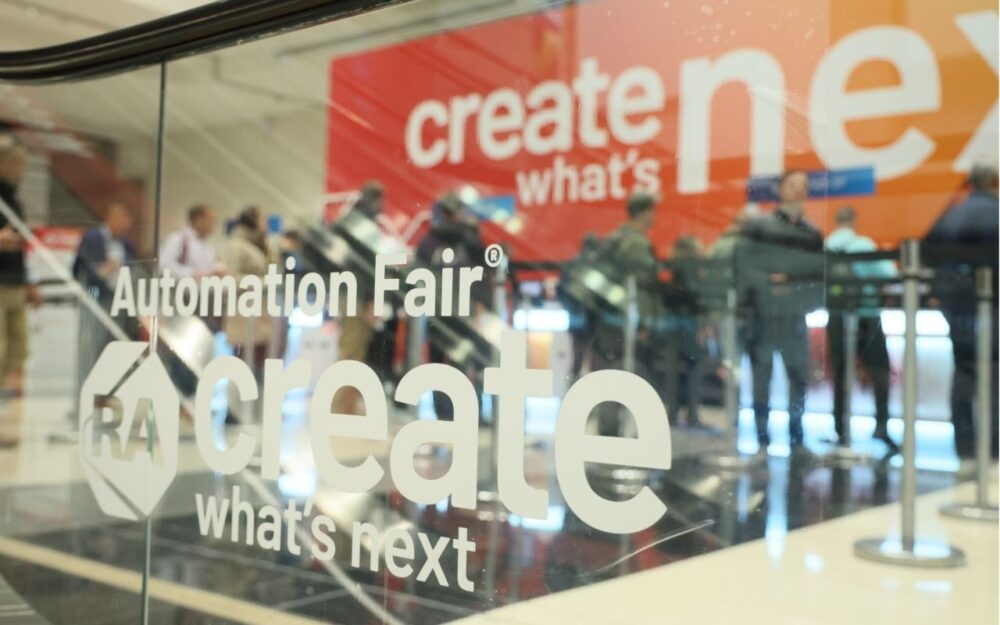
Our reporter, Abigail Saltmarsh, has just returned from Rockwell Automation’s annual event, Automation Fair 2025. She brought back valuable insights on how AI is shaping the manufacturing landscape.
In a hurry? Here are the key notes to know:
- Automation is evolving into autonomy: AI, robotics, and intelligent systems blur the line between human and machine intelligence, empowering employees rather than replacing them.
- Holistic, systems-based approach: Integrating advanced technology with human expertise simplifies complex operations through AI and anticipates operational needs.
- Factory of the future in action: New advanced automation facility in Wisconsin uses digital twins, automated material handling, energy management, and workforce training to demonstrate AI-enabled manufacturing.
- Generative AI at the industrial edge: FactoryTalk Design Studio Copilot with NVIDIA Nemotron Nano SLMs brings AI directly to industrial environments, accelerating workflows while maintaining control.
- Digital trust and cybersecurity are critical: SecureOT ensures end-to-end protection for industrial AI systems, maintaining safety and confidence as operations become increasingly autonomous.
The world is on the cusp of the next great evolution in manufacturing, as technology advances at an unprecedented pace and opportunities become boundless. With software-defined automation (SDA), embedded AI, robotics, and advanced analytics, intelligent autonomous systems represent the future of manufacturing.
There were several strong messages at Automation Fair 2025, which took place in Chicago a couple of weeks ago. Rockwell Automation’s annual event was attended by more than 15,000 engineers, makers, and industry leaders.
Speaking during a keynote speech, and to DirectIndustry during the event, Rockwell’s CTO, Cyril Perducat, said the transformation from automation to autonomy had to be embraced:
“This is a very, very important moment for all of us. The world is changing very, very fast. There is a lot of transformation happening. It’s an important moment because the boundary between human intelligence and robotic intelligence is blurring.”
Time for Reinvention
Mr. Perducat said every crisis or disruptive moment brought opportunities for reinvention:
“The opportunity we have in our industry is to reinvent what automation is about, and not just because we can do it and technologies allow it, but because there is a real need associated with it. I think for me, the context of this transformation of automation to autonomy is that the industrial scenarios for customers are more and more complex. They want to achieve more and more things at the same time. It’s not just any more about the right product at the right time, at the right quality, but it’s empowering people, it’s being more sustainable, it’s surviving the volatility of the world.”
For him, all those things are complex to operate, and that requires a different system. Programmable systems mean every time a change is required, a new line of code is needed, he observed. But a system that learns or adapts doesn’t need this anymore – and AI allows to do this:
“How do you adjust parameters autonomously? How do you have autonomous vehicles like AMRs moving in your factory?”
For him, the idea of autonomy is not the idea about getting rid of people, but it’s the opposite.
“For me, the idea of autonomy is how do we empower people so that they can have the maximum level of autonomy?”
A Holistic Systems Approach
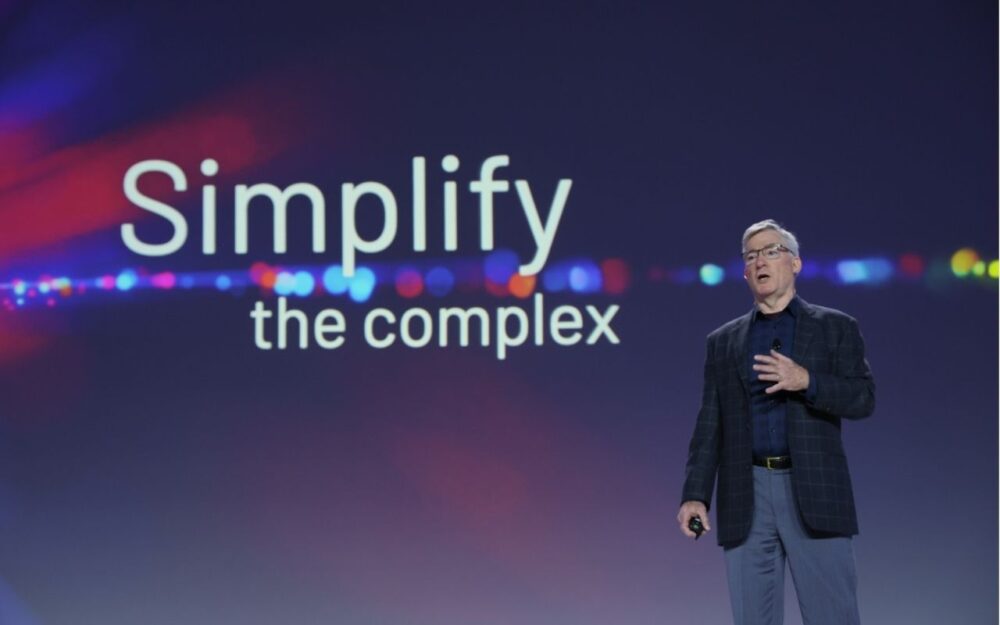
During his keynote speech, CEO Blake Moret said that the way forward was to combine the imaginations of people with the potential of technology. Rockwell Automation creates a future of industrial operations where equipment operates autonomously and integrates seamlessly into highly orchestrated production systems.
“But the challenge is that automation is complex: the technology underlying it, the disparate systems. No company has a homogeneous architecture, and so to be able to get to where we want to go faster, it’s so important to be able to simplify that complexity. The technology is still going to be advanced, but to be able to bring it together using artificial intelligence, a systems approach and the expertise from living, breathing people, that’s still an essential part of high-functioning factories.”
The starting point of this, for him, is looking at things holistically in a systems approach:
“It’s creating autonomous systems that anticipate the needs.”
The Factory of the Future
During the event, Mr. Moret announced Rockwell was to build a new advanced automation manufacturing facility on a greenfield site in Wisconsin. The plant will feature robotics and digital systems. It will also provide the workforce with advanced training and serve as a demonstration center to customers.
Bob Buttermore, SVP, Chief Supply Chain Officer, said helping customers to transform their manufacturing meant starting inside Rockwell itself:
“We are working to become the showcase of how to move from automation to autonomy, build that into the future, build supply chains in the future that enable growth, enable resiliency and enable market expansion. You’ve got to start with optimizing end-to-end processes, leaning processes out, coordinating activities, streamlining activities across the enterprise. We find that establishing a robust MRR builds productivity and expansion efforts for us, which then allows us to step into re-engineering our network and building more autonomous operations.”
Mr. Buttermore said the new Wisconsin site would allow Rockwell to do this. This idea is to create the factory of the future in their own factories. Just like they did two years ago in Singapore. For him three things have driven that success:
“The first piece is moving to a digital design: we used our digital twin Emulate3D software package to look at how we lay out the facility and optimize the design. The second piece is automating material movement from inbound to outbound.”
They have a lights-out warehouse now, and AMRs moving material throughout the facility to the line and away from the line, helping them automate a lot of inefficient labor improvement.
“And then the last example is that we implemented FactoryTalk Energy Manager, with a lot of instrumentation, into sensors, and we got a payback on that in less than a couple of weeks.”
One of the other items that was critical in Singapore was also accelerating their own AI journey:
“We have many projects that are not only for helping solve the pain points of Rockwell Automation, but helping solve industry challenges by implementing AI. One of the most important things it’s doing is actually energizing and engaging our workforce, because they are part of this journey. They are helping engineer these solutions, and it’s making their jobs more productive, more efficient, and it’s giving them the tools to react, because they want to win. At the end of every day, they want to walk home and feel like they won, and AI is doing that for them.”
Bringing GenAI to the Edge
Rockwell’s FactoryTalk software suite supports and manages an ecosystem of advanced industrial applications. Earlier this year, Rockwell began to commercialize FactoryTalk Design Studio Copilot, its generative artificial intelligence (GenAI) assistant for its cloud-based system design software.
FactoryTalk Design Studio Copilot can process natural language and bring the power of GenAI to the company’s Logix suite. Showcased at the Automation Fair was Rockwell’s recently announced breakthrough in bringing GenAI directly to the industrial edge.
The company introduced its integration of NVIDIA Nemotron Nano, a purpose-built small language model (SLM) optimized for FactoryTalk Design Studio and other Rockwell product workflows, marking a major step in real-time intelligence for industrial teams.
In collaboration with NVIDIA, the company is leveraging the open-source Nemotron-Nano-9B-v2 model and NVIDIA NeMo to deliver an edge-based generative AI capability designed specifically for industrial environments.
Nemotron Nano distillation techniques provide the foundation for an SLM that can run in edge environments with less space and power than a traditional data center. By fine-tuning the model with data used by FactoryTalk Design Studio Copilot, Rockwell is creating a solution that can be deployed anywhere to help customers accelerate workflows without compromizing predictability or control.
For Mr. Perducat,
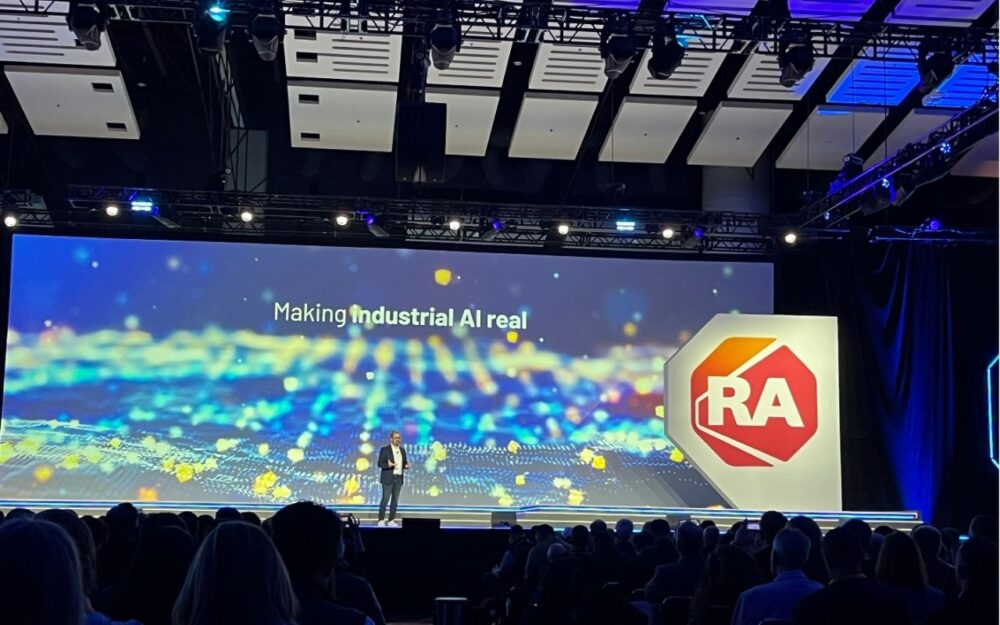
“This is where we are – at the edge of intelligence and physical AI. This is what Rockwell is focused on. We have built those capabilities. They are real.”
Building Digital Trust
However, AI and systems that learn, adapt and improve bring not only opportunity, but also risk in terms of new and ever more complex threats. As industrial operations become increasingly connected, organizations are facing a sharp rise in cyber threats targeting operations technology (OT) systems. There was also, therefore, heavy emphasis at the event on the need for digital trust and cybersecurity within this evolution of automation.
Shortly before the Automation Fair, Rockwell announced the launch of its SecureOT solution suite, a comprehensive industrial cybersecurity offering designed to help protect critical operations and build secure environments.
Many legacy systems were not designed with cybersecurity in mind, and SecureOT was developed to deliver end-to-end protection across all levels of cybersecurity maturity. It brings Rockwell Automation’s purpose-built SecureOT Platform, professional services and managed security services together into a unified solution.
SecureOT Platform delivers real-time asset visibility, risk prioritization and vulnerability management. Through its professional services, SecureOT offers strategic advisory, assessments and implementation support to help organizations strengthen their security posture.
“There is no digital transformation without digital trust – it’s absolutely fundamental,” stressed Mr. Perducat. “Digital trust, in general – and within digital trust, cybersecurity – is very important to us. We are not going to be able to scale any digital business if there is a perception that what we deliver to our customers represents intrinsic cybersecurity risk.”
The Next Level of Automation
Mr. Perducat suggested that three fundamental technology advancements must work together to ensure the transformation of automation to autonomy – software-defined architecture, AI and the physical embodiment of AI (robotics). These are the technical foundation of this revolution of industrial operations:
“They are not three isolated topics. They work together. You need a software-defined architecture to enable AI in the right way. You need the agility of a software-defined architecture to get the best out of AI and to have a system that has less friction between software and hardware, where both parts of the stack play a role in the right way.”
Technology has given access to a lot of information over the last decade, he said. What really matters now is transforming insights into actions and closing the loop at the end:
“This is what will create a completely autonomous system. This is not just patching AI to automation or considering that AI is another category of product. It’s really for us at Rockwell Automation the idea of reinventing what we have been doing over decades around automation to the business of autonomy.”
He added:
“This is for us, not a revolution in the sense that we are entering a field that is unknown to us and that we have to completely discover.”
This is the next evolution of automation.
Read also