


Wi-Fi HaLow (IEEE 802.11ah) is emerging as a strong fit for rail networks, offering the long-range, obstacle-resistant connectivity needed to link sensors, gateways, and access points along trackside corridors. However, communication range alone will not keep a deployment running. The enclosures protecting that equipment must withstand rain, dust, UV exposure, and extreme temperature swings over years of outdoor service. This article looks at how enclosure selection, specifically TAKACHI’s WGPC and WGV series, plays a decisive role in the long-term reliability of Wi-Fi HaLow systems on the rails.
Content provided by TAKACHI ELECTRONICS ENCLOSURE WEB Marketing Team
The true test of a wireless sensor or gateway’s performance comes on its worst day — exposed to the harsh conditions on the trackside. Rail operators across Europe and elsewhere are exploring IEEE 802.11ah, commonly known as Wi-Fi HaLow, to wirelessly connect the numerous sensors, gateways, and access points installed along their rail lines.
One reason lies in Wi-Fi HaLow’s communication characteristics. Operating in the sub-GHz band, Wi-Fi HaLow is better suited to long-range communication than conventional Wi-Fi, and is less affected by obstacles. These characteristics make it well suited to establishing networks along railway lines — long, linear corridors where the communication environment is influenced by the surrounding buildings and terrain.
However, long communication range alone isn’t enough. If the equipment itself cannot withstand the installation environment, the system will not run reliably over the long term. Tunnels, cuttings, embankments, and open trackside locations — wherever rail equipment is installed — demand protection against a wide range of environmental factors: rain, dust, mud, moisture, UV exposure, and change in temperature. For this reason, when deploying Wi-Fi HaLow as communication infrastructure along rail lines, enclosure selection — not just the wireless module and antenna — becomes a critical design consideration.
TAKACHI Electronics Enclosure offers a wide range of plastic and metal enclosures suited to outdoor and industrial applications. Among them, the WGPC series and WGV series stand out as options well suited to Wi-Fi HaLow equipment installed in outdoor environments such as trackside locations.
WGPC Series: Waterproof, Dust-Resistant, and a Wide Operating Temperature Range
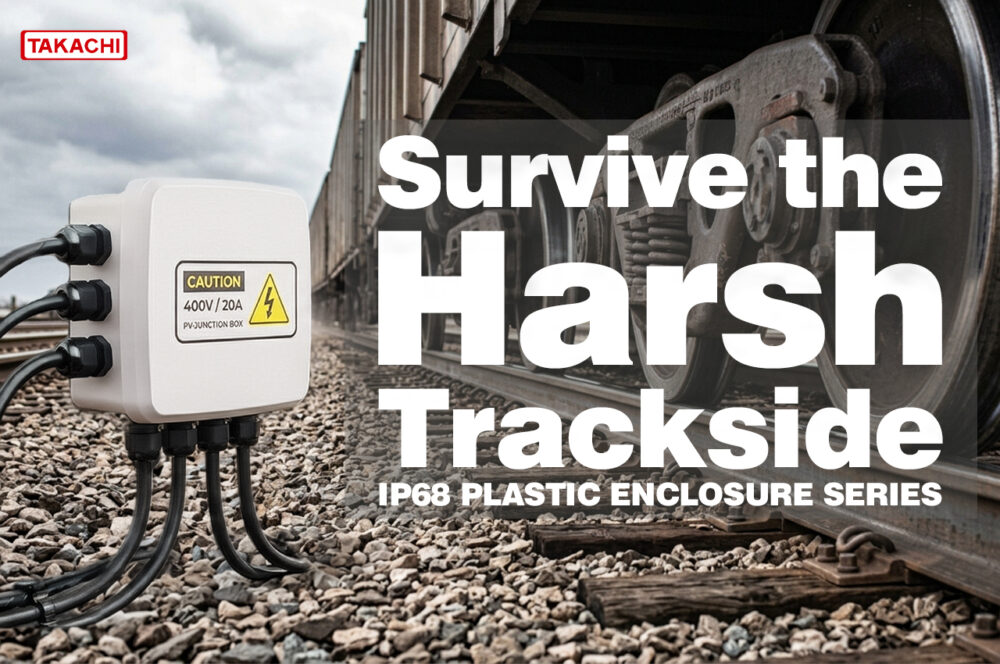
The WGPC series is a waterproof, dust-resistant enclosure made from PC+ASA resin. It meets IP68 protection standards, with a specification that withstands immersion at 1m depth for 24 hours. It also realises an operating temperature range of -30°C to +75°C, making it well suited to protecting communication equipment installed outdoors. Along railway lines, enclosure interior temperatures can rise not only due to seasonal changes but also, depending on where it is installed, due to direct sunlight or radiant heat from surrounding structures. Therefore, securing sufficient temperature margin for the operating environment is essential for keeping communication equipment running reliably over the long term. The WGPC series also uses self-tapping screws with an anti-drop structure to secure the lid. This reduces the risk of losing screws when opening or closing the lid, adding a practical convenience for outdoor installation and maintenance work.
WGV Series: UV Resistance and Protection Against Internal Pressure Changes
The WGV series is also designed for use in harsh outdoor environments. It is made from ASA resin, valued for its excellent UV resistance, making it well suited to outdoor environments exposed to prolonged sunlight. In addition to the anti-drop self-tapping screws, the WGV series also features a ventilation plug with a membrane structure. Generally, the more tightly sealed an enclosure is, the better it prevents water and dust from entering — but temperature differences between the interior and exterior can create difference in pressure that causes stress on seals and other components. The ventilation plug helps address this fluctuating pressure by equalizing internal and external pressure while still blocking the entry of liquid. The WGV series meets IP68 protection standards, withstanding immersion at 2m depth for one hour, making it well suited to protecting communication equipment and sensors installed outdoors. This is particularly important for trackside equipment exposed to prolonged sunlight and rain: not only the enclosure’s waterproof performance, but also the weather resistance of its materials and its ability to manage internal pressure changes, become key considerations.
The WGPC and WGV series share a common mechanical platform, offering a lineup of 16 sizes from 150 × 100 × 55 mm up to 400 × 280 × 150 mm, allowing users to select the size that fits their application. Accessories matched to each size are also available, including wall-mounting brackets, pole-mounting brackets, DIN rail adapters, cable glands, and terminal blocks.

Watch their youtube video
Along railway lines, a variety of equipment is needed — Wi-Fi HaLow access points, repeaters, sensor gateways — each with different installation locations and configurations. Under these circumstances, being able to standardise not just the enclosure itself but also mounting and wiring methods offers a significant advantage for system integrators. Standardising installation methods not only streamlines on-site construction work, but also helps consolidate the parts needed for maintenance and replacement, improving inventory management efficiency.
For rail network planners considering Wi-Fi HaLow as a wireless communication layer along trackside infrastructure, the enclosure is not simply a “box to hold equipment.” Sustaining wireless communication hardware running reliably over the long term requires a comprehensive evaluation of dust and water resistance, operating temperature range, weather resistance, UV resistance, and pressure-change countermeasures suited to the installation environment — as well as ease of installation and maintenance. Particularly in locations like rail lines, where environmental stresses such as rain, dust, UV exposure, and change in temperature accumulate over long periods, enclosure performance becomes a critical factor determining the reliability of the entire system.
To make the most of Wi-Fi HaLow’s long-range communication, the enclosure that protects that equipment over the long term matters just as much. TAKACHI Electronics Enclosure’s WGPC and WGV series combine IP68 dust and water resistance with materials and thermal characteristics suited to outdoor environments, along with accessories designed for easy installation and maintenance — making them a well-suited enclosure choice for protecting Wi-Fi HaLow equipment used in harsh outdoor environments, including along railway lines.
Contact TAKACHI today to find out more!