

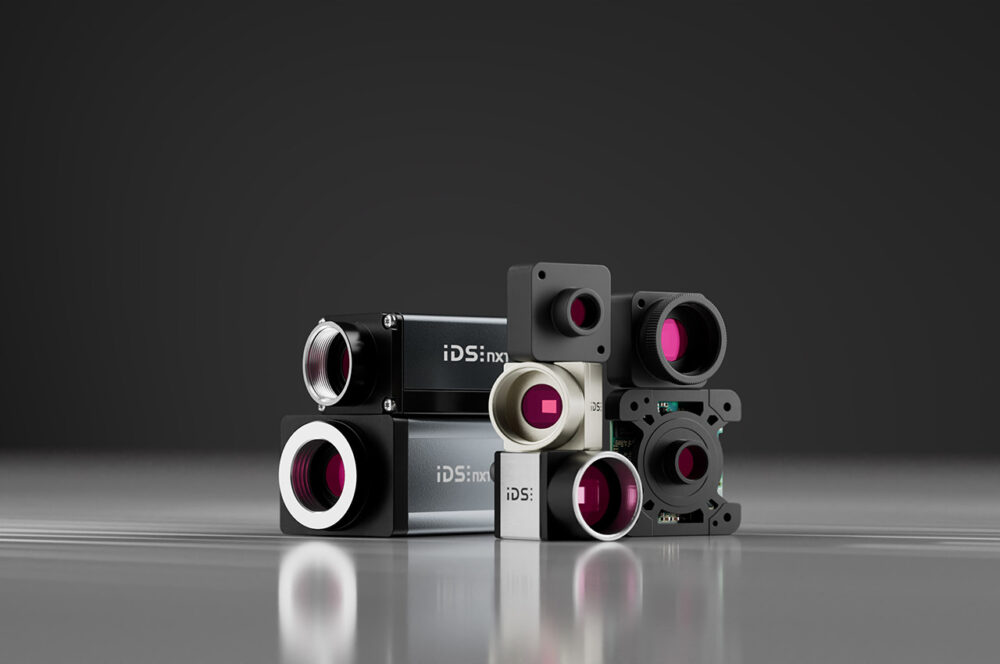

IDS integrates Sony STARVIS 2 sensors across multiple camera series, creating a unique range for a wide variety of applications. From compact entry-level models to high-performance industrial cameras, users benefit from outstanding light sensitivity, excellent image quality and a breadth of sensor options that is only available from IDS.
By Sabine Terrasi, Communication Specialist – Corporate & Product at IDS
A broad and consistent camera portfolio combined with state-of-the-art sensor technology opens up new possibilities for industrial imaging. IDS offers an exceptional variety of Sony STARVIS 2 sensors, setting new standards in flexibility and application coverage.
Specifically, five sensor variants are available: IMX662 (2 MP), IMX664 (4 MP), IMX675 (5 MP), IMX678 (8 MP) and IMX676 (12.5 MP). This breadth makes it possible to select the right camera for a wide range of industrial requirements without compromising on image quality.
What makes Sony STARVIS 2 sensors stand out?
In industrial image processing, reliable results are essential – regardless of external conditions. This is precisely where Sony STARVIS 2 technology excels.
These sensors deliver clear, highly detailed images even in challenging lighting conditions. This performance is achieved through a combination of exceptional light sensitivity down to the NIR range, minimal noise and an enhanced dynamic range thanks to Clear HDR. The asynchronous exposure trigger also makes Sony STARVIS 2 sensors ideally suited for industrial use.
The result is dependable image data that can be evaluated accurately even in demanding environments. This improves overall process stability while reducing the effort required for downstream image processing.
Which camera series are available?
At IDS, Sony STARVIS 2 sensors are not limited to a single camera family but are integrated across multiple product lines. For users, this means consistent sensor technology combined with a wide choice of form factors, interfaces and performance classes.
uEye CP – powerful all-rounders
The CP series combines a compact design with high efficiency. Measuring just 29 × 29 × 29 mm, it offers maximum functionality in a small form factor and is ideal for more demanding image processing tasks.
uEye LE – efficient for high-volume projects
These GigE single-board cameras are designed for projects with large quantities. They combine low cost with stable image quality and an industry-standard interface.
uEye XCP – compact and cost-effective
uEye XCP cameras offer an affordable entry point, combining a compact design with high performance. They are particularly well suited for cost-sensitive applications that still demand reliable image quality.
uEye XLS – flexible board-level variants for embedded designs
These board-level cameras enable straightforward integration into custom systems. Thanks to their compact design, they are ideal for embedded applications where space is limited.
IDS NXT malibu & oslo – Live AI in video streams
IDS NXT cameras combine AI-based image analysis and streaming in a single system. They analyse image content in real time, without the need for an external PC. IDS NXT oslo is also suitable for harsh environments, thanks to its IP69K housing.
Further models will follow.
Which applications benefit from this portfolio?
By combining a wide range of sensors with different camera platforms, the portfolio covers numerous application areas. These include classic tasks such as quality control under variable lighting and inspection of dark or reflective surfaces, as well as more specialised applications in microscopy or NIR-based imaging.
For example, the 12.5 MP IMX676 sensor, with its square sensor format, enables optimal utilisation of the image circle and opens up additional possibilities in optically demanding setups. Depending on the specific requirements, the appropriate camera model can be selected to match the application.
This demonstrates that modern sensor technology delivers its full potential only when it can be used flexibly – exactly where every detail counts.