



In recent years, ds Automation GmbH has deepened its expertise in measurement and sensor technology and has come to the firm conclusion that, in times of digitalization and automation, the acoustic sensor technology process is widely applicable and will continue to have decisive potential in the future.
By Patricia Kopp, Marketing Assistant at ds Automation
Auger Monitoring
Viral videos on social media show how metal shavings are extracted from milk powder using a magnet. The consequences for the manufacturer are clearly noticeable.
Online campaigns and the loss of trust among its own customers are creating an economic hole. In addition, the metal shavings could pose a life-threatening risk if consumed.
Many companies rely on X-ray based or visual monitoring systems to avoid similar risks and scandals. However, these systems are by no means infallible and expensive recalls occur regularly. These systems detect the metal shavings after the product has been contaminated.
In the case of filling systems, dsound® sensors constantly monitor the filling pipe. If the internal auger comes into contact with the filling pipe, metal abrasion occurs, which gets into the product.
The sensors detect this contact and shut down the system until the problem has been rectified, before the product is contaminated. No recalls, no material waste, and no increased costs.
Glass Breakage
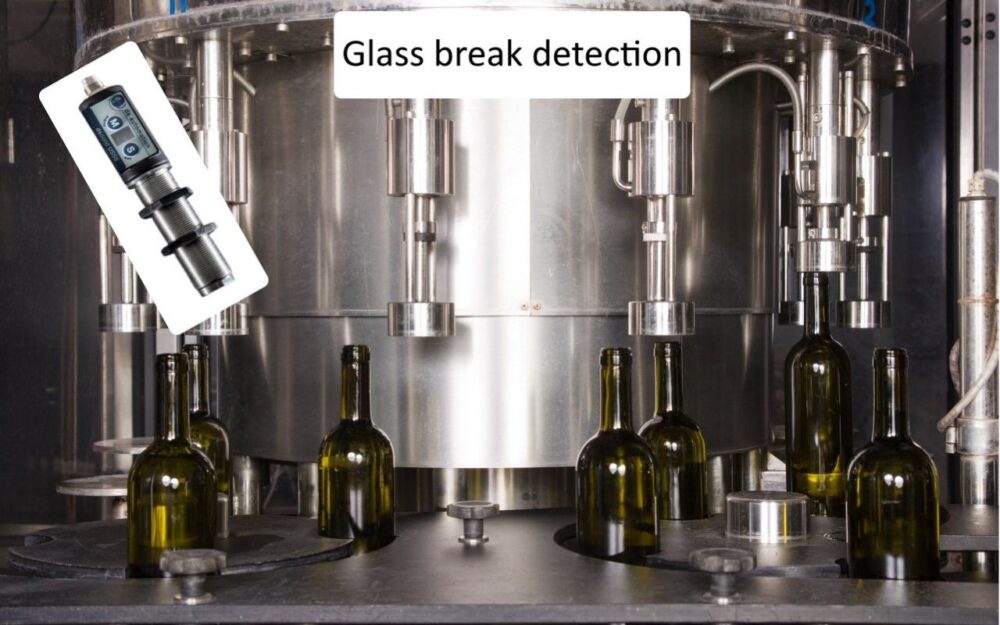
Sound sensors are reliable in detection of glass breakage in filling- and production lines. In any areas, where glass bottles are filled, breakage can occur.
The dsound® sensors are specialized microphones, that continuously monitor the area. They identify any change in the sound situation. Prior to installation trigger thresholds are determined.
However, a significant challenge in detecting glass breakage events using airborne sound is the sound attenuation caused by the air and the background noise of the production line. However, air attenuation and thus susceptibility to errors are lower the closer the sensors are positioned to the sound event to be detected. In most production lines, there are specific points where glass containers typically break, such as during separation or filling processes.
The risk of false alarms increases due to the typically loud ambient noise on production lines. To solve this problem, the measurement technology specialists at ds automation use an alternative method: they not only measure the sound level, but also perform bandpass filtering. This allows the measurement signal to be concentrated specifically on the frequency spectrum between 16 and 32 kilohertz, which is barely or not at all perceptible to the human ear.

Acoustic Quality Control
Sound recognition is ideal for a variety of quality check even during the manufacturing process. Especially in industrial mass production settings, this line of testing can detect anomalies in the production process early, minimizing the risk of failure.
Small fissures in screws, faulty nuts or inclusions change the sound of the manufacturing parts. This isn’t always noticeable by human ears, but very easily detected by a sound sensor.
Ds automation has been successful in this usage of the sensors for several years.
The sensors process all acoustic signals immediately. This way, a large number of pieces can be checked for quality in a short time, as much as 10.000 nuts per hour. Defective parts are instantly removed.
This method has great potential in areas, where other systems, like cameras, prove expensive, inaccessible or defects simply aren’t visible.
The sensor can be easily implemented in new and already existing production lines.
Almost Unlimited Possibilities
Auger monitoring, glass breakage and invisible fissures in manufacturing parts are only the
tip of the sound sensory ice berg. The innovative solutions can range from light activation to
leak detection for bottles, cans or even pipes.
Do not hesitate to contact us if you have any question pertaining a specific product.
Do you have an issue and maybe haven’t thought of sound sensors yet? No worries. Even if
your problem isn’t common, we would love to workshop a solution with you.