




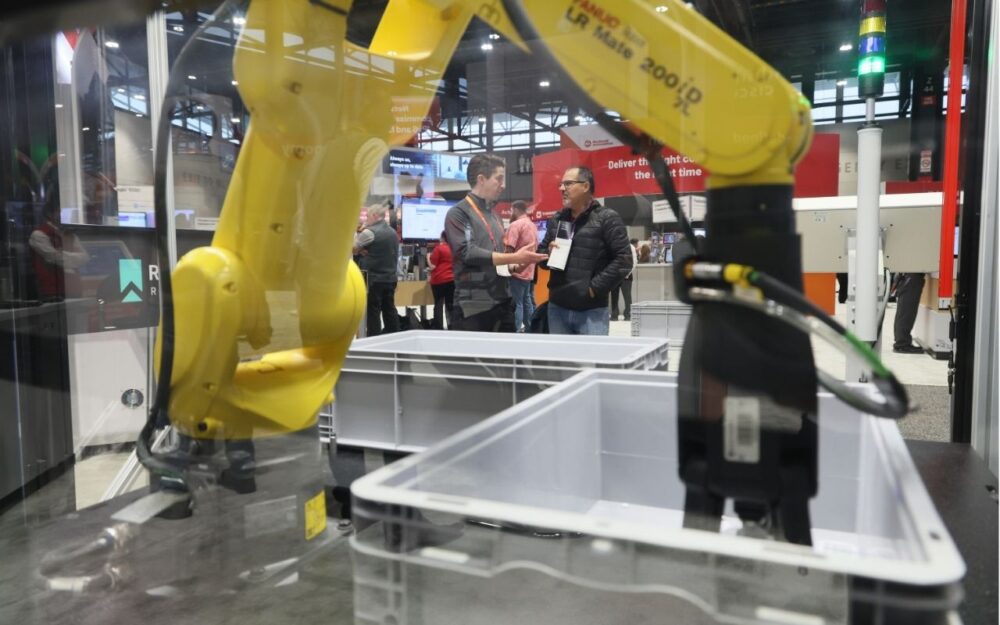

Empowering the workforce and building digital fluency will be key to the acceleration of AI and robotics in the workplace, according to experts we met at the Rockwell Automation Fair 2025.
In a hurry? Here are the key notes to know:
- People at the center: Successful companies recognize that skilled, digitally fluent, and empowered employees are critical to running operations and driving innovation with AI and robotics.
- Shop floor interaction: Natural, intuitive interactions—via chat, voice, or visual interfaces—empower workers to make decisions faster and enhance operational efficiency.
- AMRs and integrated robotics: Autonomous mobile robots (AMRs) are increasingly working alongside humans, requiring thoughtful factory design, safety measures, and fleet management software to coordinate operations.
- AI-driven industrial automation: AI and machine learning integrated into production systems and robotics allow adaptive, self-learning control, enabling safer, more efficient, and data-driven industrial processes.
Keynote speakers and robotics specialists at the event, which took place last month in Chicago, discussed the roles of control systems and software platforms, but also emphasized the need for keeping people at the heart of the evolution.
As Tessa Myers, Senior Vice President, Intelligent Devices, Rockwell Automation, explained:
“One of the key factors that sets apart the companies making the most progress in improving their operations is their recognition that people will always be at the heart of their business, their production floors, and their operations. At the same time, we need more skilled, digitally fluent, and empowered individuals to run our plants, maintain our systems, and envision the future of more effective operations.”
For her, building 21st-century skills within a team is critical to success, both in the short and the long term.
Shop Floor Interaction
Cyril Perducat, Rockwell’s CTO, agreed this is essential to the successful integration of AI and robotics into the workplace:
“I’m particularly excited about the nature of interaction between people and machines on the shop floor and beyond the shop floor. This is going to be fundamentally different from the type of experience we see today. This is going to help create more value.”
By introducing natural and simple interactions—via chat, voice, and other methods—he believes they can empower people on the shop floor to engage with the system in a new way:
“Instead of searching through data to make a decision, you can get a direct recommendation. We are focused on not just developing the right technology, but understanding personnel, how they use technology, and creating breakthrough experiences for them. With technology, we change the way people work, we change the way they are empowered, and, overall, we make industrial operations more efficient.”
Within The Same Space
The expected surge in the use of AMRs in particular will require change, many believe. In 2023, Rockwell signed an agreement to acquire Canada-based Clearpath Robotics Inc., a leader in AMRs for industrial applications. Last October, the first OTTO AMRs officially rolled off the production line at Rockwell’s global headquarters in Milwaukee.
A new 25,000 sq ft production space is now assembling the OTTO 600 and OTTO 1200 AMRs, designed to move heavy materials across factory floors where humans also work. For Mr. Perducat,
“Bringing robots onto the shop floor is not natural. It can be strange for some people. So we have to communicate about safety. So far, robots in factories are often isolated from people. They operate in their own space, usualy a cage. If you are a worker, you need specific credentials and key codes to access these spaces. By introducing AMRs, robots and people exist together in the same space. So we need to think differently about design, architecture and layout of the factories.”
But he stressed the required technologies exist and Rockwell has a very strong culture of machine safety. The company’s products are designed to be safe. But as customers demand ever faster robots, safety must keep pace:
“Today, if you ride in a Waymo, that’s a fascinating experience. If it’s not too fast, you don’t freak out. But if it was driving at 100 miles per hour, that would be frightening. Today, Waymos go at a certain speed and it’s safe. That’s the same thing in an industrial environment. Today it’s safe to be operating at a certain speed. Now, our customers still want safety but at faster speeds.”
Accelerating Adoption
One of the reasons why Rockwell chose to acquire the AMR company was because it can integrate into existing systems, said Mr. Perducat. And according to Ryan Gariepy, Vice President, Robotics, Rockwell Automation and also co-founder of Clearpath Robotics,
“Robotics is a lot more than just building the next smartest robot, no matter what that robot is, whether it’s the new robotic arm, the new AMR or the new humanoid drone. There’s a lot of potential for all of those industrial operations. But one of the things that had me excited is that Rockwell has the potential to bring this all together and to accelerate the adoption.”
Rockwell has the building blocks critical to deploying robots safely and at scale, he explained:
“With these new robotics developments coming up, there’s an increasing need for safety and for high-performance control. This is technology that Rockwell is very good at. Our product line can support all of these companies as they are finding new potential.”
But if AI has the potential to open up the field of coordinated robots, people and environments, he says, safety must not be forgotten:
“You still need control systems – these components we have been making for decades – and we are actively looking at how we take them further and what changes are required. We also have software platforms. Unified robot control (URC) has allowed many machine builders and OEMs around the world to service new use cases with robotics that they have previously been unable to. Many niche applications for robotics aren’t necessarily well served by a traditional robot OEM. Things like the unified robot control platform allow these needs to be captured.”
For him, you can have as many robots as you want, and they can be as smart as you want, in the end, the objective is to solve general industrial and production problems:
“You need to simulate your systems and to connect them. You also need to diagnose your systems and to coordinate people. And you will have to fit into existing industrial operations. Rockwell has the software, the technology, and the market trust to deploy these robots.”
Integrated Learning
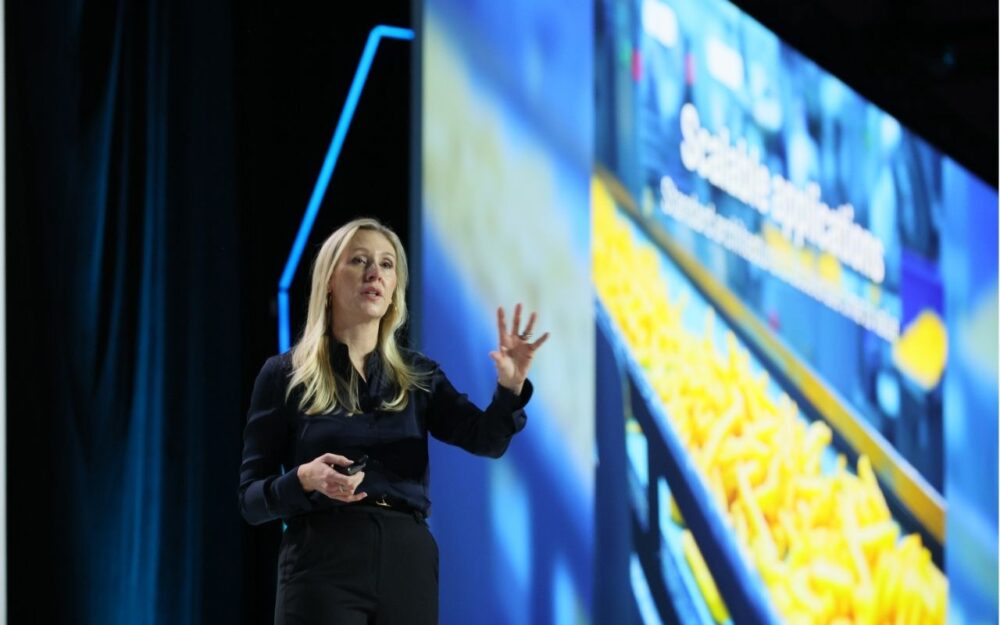
Jordan Reynolds, Vice President, Artificial Intelligence & Autonomy, Rockwell Automation, is excited about the potential of AI in static robotics. For him, the AMR has complex neural network-based vision systems that are used to perceive its environment. It leverages model control technology to navigate itself around a door and other obstacles as it encounters them. And it has the ability to take actions and adapt as conditions change, all while fulfilling a pre-established goal.
“Just like you might enter an address in your vehicle and have a driver there, an address essentially is given to an AMR. Go and pick up this package in this location and deliver it over here. It’s a manifestation of the exact same technology.”
What is interesting now and is that the industry is moving outside the area of mobility:
“Even traditional production systems, machines – everything from compressors to pumps, extruders, mixers, packaging machines, assembly stations, and so forth – are all beginning to adopt this technology as well.”
He gave an example of a vehicle robotic assembly system that also leverages neural network-based sensing to understand the current state of the operation.
“It has the ability to translate sensory inputs into control actions. It can take those control actions in closed loop, and it can fulfill a level of automation and vehicle assembly that was never before possible with programming alone.”
Here, the PLC becomes like an adaptable learning control. Machine learning functions like vision and machine learning based control policies are natively integrated into the control system.
“And the sensors and actuators in our portfolio essentially play the role of understanding the environment and then manipulating the environment, on the basis of what the machine learning model says. This is what our AI economy vision is focused on.”
Looking Ahead
Mr. Perducat said the future of robotics in the workplace means being able to have faster speeds, higher integration, a range of motion and dexterity, and advanced sensors. An interesting point is also that robots can be used as data collectors:
“When you have an AMR that goes across a factory, you can collect the data related to the specific application and move from A to B, but you can also create applications that monitor safety risk equipment at the right place, people not wearing the right protection, for example.”
They therefore become mobile sensors, which makes the idea of fleet management software—used to coordinate all the different robots—a crucial foundation for the automation leader to remain at the center of the robotic evolution.




![Image [Best of 2025] Power Moves in the Energy World](/wp-content/uploads/sites/3/energy-320x213.jpg)