


In this article, Dr. Thomas Schmidt, Manager Applications, Hitachi High-Tech Europe explains how electron microscopy software uses automation and visual workflows to simplify imaging, boost efficiency, and ensure consistent results.
What is electron microscope scripting and automation software?
EM scripting and automation software allows labs to create, store, and execute precise observation “recipes” that run without manual intervention at every step.
Historically, achieving this meant having advanced coding knowledge. But a new generation of tools is lowering the barrier to entry through visual programming.
Instead of writing lines of complex code, you’re able to build workflows by dragging and dropping “procedural blocks.” These modern tools combine instrument control, such as stage movement and beam management with advanced image recognition and conditional logic.
Key characteristics of this software include:
- Visual programming: Users sequence blocks to define a workflow, making automation accessible to non-programmers.
- Conditional logic: The software can make “decisions” during a run, such as branching to a different step if a specific feature is detected.
- Python functionality: Power users can execute Python scripts which ensures that even the most custom research needs can be met.
- Integrated recognition: Built-in algorithms identify specific structures so the microscope can adjust its own field of view.
Why automate electron microscopy?
From the perspective of a lab manager or lead scientist, automation is about more than just convenience. It’s about maximizing the use of expensive instrumentation and getting the most out of your microscope. By implementing electron microscope scripting and automation software, labs can realize several core strategic benefits:
- Added throughput: Labs acquire significantly more images across a higher volume of samples in less time, increasing capacity without hiring extra headcount.
- Improved reproducibility: Automation removes operator-to-operator variability; because every sample is subjected to the same observation recipe, the resulting data is consistent and reliable.
- Managing complexity: Multi-step workflows including tedious adjustments like focus, brightness/contrast, and astigmatism correction are executed perfectly every time, regardless of the hour or operator fatigue.
- Operator freedom: By offloading repetitive acquisition tasks to software, skilled scientists are freed to focus on high-level data interpretation and critical R&D decision-making.
- Data-driven R&D: Modern research needs massive, consistently acquired datasets to feed into AI and machine learning models. Automation makes the generation of these large-scale datasets feasible.
Introducing Hitachi EM Flow Creator
Hitachi High-Tech developed EM Flow Creator, a sophisticated software package designed to automate SEM and TEM workflows across a wide range of application fields. It’s engineered to be flexible enough for routine quality control, yet powerful enough for the most demanding research environments.
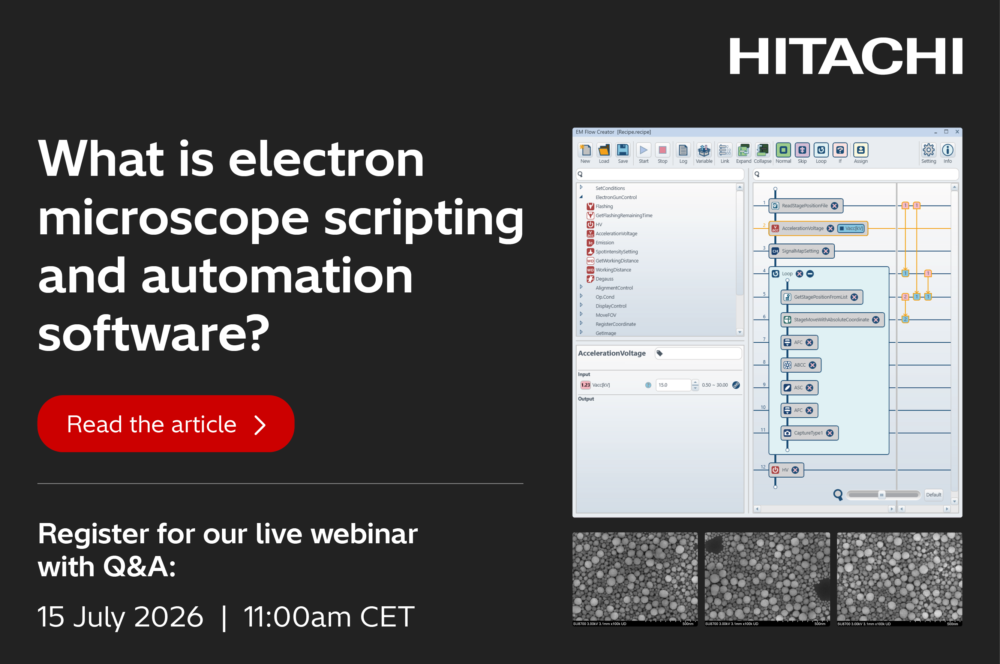
The hallmark of EM Flow Creator is its intuitive drag-and-drop interface. Users create “recipes” by selecting procedural blocks from a comprehensive list.
These blocks are sequenced in the recipe area, letting you automate complex procedures with no coding needed.
How it works: Visual programming
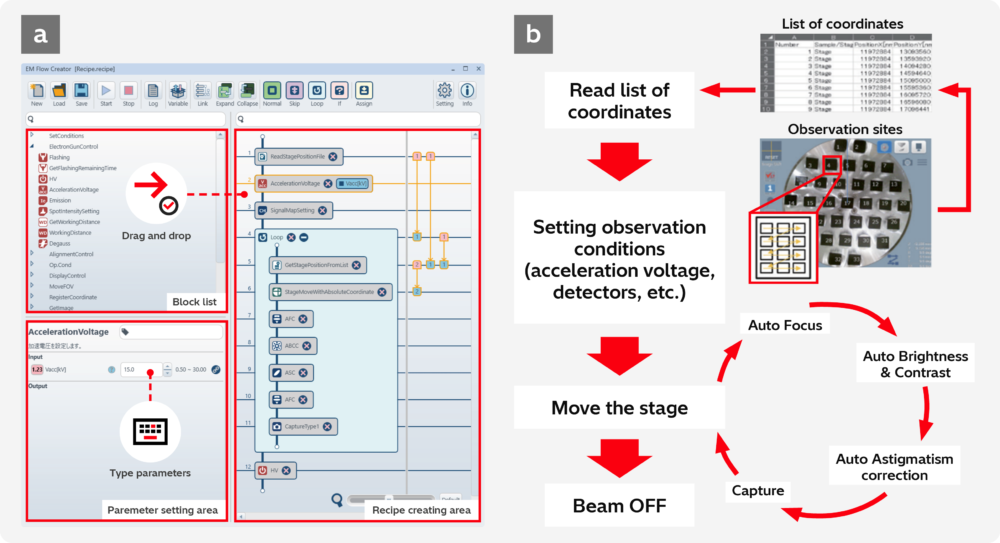
(a) Screenshot of EM Flow Creator session. (b) Outline of observation workflow.
Key capabilities include:
- Sophisticated logic: The software supports sequential execution, looping, and conditional branching, allowing the microscope to respond dynamically to what it “sees”.
- Intelligent image recognition: Integrated algorithms enable the tool to search for specific features and automatically adjust the field of view to centre on targets of interest
- Broad compatibility: EM Flow Creator is now compatible with all Hitachi electron microscope platforms.
- Python options: While the visual interface handles most tasks, advanced users can execute custom Python scripts to extend functionality for highly specialized needs.
Whether you’re managing a semiconductor fab, a battery manufacturing line, or a life science research facility, EM Flow Creator provides the stability and scalability you need to streamline your data acquisition.
Discover automation in action with three real-world case studies at https://hte.hitachi-hightech.com/electron-microscope-flow-creator-software
Join our Live Webinar and Q&A on Wednesday 15 July 2026 at 11:00 CET about the Faster Electron Microscope Scripting Through Automation with EM Flow Creator.
About Dr. Thomas Schmidt
Dr Schmidt holds a Diploma in Biology and Biotechnology (University of Münster) and a PhD in Biotechnology and Biochemistry of Plants (Biology, University of Münster). After 5 years as a Postdoc and Head of department at the Leibniz Institute in Aachen, he has been the European applications specialist for TEM and IM at Hitachi-High-Tech Europe for 11 years.