

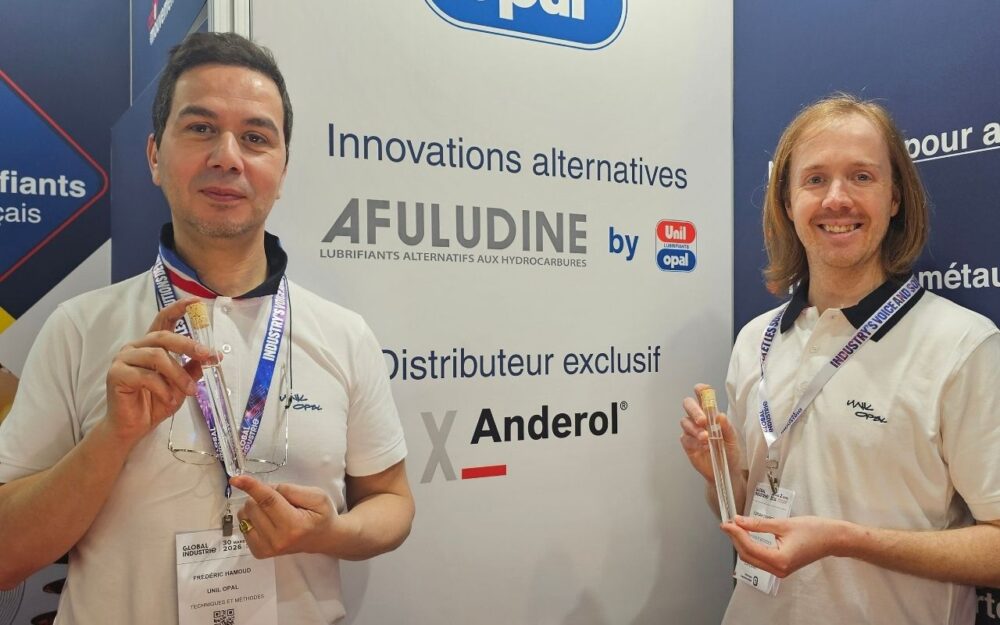

At a time when industry is being called to reconcile performance with environmental responsibility, certain innovations are shaking up practices that have been in place for decades. This is the case with the AFU-M15, an oil-free lubricant developed by UNIL OPAL. Presented this year at Global Industrie, it is designed to profoundly transform machining processes.
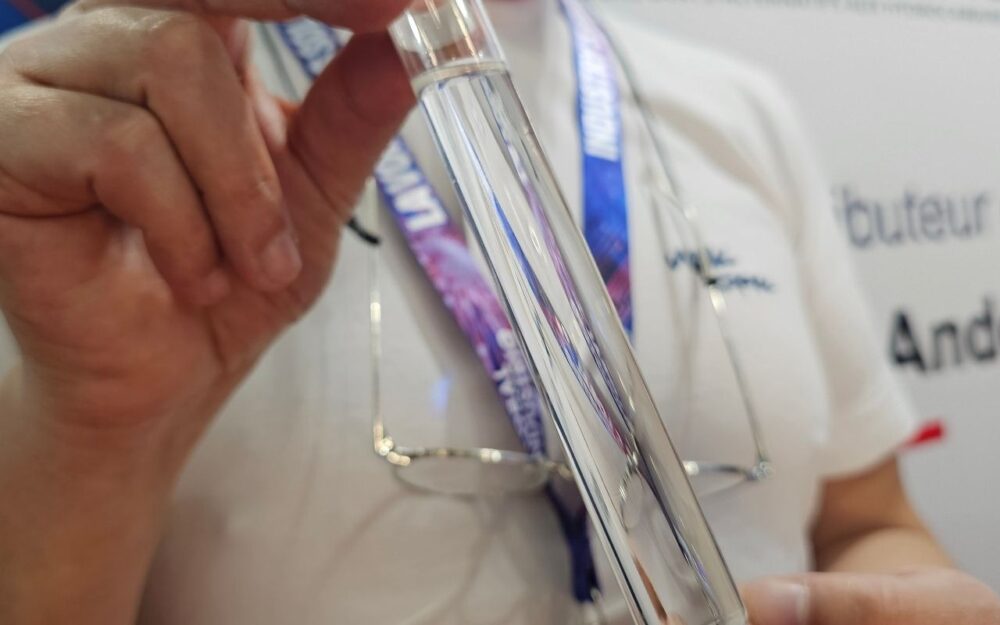
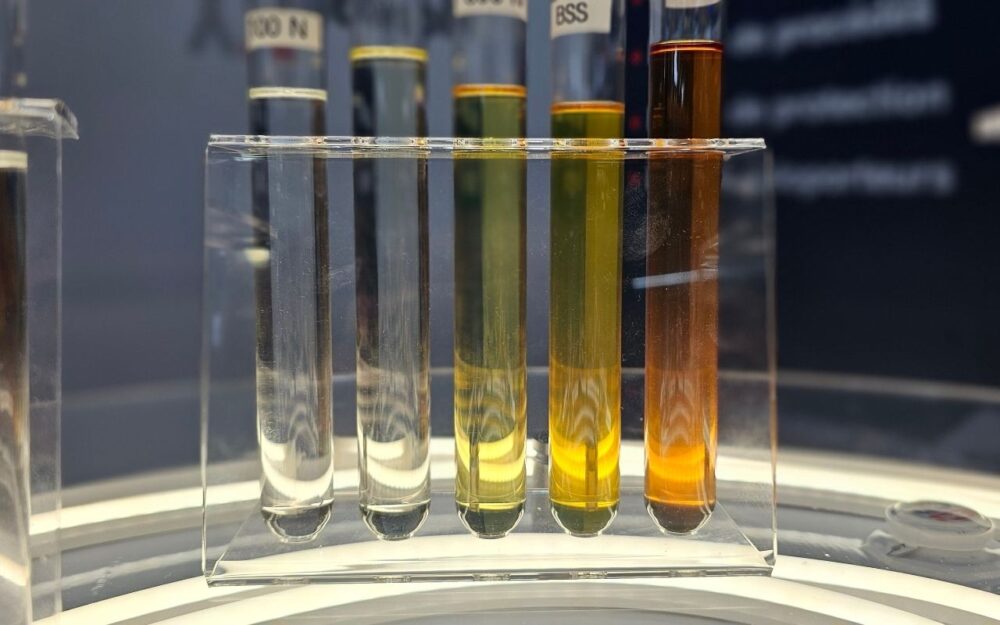
On UNIL OPAL’s booth, colorful barrels and tubes catch the eye. But the one we are interested in today is transparent. It’s the AFU-M15, an oil-free lubricant. And it represents a major breakthrough in a sector historically dominated by hydrocarbons. Traditional lubricants, effective but polluting, are now being questioned both for their environmental impact and for the constraints they impose on production.
For Frédéric Hamoud, Scientific Director at UNIL OPAL:
“Today, we know that lubricants are considered potentially polluting substances. So there was a real interest in creating lubricants that have the least possible impact on the environment and on the health of operators. But how do you replace ancestral recipes that have proven themselves with other ingredients while maintaining an equivalent level of performance?”
Modifying the solvent without degrading efficiency indeed required advanced formulation work. UNIL OPAL’s solution is based on an organic synthetic molecule, not derived from petroleum, developed over nearly eight years by the company Afludine, which UNIL OPAL acquired in 2024.
According to Florian Charrier, head of the Dole production site in the Jura region of France, where the AFU-M15 is produced:
“The product is 98% bio-sourced and biodegradable.”
From Product to Process: A New Way to Lubricate
More than just a fluid, the AFU-M15 is part of a broader logic of transforming industrial processes. The technology relies on microlubrication, using extremely small volumes, around 20 ml per square meter, up to ten times less than conventional lubricants. This change in scale brings a cascade of very tangible benefits, explains Frédéric Hamoud:
“We have a cleaner working environment. Above all, the disappearance of the greasy film on parts allows us to remove a key step: washing. There is no more washing operation, and therefore no more drying operation. You can directly store a lubricated part without stains or greasy residue.”
Microlubrication already exists with lubricants, but there were always greasy residues on the parts. The AFU-M15 solves this problem.
“So you can directly move to the next step, whether surface treatment, painting, or corrosion-resistance treatment, or even storage without greasy parts that could stain boxes or plastics.”
This innovation simplifies production lines, reduces water and chemical use, and improves overall productivity. The benefits are multiple: less waste, longer tool life, and lower operating costs.
According to the company, the AFU-M15 also stands out with better wettability, allowing a more uniform distribution of the active ingredient on the part. The result: the lubricant remains effective longer and enables multiple machining operations on the same part, especially in so-called “follow-up tool” processes. It therefore gains in performance compared to traditional lubricants. Another notable advance is reduced volatility.
“That means fewer particles in the air,” he adds.
This is crucial for operators’ health, but also for the cleanliness of machines and workshops.
An Innovation Already on the Market, But Accompanied
The AFU-M15 has just been launched in France, with a gradual rollout. Its adoption, however, requires technical support.
“The quantity must be well dosed […] the machine must be properly adjusted,” insists Frédéric Hammoud. “If you want to save and reduce environmental impact, you need the right amount applied to the part. So we help the manufacturer adjust the right quantity.”
Two modes of use coexist: as a spray, easily integrated, or via microlubrication (MQL), which requires specific equipment. While some machines are already equipped, others will need adaptation, limiting immediate large-scale adoption.
Certain industrial segments, notably stamping, bending, or some light machining operations, already offer favorable conditions, according to Frédéric.
“It is also important that for the manufacturer, there is an interest in using a more environmentally friendly product,” he recalls. “The ability to eliminate polluting steps, like degreasing, further reinforces this advantage.”
A Gradual Scale-Up, from France to International Markets
For now, UNIL OPAL favors a controlled rollout, starting in France before considering expansion across Europe and then internationally.
Production at the Dole site currently reaches approximately 60,000 liters per year, a modest volume at market scale, but consistent with a phase of development and optimization. Packaging ranges from small one-liter containers, mainly for watchmaking and luxury sectors, up to 200-liter drums.
Frédéric emphasizes, and this is the purpose of their presence at Global Industrie: making the product visible to manufacturers so they understand the benefits of switching to an eco-responsible product.
“We want greater visibility among manufacturers, so they understand that non-greasy synthetic lubricants can now be used, offering benefits both for operators and for machining processes by eliminating steps like degreasing. It’s about showcasing the improvements possible today in machining, including in deformation, and demonstrating the full range of applications for this product. Collaboration with manufacturers is essential; by working together, we can adapt our solutions and explore new uses.”
Towards the Lubricant of Tomorrow
The AFU-M15 is only a first step. Development prospects are numerous: new materials, more severe machining, even applications in aerospace or space. Research is already underway to evolve the molecular structure, says Florian Charrier:
“This could improve certain performances, and we might even achieve a 100% bio-sourced product, who knows?”
This could also enable uses in extreme environments like space, where constraints are completely different.
“In space, we are under vacuum, we can have significant temperature variations. We may have high demands for wear reduction.”
A PhD thesis dedicated to these issues is set to begin at the end of 2026 with partners, aiming to develop products specifically for the aerospace sector.
AFU-M15 represents just one segment of UNIL OPAL’s extensive range of automotive and industrial lubricants. The company manufactures a wide variety of products, from engine oils for vehicles to transmission fluids, industrial oils, pump oils, and gear oils. Its portfolio also includes greases, coolants, and specialized fluids for various applications. Within this broad offering, AFU-M15 stands out as a targeted solution for machining processes, complementing the company’s overall expertise in lubrication.